If you walk into a Korean apartment complex, the important places are easy to spot once you know the labels. You are usually looking for the management office, guard booth, recycling area, playground, neighborhood shops, or underground parking—not one apartment building, but a whole shared residential compound.
Inside Korean Apartment Complex: What You Need to Know
- Look for 관리사무소 first—it is the management office and the best place for resident questions.
- Spot 경비실 near the main gate; the guard there can point you in the right direction.
- Never put trash in the 분리수거 area without sorting it first.
- The 상가 block is the shop area, not a residential lobby, even when it is attached to the buildings.
- The 지하주차장 ramp is for cars; pedestrians should use stairs or elevators.
- Find the building number first, then the unit number.
- If you are lost, ask the 경비원—the guard usually knows every corner of the complex.
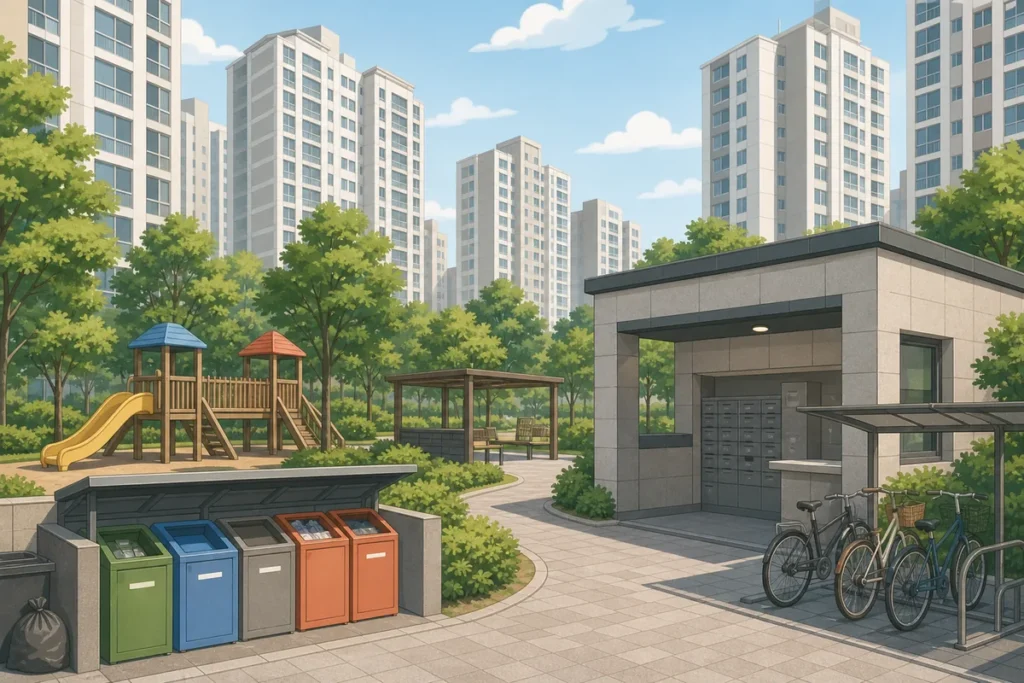
What a Korean apartment complex includes
A Korean apartment complex is usually a full residential compound with several buildings, shared outdoor space, parking, and common facilities. A single complex can feel like a small neighborhood. The buildings are numbered by dong, so your friend may live in 101동 or 305동, and each building has its own entrance lobby, elevator, and mailboxes.
Once you know the main labels, the whole place becomes much easier to read. The sections below take you through the most common spaces you will see on foot.
Management office: 관리사무소
관리사무소 is the management office for the complex. It handles maintenance requests, package issues, lost and found, parking passes, and general resident administration. It is usually a low separate building or a ground-floor office near the main entrance or central area of the complex.
As a visitor, you may not need it often, but it is the right place to go if a package was left for your host, if you cannot find a building, or if something in the complex seems locked or broken. Staff usually speak Korean, so having the building number and unit written down helps.
Signs to recognize at the management office
Security booth: 경비실
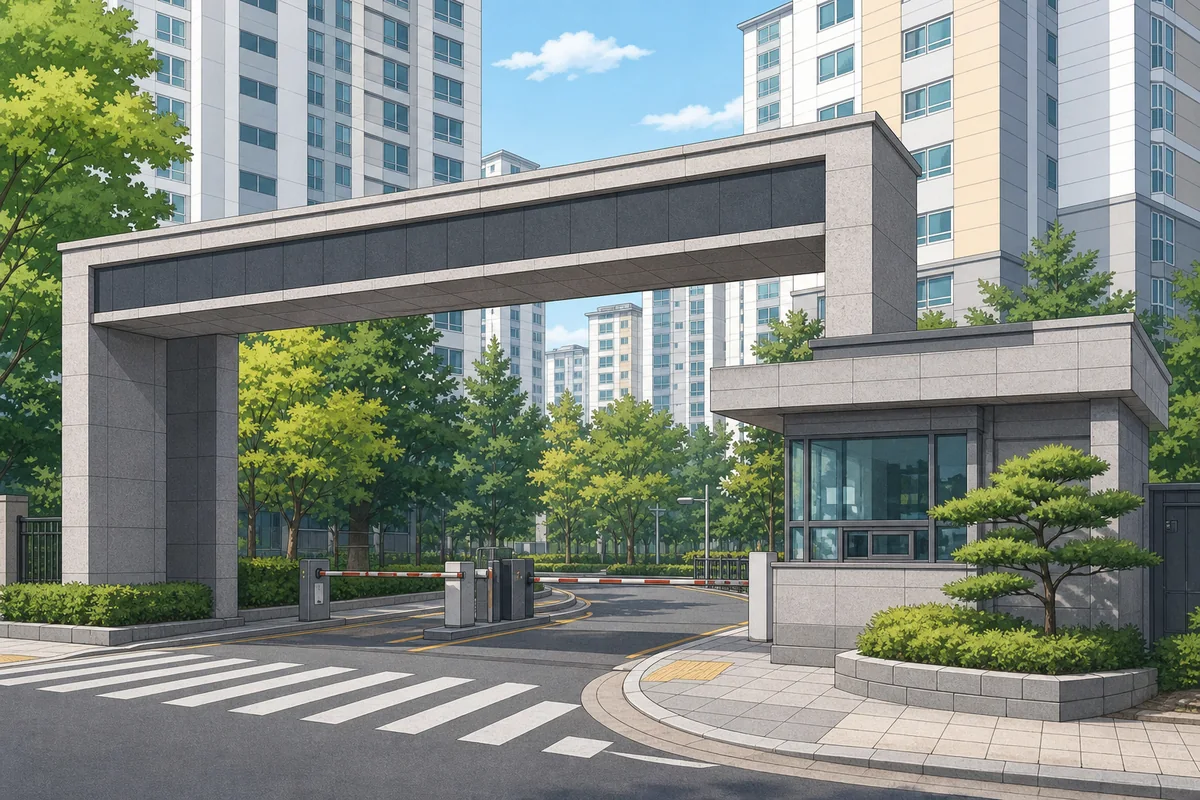
경비실 is the guard booth, and the person inside is the 경비원. You will usually find it near the main gate or at a building entrance. It is a small enclosed booth, often with a glass window facing outward so the guard can watch who is coming and going.
The guard monitors access, accepts deliveries, and helps with basic directions. If you are lost, cannot find your friend’s building, or notice something wrong, the guard booth is usually the fastest place to ask. Showing a written address or phone number helps a lot.
Do not confuse 경비실 with 관리사무소. The guard booth is a security point near the entrance. The management office is an administrative office deeper inside the complex.
Guard booth vocabulary
Recycling area: 분리수거 station
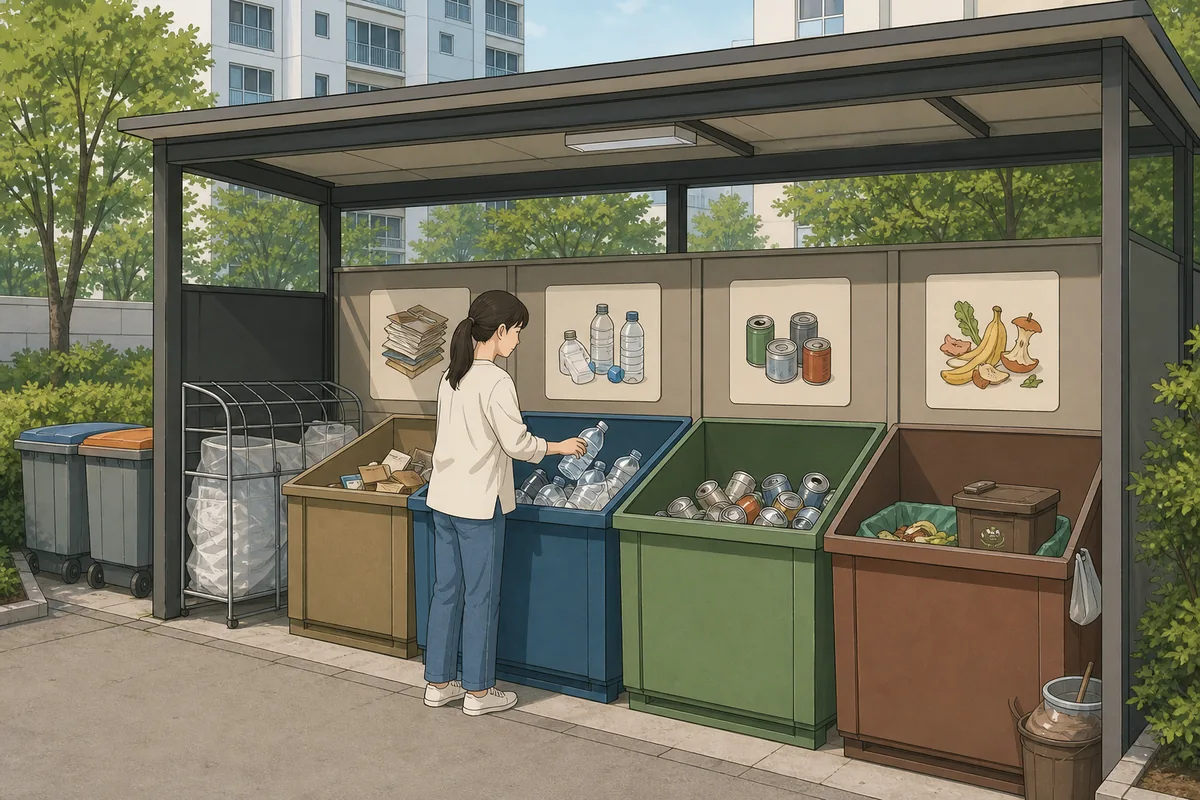
분리수거 means separated waste collection. In a Korean apartment complex, this is a dedicated area where residents sort their waste before disposal. It is not a general trash can. Mixed garbage in the wrong place is a problem, and residents take it seriously.
The area is usually color-coded and labeled by material. You will see separate bins or bags for general waste, paper, plastic, glass, cans, and food scraps. General waste requires a special designated bag purchased at a convenience store or supermarket. Food waste goes in its own container, often with a card or coin system.
If you are staying short-term, your host will usually handle the recycling rules. If you are staying longer, ask them to walk you through it once.
Recycling area signs
Playground and resident common spaces
Most Korean apartment complexes have a 놀이터, or playground, between the buildings. It is a standard feature. You will usually find swings, climbing frames, and benches, and larger complexes often add outdoor exercise equipment for adults.
Look for other shared spaces too:
- 벤치 / 쉼터 — Benches and rest areas along the walkways
- 운동시설 — Outdoor fitness equipment
- 커뮤니티센터 / 주민센터 — A community hall, small gym, or reading room in larger complexes
These spaces are for residents and their guests. They are not public parks, even though they often feel open and calm.
Shop area: 상가
상가 is the commercial strip built into or beside the complex. It often looks like a row of storefronts at ground level or in a low separate building. That is why first-time visitors sometimes mistake it for part of the residential area.
Inside, you usually find a convenience store, pharmacy, hair salon, restaurant, dry cleaner, real estate office, or small bakery. The exact mix depends on the size and age of the complex. The storefronts face outward and usually have lit signs and glass doors.
If you see a 편의점 sign, you have probably found the 상가 zone.
Common 상가 businesses to recognize
Underground parking: 지하주차장
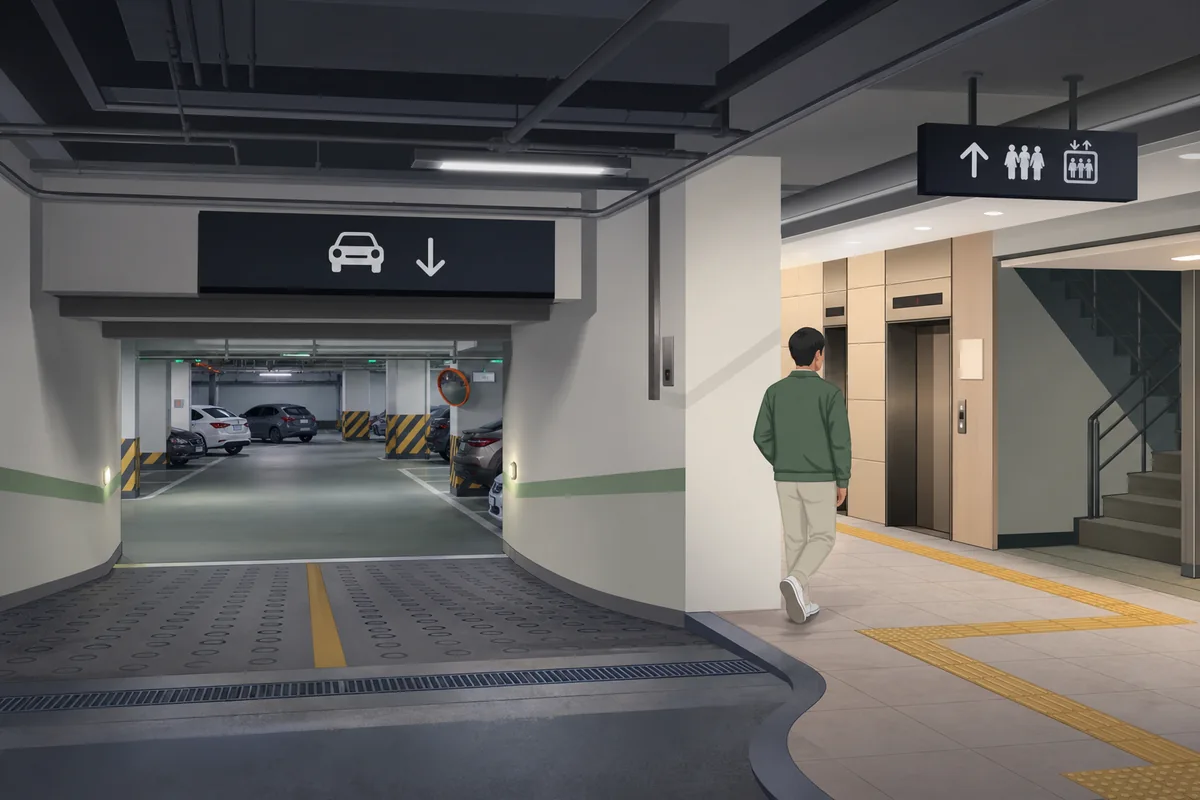
지하주차장 means underground parking lot. Many modern Korean apartment complexes put most vehicle traffic below ground, which is why the surface area between buildings can feel quiet and walkable. The ramp entrance is usually marked with a large sign and a downward arrow near the edge of the complex.
As a pedestrian, you normally do not need to walk down the vehicle ramp. The underground level connects to the elevator cores of each building, so residents often park below and go straight up to their apartment. If you are visiting someone and they tell you to come to the underground parking, look for the elevator lobby near the ramp or a marked pedestrian entrance.
Do not walk down the vehicle ramp. Use stairs or an elevator marked for pedestrians if one is posted nearby.
Parking area signs
How to tell these places apart quickly
At the gate of a Korean apartment complex, several places can look similar at first glance. Use this quick mental map:
- Small booth at the gate with a person inside → 경비실, the guard booth
- Low separate office or ground-floor office with a clear sign → 관리사무소, the management office
- Row of storefronts with lit signs and open doors → 상가, the shop area
- Covered or open area with sorting bins and labels → 분리수거 zone
- Open space between buildings with swings or climbing frames → 놀이터, the playground
- Downward ramp with overhead signs and a barrier arm → 지하주차장 entrance
A residential lobby is different from all of these. It usually has mailboxes, an intercom panel, and an elevator, and that is where you go to reach a specific apartment building.
A Korean apartment complex is a full residential compound with shared spaces, not just one building. Once you can read the signs for 관리사무소, 경비실, 분리수거, 놀이터, 상가, and 지하주차장, the complex becomes much easier to navigate. If you get stuck, the guard at the 경비실 is usually the fastest person to ask.
Inside Korean Apartment Complex becomes easier to handle when you recognize the situation and follow the practical steps above.
Inside Korean Apartment Complex becomes easier to handle when you recognize the situation and follow the practical steps above.
Note: This guide is for travel navigation in Korea. It is not medical, legal, or emergency professional advice. For urgent situations, contact local emergency services, official staff, or your embassy/consulate as appropriate.
Sources & Verification
- VISITKOREA – Imagine Your Korea — english.visitkorea.or.kr
Last checked: July 30, 2026