Seoul Not One City: What You Need to Know
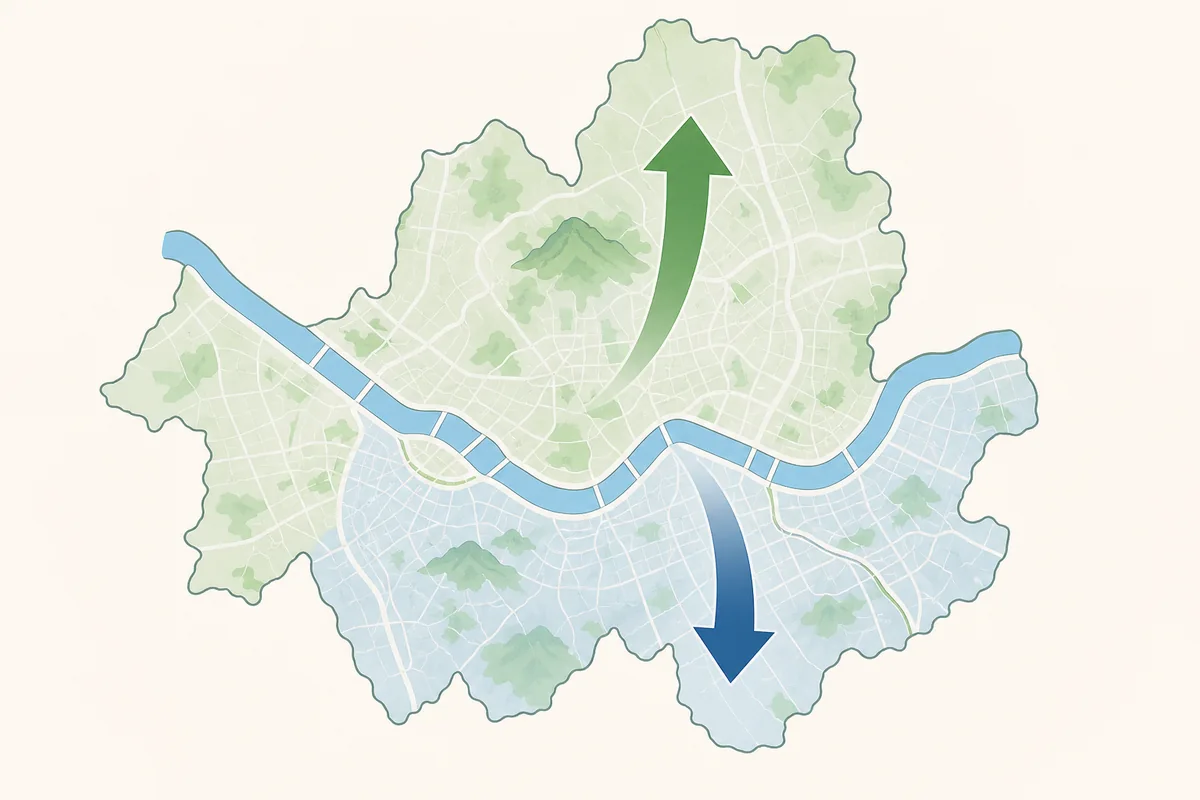
- Think of the Han River as a dividing line — north is older and historic, south is newer and commercial.
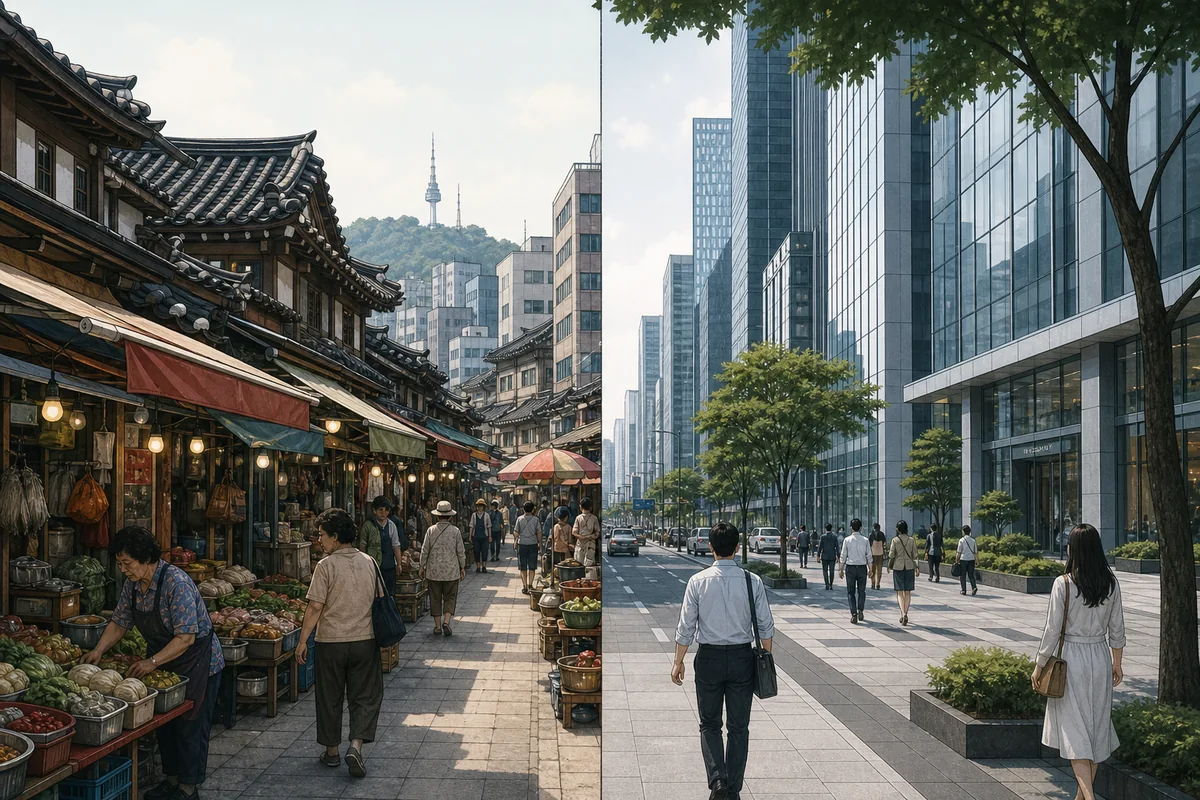
- Use Jongno as your base if you want palaces, traditional markets, and everyday Korean street life.
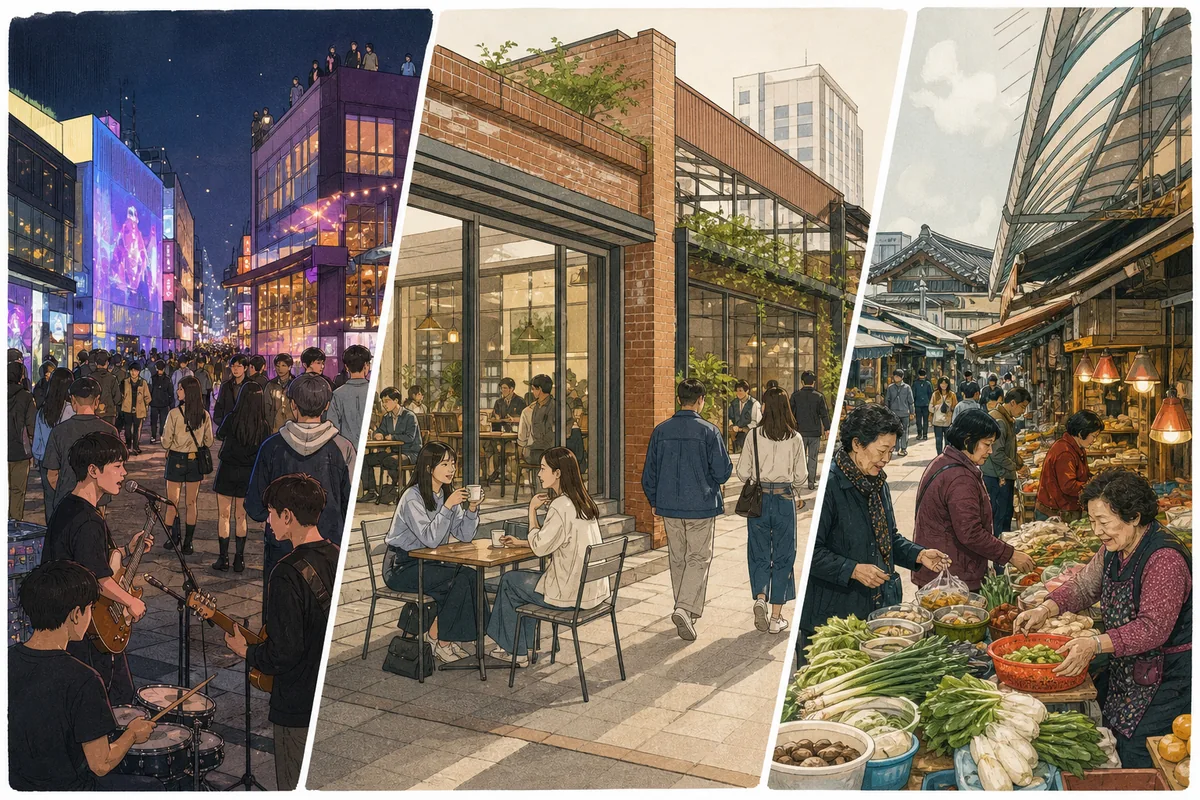
- Use Hongdae if you want nightlife, cafes, street performance, and a university-town energy.
- Visit Seongsu if you want design-led shops, converted warehouses, and a curated, contemporary feel.
- Do not assume “newer” means better or “older” means less interesting — they are just different trips.
- Check which subway line connects your accommodation to the areas you want — Seoul’s districts are spread out and a single line rarely covers everything.
- Pick a neighborhood style first, then find your hotel — not the other way around.
Why Seoul Feels Bigger Than One City
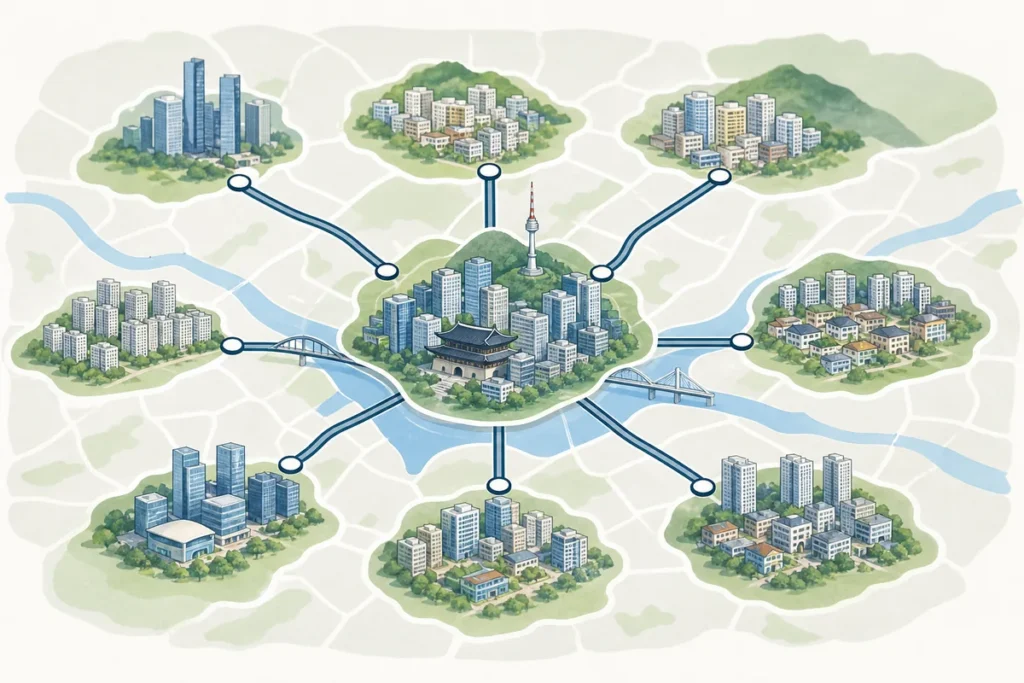
Seoul city structure is built on multiple hubs, not one single downtown, which is why the city can feel like several places at once. If you know that from the start, the map makes sense much faster.
Seoul is home to around ten million people inside the city boundary, and the wider metro area pushes that number much higher. That alone explains why it never feels like a single compact center. But the bigger reason is that Seoul grew in layers. Different districts developed at different times, for different reasons, and they never merged into one uniform core.
When you open a map, you see neighborhood names spread across a huge area: Jongno, Myeongdong, Hongdae, Itaewon, Gangnam, Sinchon, Seongsu, Insadong. None of these works like a single all-purpose center. Seoul is better understood as a city of strong local hubs, each with its own character, transport links, and purpose.
That is useful for a visitor. Once you understand what each hub is for, you stop feeling lost and start making real choices about where to spend your time.
The Han River: The Split That Shapes the Map
The Han River (한강, Hangang) cuts across Seoul from east to west. It is the most useful mental divider in the city. Everything north of the river is called Gangbuk (강북). Everything south is called Gangnam (강남). Those words literally mean north of the river and south of the river.
The river is not a barrier you need to fear crossing. There are many bridges, and the subway crosses it often. But knowing which side of the Han you are on tells you a lot right away. Gangbuk is where Seoul’s older streets, royal palaces, traditional markets, and historic neighborhoods sit. Gangnam is where wider boulevards, glass office towers, luxury shopping, and newer residential blocks were built later.
Neither side is better. They are genuinely different experiences, and many visitors spend time on both. The river itself has long public parks along both banks, which are ideal for walking, biking, or simply seeing the city from a different angle.
River Direction Words to Know
Gangbuk and Gangnam: Old Core vs New Core
Gangbuk is where Seoul started. The royal palaces, old city gates, winding alley markets, government buildings, and densely packed hillside neighborhoods are all here. Walking through Gangbuk, you can feel the city’s age in the layout: streets that do not follow a grid, neighborhoods that grew around hillsides and streams, and blocks where a centuries-old temple sits next to a convenience store.
Gangnam feels almost opposite. It was largely farmland and flood plain until major development pushed south of the river in the 1970s and 1980s. The streets are wider and more planned, the buildings are taller and newer, and the commercial energy is more corporate. The famous Gangnam district is only one part of the larger Gangnam area, centered around Gangnam Station and the streets nearby.
A simple way to picture it: Gangbuk often feels like a city you discover by wandering. Gangnam often feels like a city you navigate with a purpose — a specific restaurant, shopping mall, or business meeting. Both are worth your time, but they reward different kinds of travel energy.
Jongno: Historic Center, Markets, and Everyday Seoul
Jongno (종로) is the closest thing Seoul has to a historic downtown, and it is one of the clearest examples of Seoul city structure in action. The district and its main street have been a civic and commercial spine for centuries. Gyeongbokgung Palace sits at the top of Jongno. Insadong runs nearby. Bukchon Hanok Village is a short walk away.
But Jongno is not a museum district. It is also full of everyday Seoul: hardware stores, pharmacies, street food tents, underground shopping arcades, and lunch spots that office workers have used for years. Gwangjang Market, one of Seoul’s oldest and most famous covered markets, is here too, with stalls selling bindaetteok, mayak gimbap, and raw fish.
If you want to understand what Seoul looked and felt like before it became a global city, Jongno is the place to start. The streets are older, the signage is denser, and the pace is mixed — tourists and locals share the same space.
Hongdae: Youth Culture, Cafes, and Nightlife
Hongdae (홍대) takes its name from Hongik University, whose arts campus anchors the area. Over time, the student and artist crowd shaped the streets around the university into something that feels permanently switched on — cafes, live music venues, street art, indie fashion shops, karaoke rooms, and clubs that run late into the night.
Today Hongdae is one of Seoul’s busiest visitor areas, and it has grown beyond the original university blocks. The streets around Hapjeong and Sangsu stations have absorbed some of the overflow and developed their own slightly quieter cafe-and-bar character. The core Hongdae area still carries the high-energy, youth-oriented feel that made it famous.
During the day, Hongdae is great for browsing independent shops, eating casual meals, and sitting in specialty coffee spots. After dark, it becomes one of the loudest and most social parts of the city. If you want nightlife or a strong student-town atmosphere, this is the neighborhood for it.
Hongdae is also well connected. It sits near a major transport interchange where the airport rail, subway Line 2, Line 6, and the Gyeongui-Jungang Line connect. Many first-time visitors stay here for that reason alone.
Seongsu: Trendy Streets, Design, and New Seoul
Seongsu (성수) sits on the north bank of the Han River in eastern Seoul, and it has become one of the clearest signs of where the city’s creative energy is heading. It used to be an industrial area with shoe factories, printing workshops, and small manufacturing spaces. You can still see that history in the buildings, even after many of them were converted into coffee roasters, design studios, concept stores, and pop-up showrooms.
Walking through Seongsu feels different from both Jongno and Hongdae. It is quieter and more curated. The streets are not packed with neon signs or loud music. Instead, you get carefully designed storefronts, queues for popular pop-ups, and a crowd that skews toward design-conscious Koreans in their twenties and thirties.
Seongsu is not the easiest area to navigate if you are new to Seoul. It is spread out, some of the best spots sit in side streets, and the neighborhood changes quickly as new places open. But it rewards exploration. If you want to see contemporary Korean urban culture without the tourist gloss, Seongsu is one of the best answers.
How Neighborhood Mood Changes What You Should Expect
One thing that surprises first-time visitors is how completely the atmosphere shifts from one district to the next. This is not just about looks. It changes what kind of restaurants you find, how busy the streets are at different hours, how easy it is to walk around, and even how locals interact with strangers.
In Jongno, expect narrow alleys, traditional food, older crowds mixed with tourists near the palace, and a sense that the area has been doing its job for a long time. In Hongdae, expect wider pedestrian streets, queues for brunch spots, music from open shopfronts, and a crowd that gets younger and louder as the evening goes on. In Seongsu, expect a slower pace, longer lines for specific destinations, and a neighborhood that rewards walking without a fixed plan.
Markets deserve a special mention. Seoul’s markets — Gwangjang, Namdaemun, Dongdaemun — are not tourist attractions pretending to be markets. They are working commercial spaces that also happen to be fascinating to walk through. The food stalls are real, the vendors are busy, and the energy is different from a shopping mall. If you have never been to a Korean indoor market, set aside a morning for it early in your trip.
The business districts — areas like Yeouido or the Gangnam office blocks around Teheran-ro — have their own rhythm too. Lunch hour is intense and fast. Evenings empty out quickly. They are not the most visitor-friendly zones, but they show Seoul as a working city, not just a tourism destination.
How to Choose an Area Based on Your Trip Style
The most useful question to ask before booking accommodation is not which neighborhood is most famous, but what kind of day you want when you walk out the door.
If you want palaces, traditional food, street markets, and a sense of Seoul’s long history, stay in or near Jongno, Insadong, or Euljiro. You will wake up close to the parts of the city that feel the oldest and most layered.
If you want cafes, late nights, easy transport, and a social atmosphere, Hongdae or the nearby Sinchon and Hapjeong areas are a natural fit. You will always have something to do, and getting to other parts of the city is straightforward.
If you want contemporary design, quieter streets, and a more local creative scene, Seongsu or the nearby Ttukseom area gives you that. It is a little farther from some tourist sights, but it feels like a different Seoul entirely.
And if you want the full Gangnam experience — wide streets, upscale dining, luxury shopping, and the clean-lined modernity the district is known for — the area around Gangnam Station, Apgujeong, and Cheongdam gives you that directly.
Seoul city structure rewards visitors who make a choice. Pick a home base that matches your energy, then use the subway to explore the rest. The city is big enough that you will not see everything in one trip — and that is exactly why people come back.
Seoul Not One City becomes easier to handle when you recognize the situation and follow the practical steps above.
Seoul Not One City becomes easier to handle when you recognize the situation and follow the practical steps above.
Why does Seoul feel like several different cities?
Because it grew in layers across a large area, with different districts developing at different times and for different purposes. There is no single downtown that everything radiates from. Instead, Seoul has multiple strong neighborhood hubs with their own history, transport links, and atmosphere.
What is the difference between Gangbuk and Gangnam?
Gangbuk is the northern half of Seoul above the Han River. It is the older part of the city, with royal palaces, historic markets, and traditional neighborhoods. Gangnam is the southern half, developed mainly from the 1970s onward, and it is known for wider streets, modern buildings, corporate offices, and upscale commercial areas.
Is Jongno better than Hongdae for first-time visitors?
Neither is better in general. Jongno is the better pick for historic Seoul: palaces, traditional markets, older street life, and a layered city feel. Hongdae is better if you want a lively, youthful atmosphere with cafe culture, nightlife, and easy transport connections. Many first-time visitors spend time in both.
What kind of area is Seongsu in Seoul?
Seongsu is a formerly industrial neighborhood on the north bank of the Han River that has become one of Seoul’s most design-forward and trend-conscious areas. Old factory buildings have been converted into coffee roasters, concept stores, and pop-up spaces. It attracts a creative crowd and has a quieter, more curated feel than Hongdae or Myeongdong.
Note: This guide is for travel navigation in Korea. It is not medical, legal, or emergency professional advice. For urgent situations, contact local emergency services, official staff, or your embassy/consulate as appropriate.
Sources & Verification
- VISITKOREA – Imagine Your Korea — english.visitkorea.or.kr
Last checked: July 30, 2026