Korean Menu Structure Explained: What You Need to Know
If a menu says 1인분, 세트, 단품, 추가, or 반찬, it is telling you what counts as one order and what costs extra. Understanding the korean menu structure means knowing that 1인분 is one serving per person, 세트 includes side items, 단품 is the main item only, 추가 means an extra charge applies, and 반찬 are the small side dishes. Get these five words right and most Korean menus become readable.
What to Do First
- Check whether the menu shows 1인분 — if so, that price is per person, not per table.
- Look for a minimum order note such as 최소 2인분 before you sit down.
- Decide between 세트 (set with extras) and 단품 (main item only) before calling the server.
- Treat 추가 items as add-ons that appear on your bill — they are never free.
- Accept 반찬 freely and ask for refills without worry at most traditional restaurants.
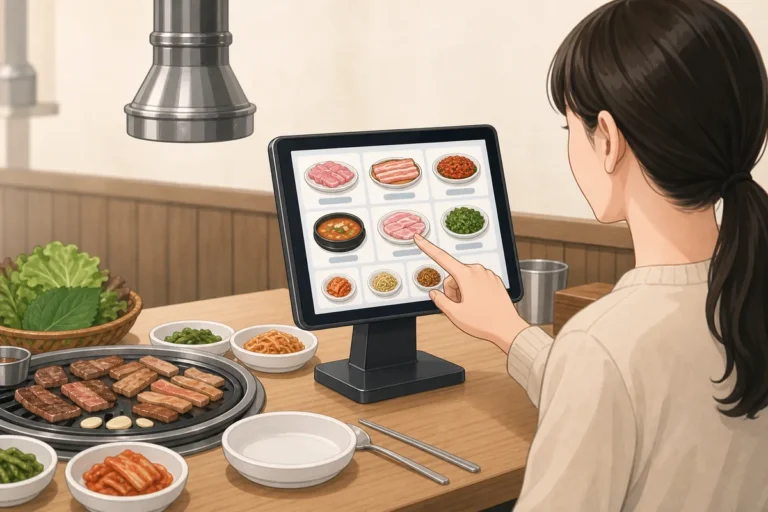
- For grill restaurants, count one portion per person and add one extra if you are hungry.
- When unsure, point to the menu item and hold up fingers to show how many people are eating.
When This Guide Helps
If a menu says 1인분, 세트, 단품, 추가, or 반찬, it is telling you what counts as one order and what costs extra. This guide helps when you are looking at a Korean restaurant menu and cannot tell whether the price is for one person, the whole table, or a dish with extras already included.
You do not need to read Korean fluently. You just need to recognize a handful of words that appear on almost every Korean menu. Once you know what each label is doing — telling you a serving size, bundling extras, or flagging a charge — ordering becomes much more straightforward.
This guide covers sit-down restaurants, Korean BBQ grills, noodle shops, and set-meal counters. It does not cover convenience store meals or fast-food kiosks, which use a different system.
What to Do First
Before you order anything, spend thirty seconds scanning the menu for these five words. They tell you the structure of the whole meal before you commit to anything.
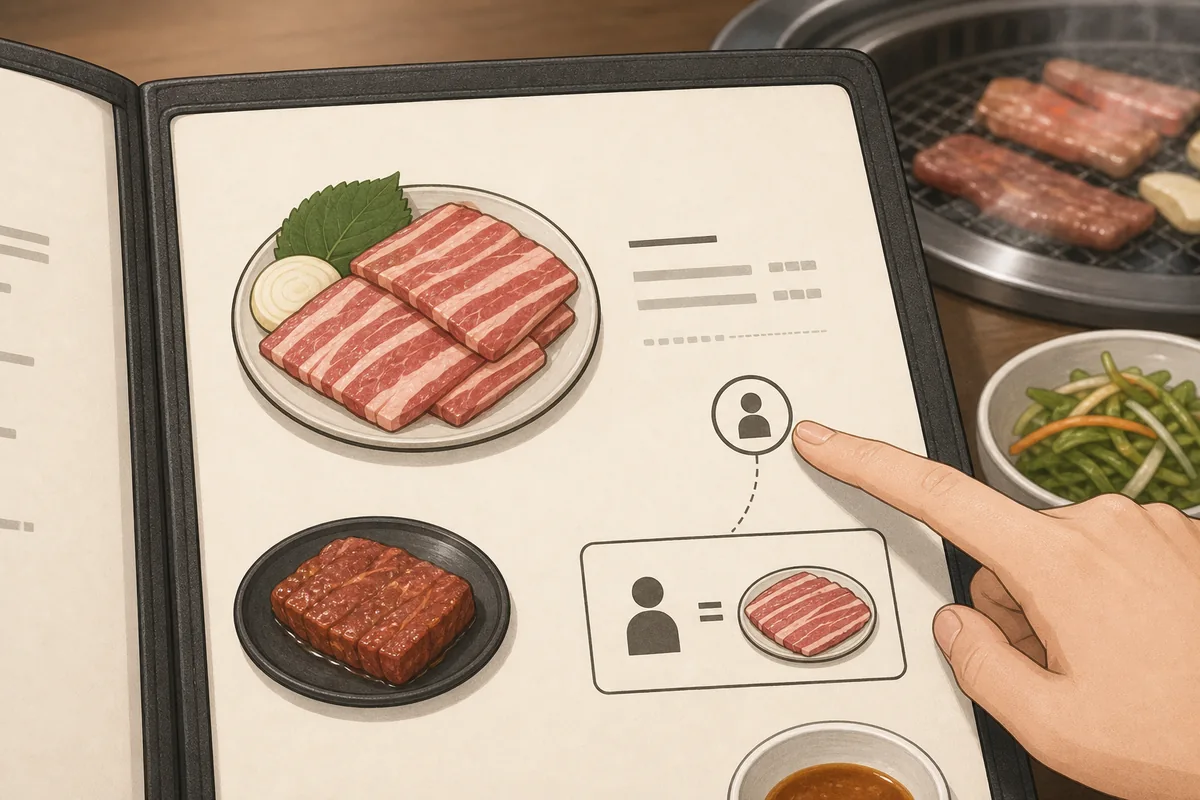
1인분 is the most important one to spot. It means one serving, priced per person. At a Korean BBQ restaurant, if pork belly is listed at a price with 1인분 next to it, that price buys one person’s worth of meat. Two people eating means two portions, and the bill doubles for that item.
최소 주문 or 2인분부터 means the kitchen will not cook less than a set minimum — often two servings. Solo diners sometimes pay for two portions at these places. It is worth checking before ordering, not after.
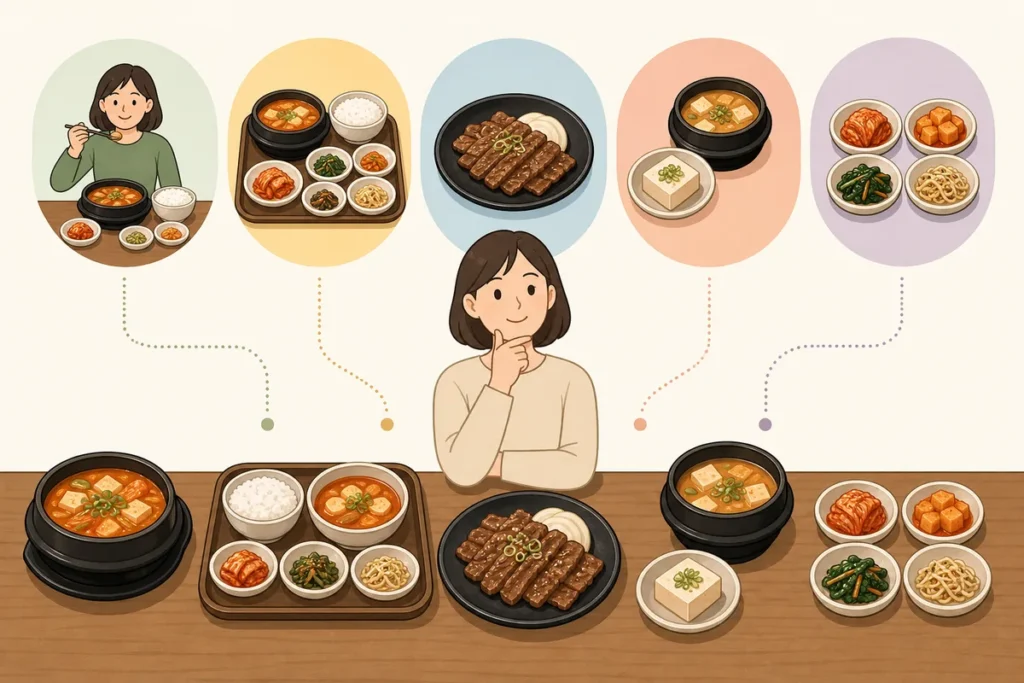
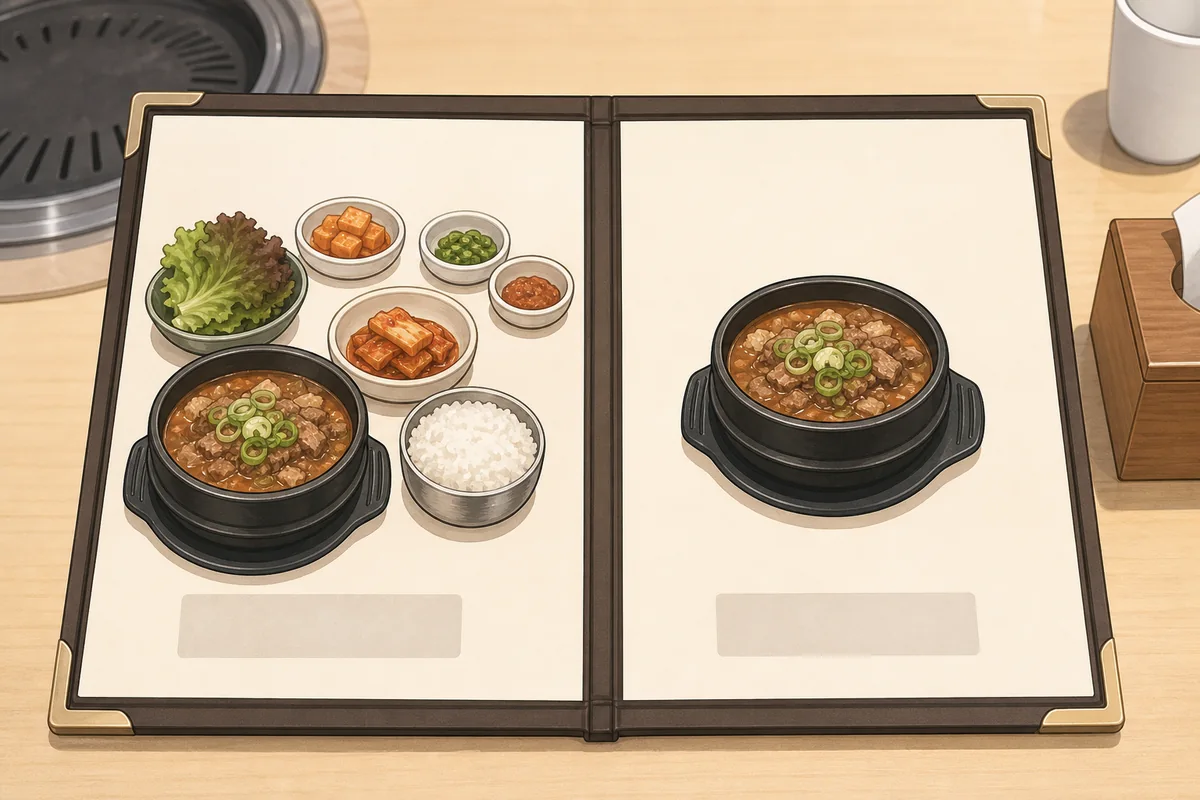
세트 menus bundle the main dish with rice, soup, or a drink. They usually cost more than 단품 but give you more food. If you are hungry or eating alone and want a complete meal, 세트 is usually the better pick.
단품 is the main item stripped of extras. A bowl of noodles listed as 단품 comes as just the noodles. No rice, no soup alongside it unless you order separately.
추가 means extra, and it always means extra cost. If you order more meat at a grill, more rice, or an additional topping, the server will ring it up as 추가.
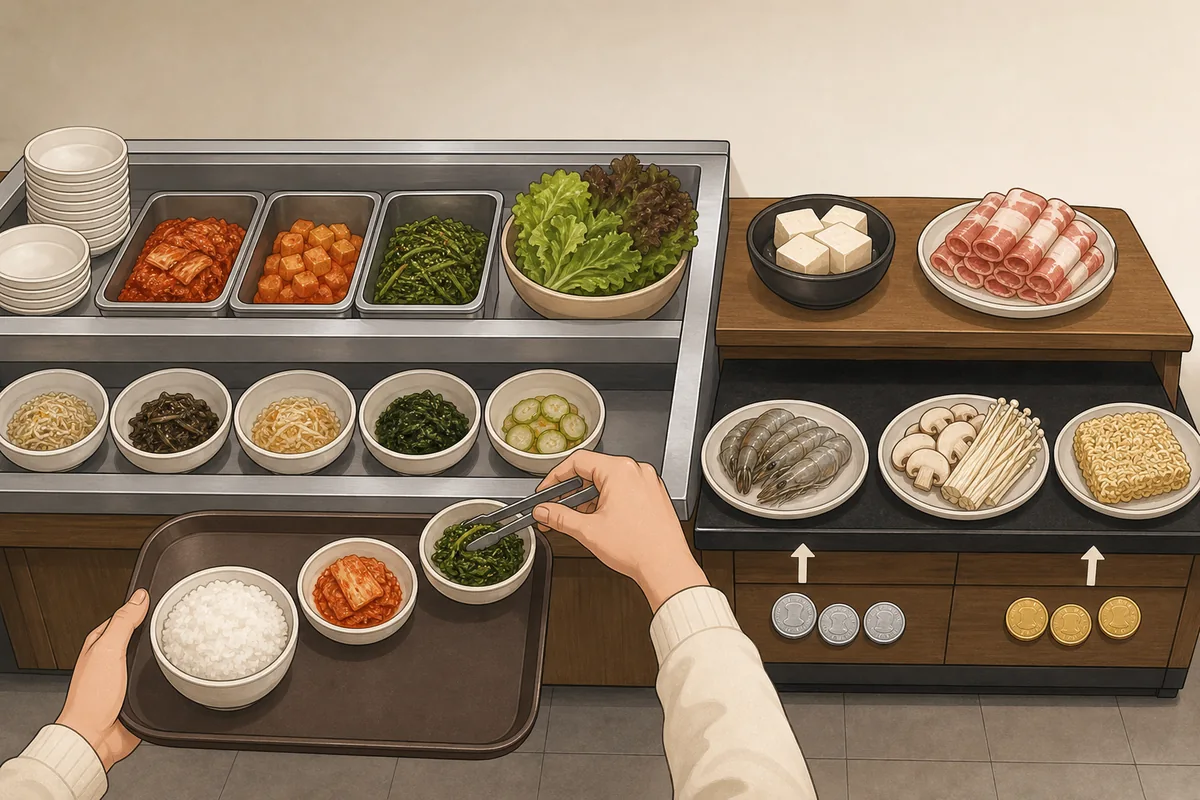
반찬 are the small shared dishes — kimchi, bean sprouts, spinach, pickled vegetables — placed on the table before your main food arrives. At almost every traditional Korean restaurant these are free, and you can ask for more at no charge. They are not a starter course you pay for.
Korean Phrases You Can Show
These are phrases you can point to on your phone when ordering or asking a question at the counter.
Useful Korean Signs or Words
These are the words you will see printed on menus, boards, or table signs at Korean restaurants.
How Serving Counts Work in Practice
The korean menu structure is built around portions per person, not portions per table. This is different from many Western restaurants where a dish is placed in the center and shared freely. In Korea, the price you see next to a main dish is usually what one person pays for their share.
At a Korean BBQ restaurant, imagine you see 삼겹살 (pork belly) — 1인분 on the menu. If you are two people and both want to eat, you order two portions. The server brings enough meat for two. If the menu also says 2인분부터 below the item name, the kitchen will not prepare less than two portions regardless of how many people are at the table.
At a noodle or rice restaurant, the structure shifts. Most dishes are already sized for one person, so you simply order one bowl each. The 단품 / 세트 choice becomes more relevant here. A 단품 bowl of bibimbap is just the rice and toppings. The 세트 version adds a small soup and possibly a drink. If you are eating a light lunch, 단품 is fine. If you want a full meal, 세트 saves you the hassle of ordering sides separately.
For groups of three or more at a grill, a practical rule is to order one portion per person and see how the first round goes. Ordering 추가 meat midway through is easy and normal — servers expect it.
Solo Dining and the Minimum Order Problem
Solo travel in Korea is common and well-supported, but some traditional Korean restaurants — especially BBQ and stew places — are designed for two or more people. The cooking vessel is large, the portions are generous, and the minimum order rule (2인분부터) exists because the dish does not work well in half quantities.
If you are eating alone and see 2인분부터, you have three options: pay for two portions and take your time enjoying the extra food, ask politely whether a solo exception is possible, or choose a different dish from the same menu that has no minimum. Many restaurants that specialize in BBQ also offer a solo-friendly rice or noodle dish on the side of the menu for exactly this reason.
Convenience stores, gimbap shops, and noodle counters almost never have minimum order rules. They are the easiest solo-dining option in Korea.
반찬: What Is Free and What Is Not
The small dishes that appear on the table before your food arrives are 반찬. At a traditional Korean restaurant — a place serving home-style food, stews, grilled meat, or rice dishes — these are part of the meal and cost nothing extra. Kimchi, seasoned spinach, fish cake, bean sprouts: all of it is there for you to eat freely. You can ask for more of any dish you like, and the server will bring a fresh plate at no charge.
The exception is upscale or fusion restaurants where banchan is presented as a paid appetizer course. This is less common but does happen. A quick visual check helps: if the banchan arrived automatically before you ordered anything, it is almost certainly free. If a server described it to you and placed it deliberately as a course, ask before eating.
Banchan is shared across the table. Do not move the dishes to your personal bowl — eat directly from the shared plate using your chopsticks, or use the serving spoon if one is provided.
Where to Get Help
If you are genuinely stuck at a restaurant — the menu is entirely handwritten, there are no pictures, and no one speaks English — these options work reliably.
Google Translate camera mode handles printed Korean menus well. Open the app, tap the camera icon, and point it at the menu. It will overlay a rough translation in real time. It is not perfect, but it will catch 세트, 단품, 추가, and 1인분 every time.
Naver Papago is the Korean-built alternative and handles restaurant vocabulary slightly better for local dishes. The camera function works the same way.
Pointing and holding up fingers is still the most universal method. Point to the menu item, hold up the number of fingers for how many servings you want, and nod. Korean restaurant staff are used to this from foreign visitors and will confirm the order back to you.
If you end up with a bill that seems wrong, stay calm, point to the items on the receipt, and ask 이게 뭐예요? (What is this?). Most billing surprises at Korean restaurants come from 추가 charges that were not noticed, not from errors.
Common Mistakes
- Ordering one portion for two people at a BBQ restaurant. The server will usually clarify, but if they do not, you will receive half the food you expected.
- Assuming 세트 always includes a drink. Sometimes it does, sometimes it includes soup or rice instead. Check the menu description before assuming.
- Ordering 추가 meat without asking the price first. Extra portions are charged at the same per-serving rate as the original order. It adds up quickly if you order several rounds.
- Thinking 반찬 is a paid appetizer. At a traditional restaurant, eating the banchan freely is expected. Leaving it untouched because you assumed it would be charged is a common visitor mistake.
- Ignoring the 2인분부터 note as a solo diner. Some restaurants will politely refuse to cook the dish for one person. Spotting this before you sit down saves an awkward moment.
- Confusing 공기밥 with included rice. A 단품 main dish often does not include rice. If you want rice, order 공기밥 separately and expect a small charge.
Official Resource
The Korea Tourism Organization (한국관광공사) maintains a traveler information service in English. You can reach it by dialing 1330 from any Korean phone or SIM, including most roaming numbers. The line operates around the clock and can help with restaurant questions, translation assistance, and general travel guidance. It is a practical backup when apps and pointing do not resolve the confusion.
Korean Menu Structure Explained becomes easier to handle when you recognize the situation and follow the practical steps above.
Korean Menu Structure Explained becomes easier to handle when you recognize the situation and follow the practical steps above.
FAQ
What does 1인분 mean on a Korean menu?
It usually means one serving or one person’s portion. In many restaurants, especially BBQ places, you order one 1인분 per eater rather than one dish for the whole table.
What is the difference between 세트 and 단품?
세트 means a set meal, usually with extras like rice, soup, or a drink included. 단품 means the single item only, without the set extras.
Does 추가 mean extra cost on Korean menus?
Yes. 추가 means an extra add-on, refill, or additional item, so it usually changes the final price or quantity.
Are 반찬 free in Korea?
Often yes, especially at traditional restaurants. Basic side dishes are usually included, and many places will bring refills if you ask.
Note: This guide is for travel navigation in Korea. It is not medical, legal, or emergency professional advice. For urgent situations, contact local emergency services, official staff, or your embassy/consulate as appropriate.
Sources & Verification
- VISITKOREA – Imagine Your Korea — english.visitkorea.or.kr
Last checked: July 30, 2026