Table of Contents
- Introduction
- Korean Restaurant Types and How They Differ
- The Full Ordering Flow, Step by Step
- Common Situations
- What Foreigners Often Get Wrong
- Useful Korean Phrases
- Warnings and Things to Check
- FAQ
- Summary
Introduction
This jumun guide is for people who have already eaten in Korea a few times but still feel uncertain the moment they walk through a restaurant door alone. You can handle the basics, but reading a handwritten menu board, adjusting spice levels, or figuring out whether you pay at the table or the counter can still trip you up. This article gives you the concrete procedures and situation-specific phrases you need to get through a real Korean restaurant meal confidently, from the moment you step inside to the moment you leave.
Korea’s restaurant culture has its own rhythm. Seats are often not assigned by a host. Staff do not hover. Side dishes arrive automatically. Sharing is the norm at many restaurants. Once you understand these patterns, eating out here becomes one of the most enjoyable parts of living in or visiting Korea.
Korean Restaurant Types and How They Differ
Not every Korean restaurant works the same way. Knowing which type you are walking into changes how you order, sit, and pay.
Casual Local Restaurants (일반 식당)
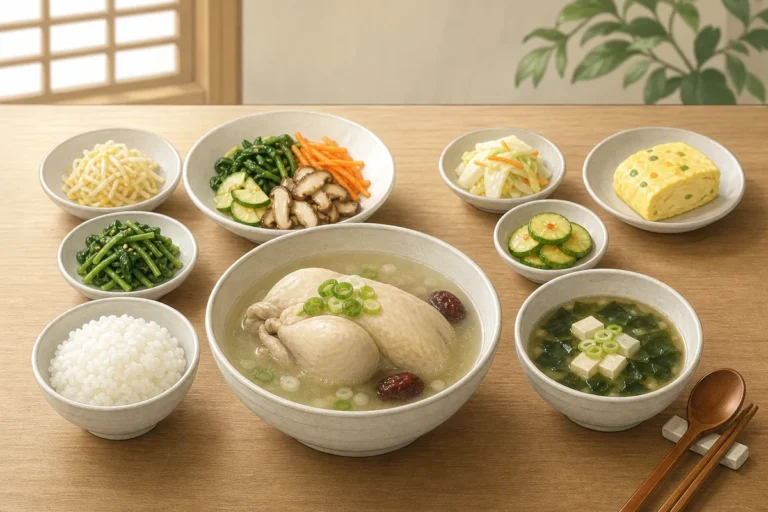
These are the most common: small neighbourhood places serving set meals, soups, or rice dishes. You seat yourself unless a sign or staff member directs you otherwise. A staff member takes your order at the table. Side dishes (반찬, banchan) come automatically and are usually free and refillable. Payment is almost always at the front counter after eating, not at the table.
Self-Service and Kiosk Restaurants
Many newer restaurants, fast-food chains, and budget lunch spots use a kiosk or counter-order system. You order and pay first, then find a seat and wait for your food to be called or brought out. Look for a kiosk screen near the entrance. Many kiosks now have an English-language option; tap the flag icon if you see one. If there is no English option, use the photo buttons or show a staff member your phone with a translation.
Korean BBQ Restaurants (고깃집)
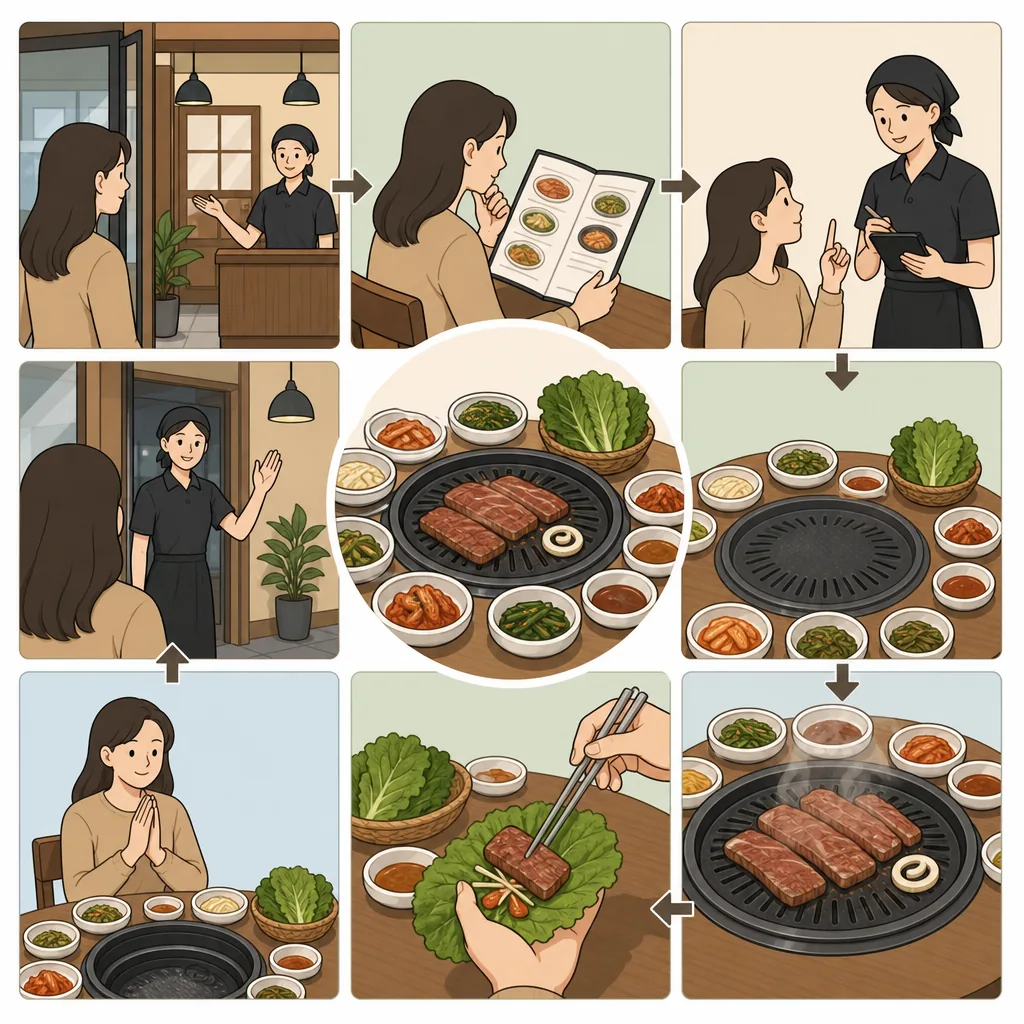
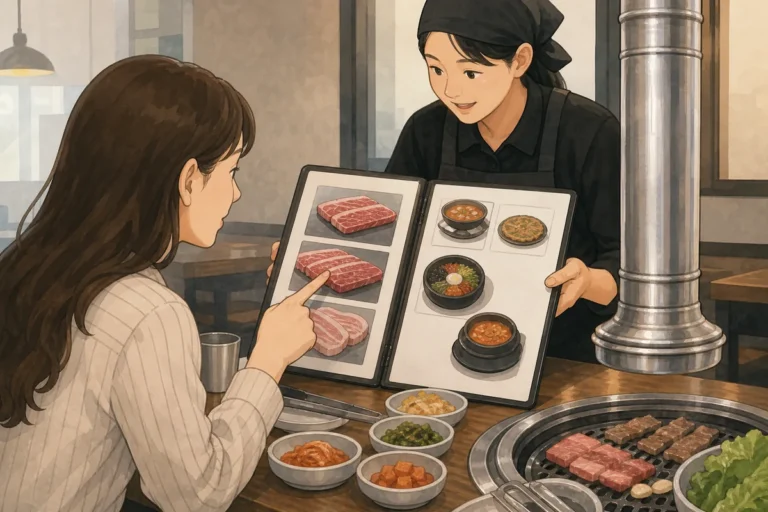
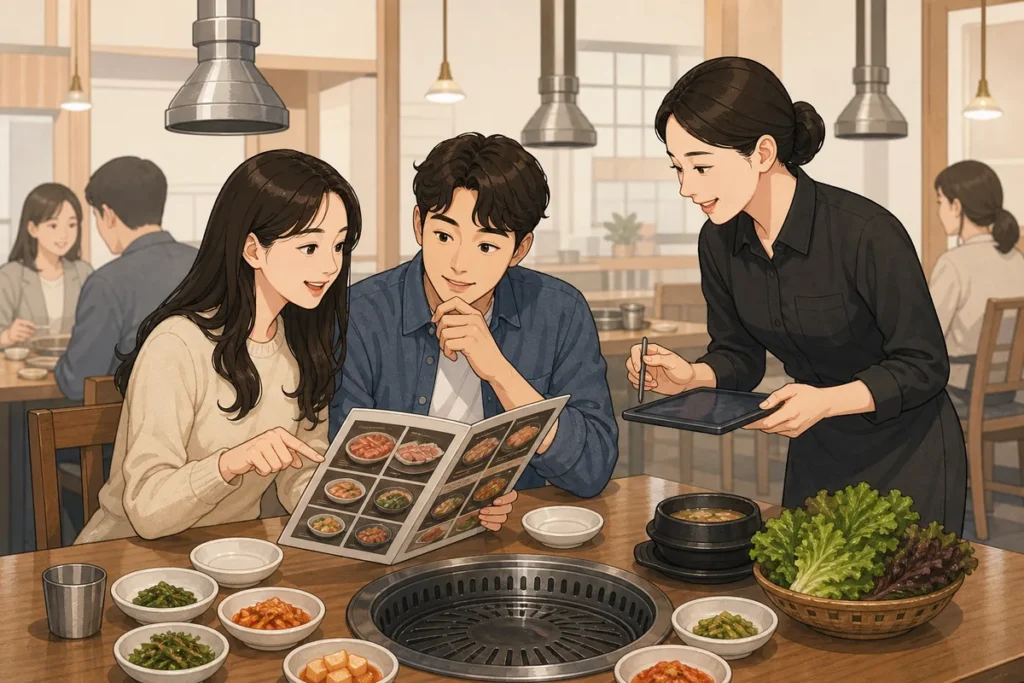
At BBQ restaurants you order raw meat that is cooked at a grill built into your table. Orders are usually per portion (1인분, il-in-bun means one serving). Many BBQ places have a minimum order of two portions, even if you are dining alone. Side dishes and lettuce wraps are included. Staff may help grill for you, or you may do it yourself. Ask if you are unsure.
Shared-Dish Restaurants (찌개, 전골, 탕)
Restaurants serving stews like kimchi jjigae or sundubu jjigae often bring one large pot for the table. If you are alone, you still get an individual portion. If you are with others, one pot is typically shared. Confirm portion sizes when ordering if you are unsure.
Pojangmacha and Street Food Stalls
These open-air stalls and tented carts are order-and-pay-immediately spots. Point at what you want, hold up fingers for the quantity, and pay cash on the spot. Card payment is not always available here.
The Full Ordering Flow, Step by Step
Step 1 — Enter and Find a Seat
At most casual Korean restaurants, there is no host waiting to seat you. Walk in, look around, and sit at an empty table. If the restaurant is busy and you are unsure, make eye contact with a staff member and they will gesture where to go. Do not wait at the entrance for someone to come to you — this is one of the most common points of confusion for newcomers.
At some popular or upscale restaurants, a sign near the door may say 잠시만 기다려 주세요 (please wait a moment). In that case, wait briefly until staff acknowledge you.
Step 2 — Look at the Menu
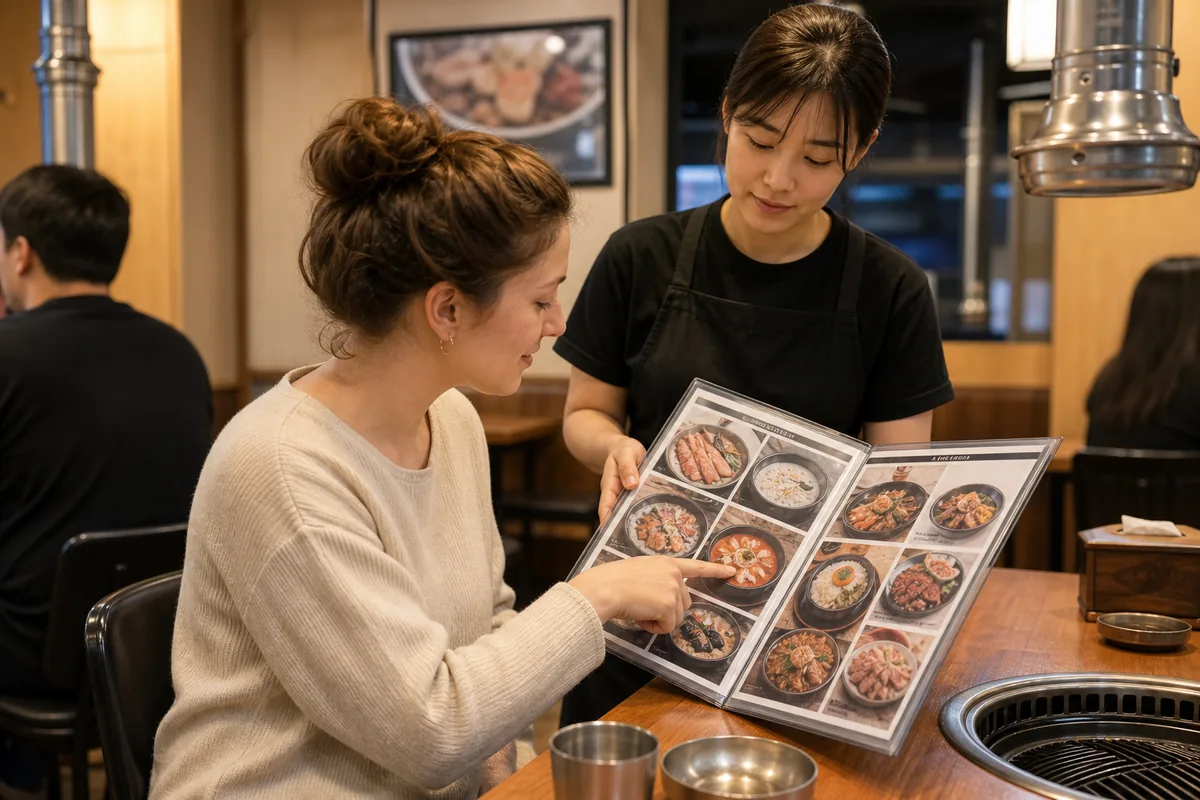
Menus are often on the table, on the wall, or displayed on a screen. Many restaurants now include photos, which makes ordering much easier. If there is no English menu and you cannot read Korean, use your phone camera with Google Translate in live-view mode — point your camera at the menu and the translation appears on screen. This is completely normal and staff are used to seeing it.
If the menu is on a chalkboard or handwritten sheet and you cannot read it at all, it is fine to ask a staff member to point at a popular dish or to show you what other tables are eating and say “I’ll have that.”
Step 3 — Call a Staff Member
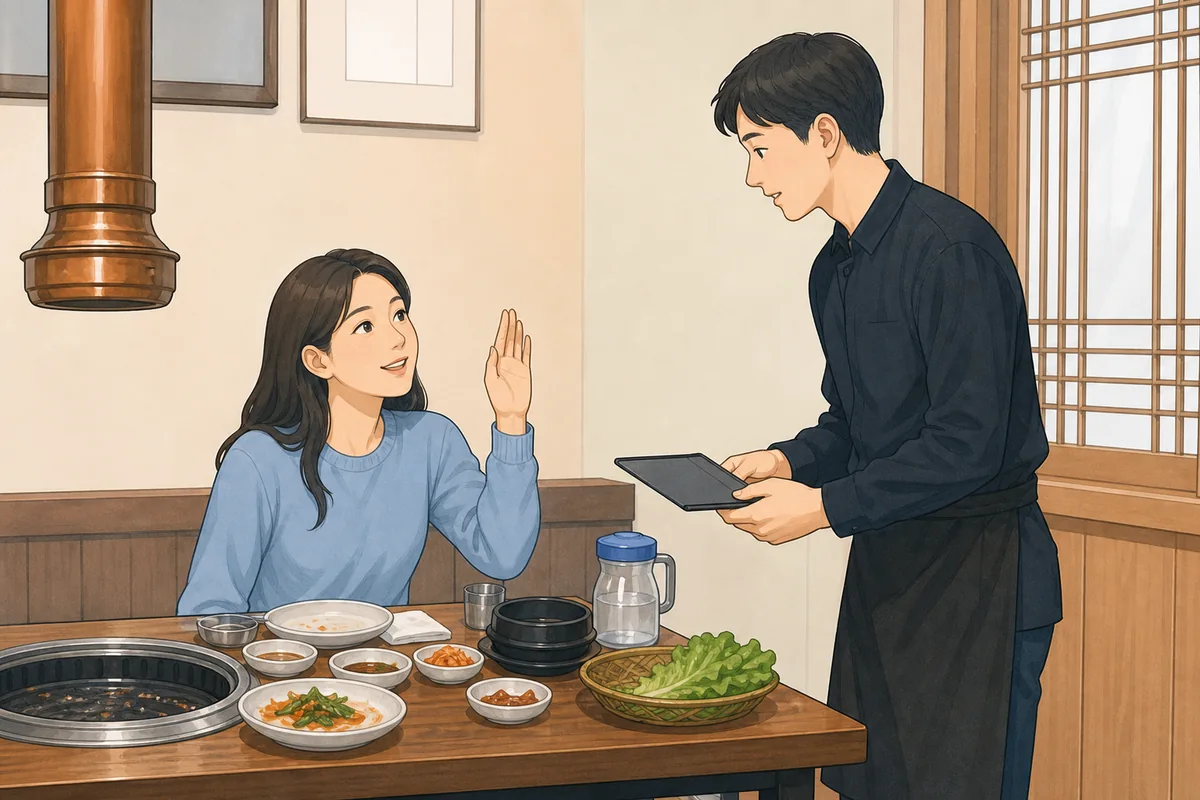
Korean restaurants do not expect you to wait politely in silence. You are supposed to call the staff. Say 저기요 (jeo-gi-yo) in a clear, moderately loud voice while raising your hand slightly. This is the standard, polite way to get attention. It is not rude. Some restaurants have a call button on the table — press it once.
Step 4 — Place Your Order
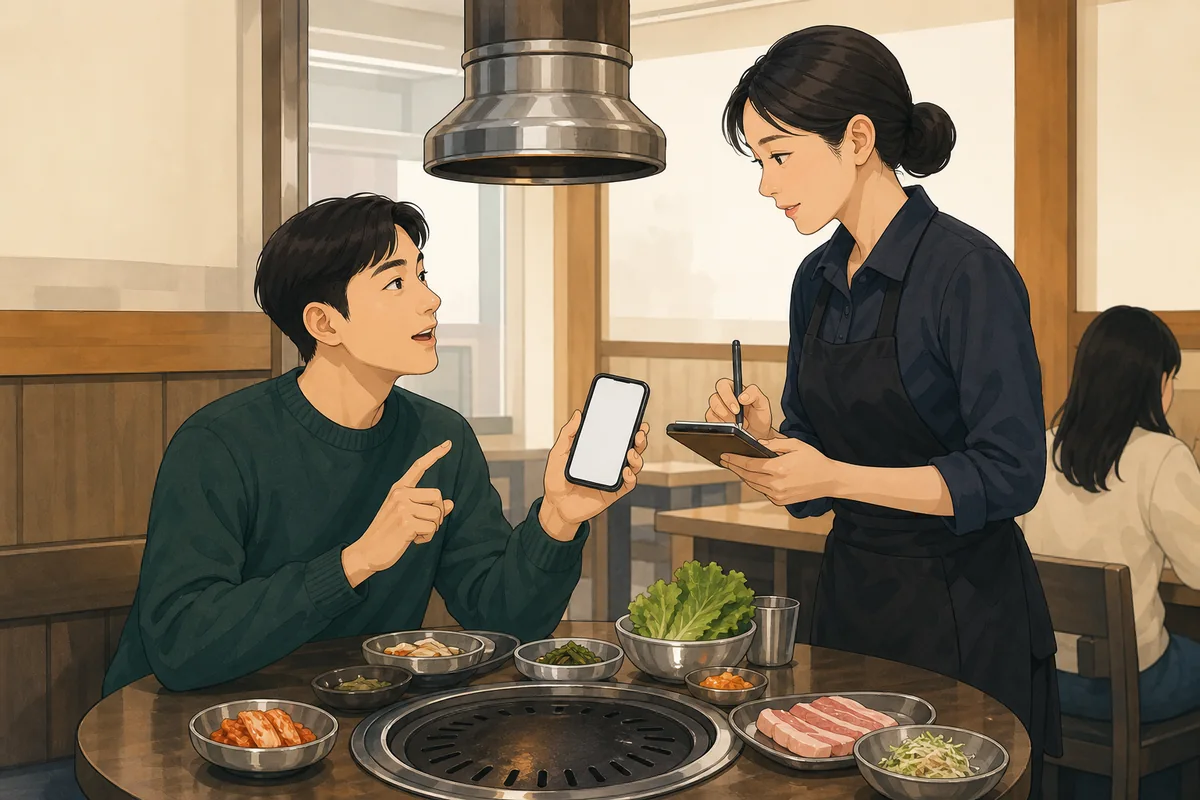
When the staff member arrives, you can say the dish name and hold up fingers for the quantity, or point directly at the menu item. You do not need to construct a full sentence. Saying the dish name plus 주세요 (ju-se-yo, meaning “please give me”) is enough. For example: 김치찌개 하나 주세요 — one kimchi jjigae, please.
If you want to show your phone with a translation or a photo of a dish, that is completely acceptable. Staff in tourist-heavy areas are especially comfortable with this.
Step 5 — Receive Side Dishes and Water
At most casual restaurants, side dishes arrive shortly after you sit down or after you order. Water is often self-serve from a dispenser or pitcher on a side counter — look around the restaurant for it. At some restaurants, a staff member will pour water for you. If you need more side dishes, you can ask (see phrases below) or, at some places, refill them yourself from a communal station.
Step 6 — Eat
Korean table etiquette is generally relaxed for foreigners. A few things to know: soup spoons and chopsticks are the standard utensils; forks are available on request at many places. It is normal to eat rice and soup with a spoon and use chopsticks for side dishes. Pouring drinks for others before yourself is a common courtesy. Blowing your nose at the table is generally considered impolite — step away if you need to.
Step 7 — Ask for the Bill and Pay
When you are finished, either go to the front counter and pay, or call a staff member and say 계산해 주세요 (gye-san-hae ju-se-yo — “please give me the bill”). At most casual restaurants, you walk to the counter to pay. Card payment (credit and debit) is widely accepted across Korea. Cash is also fine. Tipping is not customary in Korea and is generally not expected.
Common Situations
Ordering for One Person
Solo dining is common and completely accepted in Korea. Say 혼자요 (hon-ja-yo — “just me, alone”) when you arrive. Some dishes, especially BBQ, have minimum order quantities of two portions. If you see 1인분 주문 불가 on the menu, it means single-portion orders are not available for that item. Many BBQ restaurants now have solo-dining counters — look for 혼밥석 signage.
Ordering with Allergies or Dietary Preferences
This is genuinely challenging in Korea because many dishes contain ingredients like seafood paste, anchovies, or pork in broths that are not obvious. The most practical approach is to write your restriction in Korean on your phone and show it to staff before ordering. Websites like Korea Tourism Organization (visitkorea.or.kr) have resources for travellers with dietary needs, including halal and vegetarian restaurant guides. Do not assume a dish is safe based on the name alone — always confirm with staff.
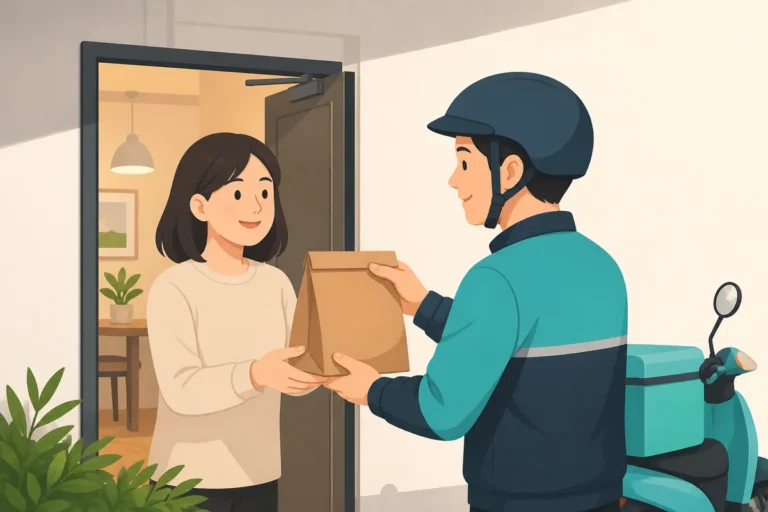
Ordering Takeout (포장)
Say 포장이요 (po-jang-i-yo — “takeout, please”) when you order. Most restaurants accommodate this. At counter-order places, simply say it when you pay. Food will be packed in containers. Some restaurants charge a small extra fee for packaging materials, though this is not universal.
Asking for Extra Rice, Water, or Utensils
Extra rice (공기밥, gong-gi-bap) usually costs a small additional fee — typically 500 to 1,000 won. Water is usually free. Utensils are in a drawer at the table at many restaurants — check there first before asking. If you need a fork, ask: 포크 있어요? (po-keu i-sseo-yo? — “Do you have a fork?”)
Adjusting Spice Level
Many Korean dishes are spicy by default. You can ask for less spice when ordering. Say 안 맵게 해 주세요 (an maep-ge hae ju-se-yo — “please make it not spicy”) or 덜 맵게 해 주세요 (deol maep-ge hae ju-se-yo — “please make it less spicy”). Be aware that some dishes cannot be easily modified because the sauce or paste is pre-made in bulk. Staff will tell you if it is not possible.
What Foreigners Often Get Wrong
Waiting to Be Seated When You Should Just Sit
Standing at the entrance waiting for a host who is never coming is the single most common mistake. At the vast majority of Korean restaurants, you seat yourself. If you are unsure, take one step inside and look around — if no one rushes over to guide you, find an empty table and sit down.
Not Knowing How to Call Staff
Many foreigners feel uncomfortable calling out to staff, either because it seems rude in their home culture or because they do not know the right word. In Korea, quietly waiting and hoping staff will notice you can mean a very long wait. Say 저기요 clearly. It is the correct and polite way to do it.
Assuming Side Dishes Are Always Free Everywhere
At traditional Korean restaurants, banchan is free and refillable. However, at some modern fusion restaurants, upscale places, or tourist-oriented spots, side dishes may be charged separately or refills may cost extra. Check the menu or ask before assuming.
Assuming Water Is Brought Automatically
In many Korean restaurants, water is self-serve from a dispenser or pitcher on a counter. Look around the room when you sit down. If you cannot find it, ask: 물 주세요 (mul ju-se-yo — “water, please”).
Misunderstanding How Sharing Dishes Work
At restaurants serving stews or shared plates, one order often feeds two or more people. Ordering one portion of kimchi jjigae for two people is normal. Ordering two separate portions each is also fine but may be more than you need. When in doubt, ask staff how many people one portion serves.
Waiting for the Bill at the Table
At most casual Korean restaurants, no one will bring you a bill. You are expected to get up and pay at the front counter when you are ready. If you sit waiting for a bill, you may wait a long time. When you are done, simply walk to the counter and say 계산이요 (gye-san-i-yo — “I’d like to pay”).
Misreading Minimum Order Requirements
Some dishes, particularly at BBQ restaurants and seafood places, have minimum order requirements — for example, a minimum of two portions per order. This is printed on the menu, sometimes only in Korean. Look for 최소 주문 or 인분 indicators. If you are alone and the minimum is two portions, you either need to order two or choose a different dish.
Useful Korean Phrases for This Jumun Guide
Getting Seated and Starting
Calling Staff and Ordering
Modifications and Dietary Needs
During the Meal
FAQ
Is it rude to say 저기요 in a Korean restaurant?
No. It is the normal, polite way to get a staff member’s attention.
Does a visitor need to wait to be seated?
Usually no. In many casual restaurants, you choose an empty seat yourself unless staff direct you otherwise.
Can a visitor order by pointing at the menu?
Yes. Pointing at the menu or showing a phone translation is completely acceptable.
Is water free in Korean restaurants?
Often yes, but the way it is served varies. Some places have self-serve water, while others pour it for you.
Does a visitor pay at the table or counter?
At many casual restaurants, you pay at the counter. Some places let you pay at the table, especially newer or more formal spots.