Jeju More Than Vacation Island: What You Need to Know
- Think of the island in two halves — Jeju-si in the north, Seogwipo in the south — they feel genuinely different.
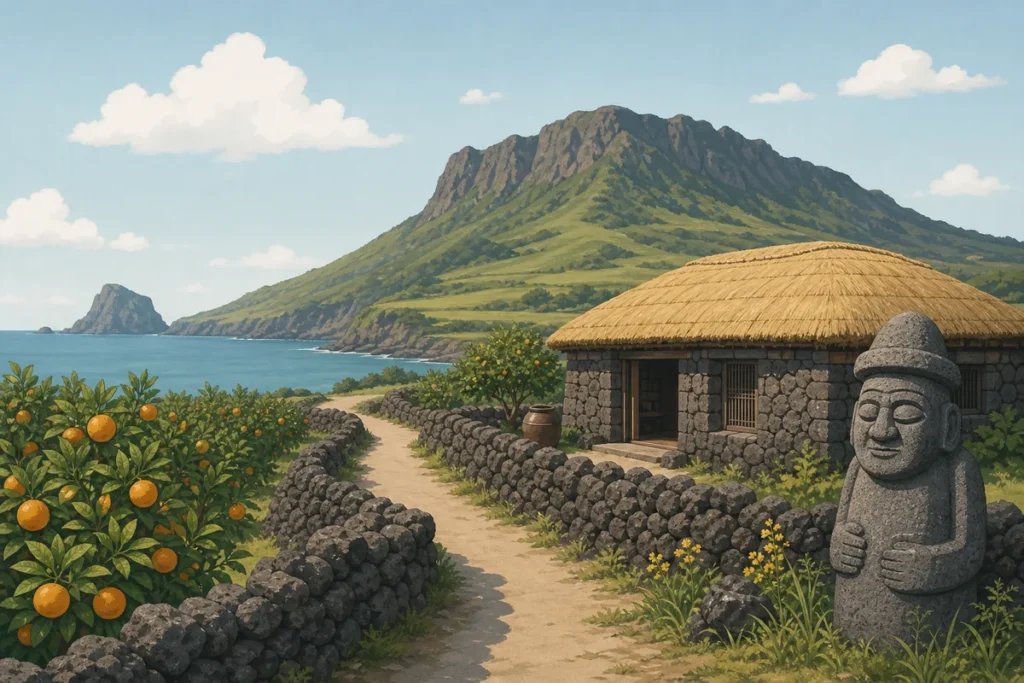
- Notice the black lava rock everywhere; it is not decoration, it is the island’s foundation.
- Look at the stone walls around fields and villages — they are functional, historic, and deeply local.
- Expect a slower pace outside the tourist zones; coastal villages are not performing for visitors.
- Recognize that Jeju has its own dialect, food traditions, and social history separate from mainland Korea.
- Do not assume every scenic spot is a tourist attraction — many are simply part of everyday island geography.
- Keep Hallasan, the central volcano, as your geographic anchor; almost everything on the island relates to it.
Jeju island is not just a place to book a beach hotel and move on. If you want to understand the island properly, you need to see how the volcano-shaped landscape, the Jeju-si and Seogwipo areas, and the coastal villages all shape everyday life here. Most first-time visitors arrive expecting a tropical holiday and leave having only scratched the surface of what the island actually is.
Why Jeju island Feels Different from Other Korean Destinations
The moment you land, something is off — in the best way. The air is softer, the horizon is wider, and the ground is visibly dark. Jeju does not feel like Seoul, Busan, or any other Korean city. That is not just atmosphere. It is geography, history, and culture working together.
Jeju was isolated from the Korean mainland for much of its history. That isolation produced a community with its own language, its own social structures, and its own way of relating to the sea and the land. The island was not always a prized destination. For centuries it was a place of exile — where scholars and officials banished from the royal court ended up. That history left a mark on the local character: self-reliant, resilient, and not particularly interested in outside approval.
Visitors coming from Seoul often notice that Jeju moves at a different speed. Restaurants close earlier. Locals are friendly but not performatively so. The tourist zones around popular beaches and resorts are genuinely busy, but step ten minutes off the main road and the island’s quieter reality comes through immediately.
The Volcanic Landscape: How Jeju island Was Formed
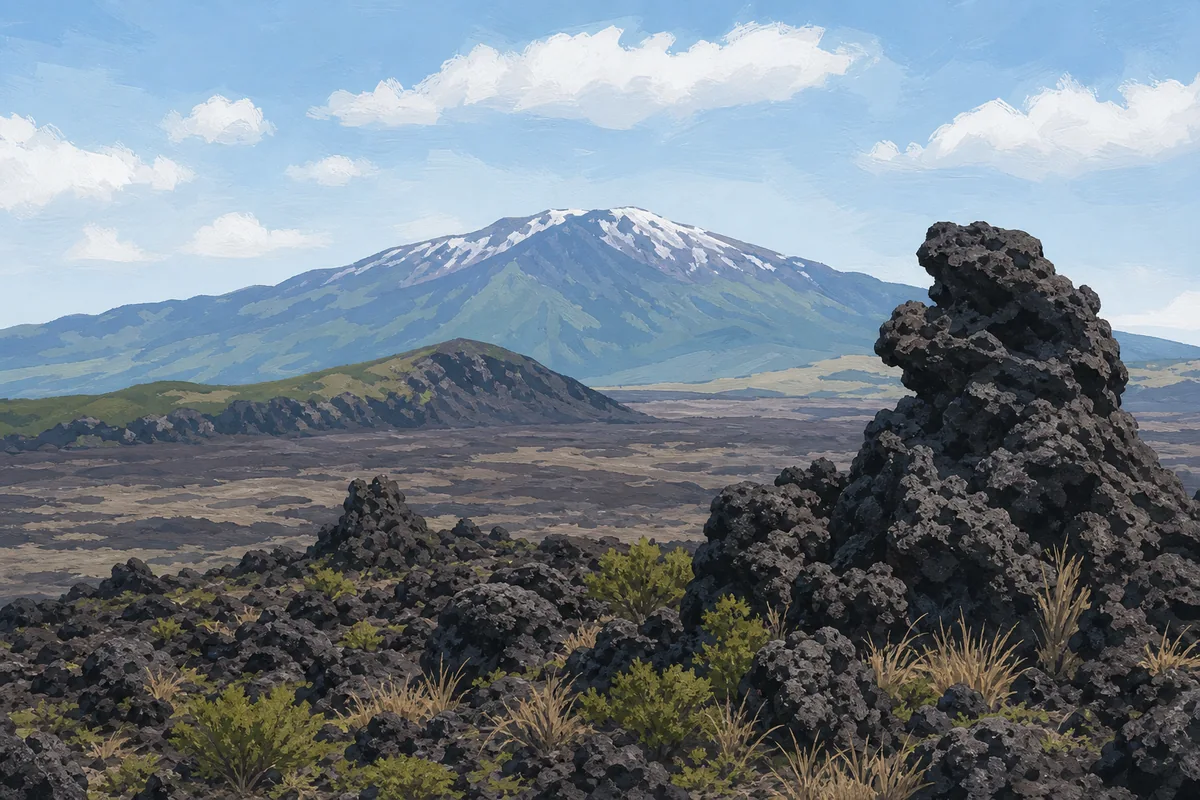
Jeju is a volcanic island. It rose from the sea through eruptions, and that origin defines almost everything physical about the place. The island’s center is Hallasan, a shield volcano that is also the highest peak in South Korea at 1,950 meters. It is not a dramatic jagged peak — it is broad, rounded, and heavy-looking, like a mountain that settled into the earth rather than pushing through it.
Around Hallasan, the landscape drops gradually toward the coast. Along the way you pass through forests, farmland, and dozens of smaller volcanic cones called oreum in the Jeju dialect. These are the rounded hills that dot the island’s interior and coastal edges. From a distance they look like gentle bumps in the landscape. Up close, many have craters at the top. There are around 360 of them across the island.
The black and reddish lava rock you see everywhere — in walls, in cliffs, in the soil — is basalt, the most common volcanic rock. It drains water quickly, which is why Jeju has very few rivers but many underground water sources. The coastline is dramatic because lava flows met the ocean and hardened into sharp, irregular formations. The famous Jusangjeolli cliffs near Seogwipo, where hexagonal basalt columns stack against the sea, are a direct result of this process.
Understanding the volcanic origin makes the landscape legible. The black walls, the rocky fields, the sudden hills — none of it is random. It is all the same geological event, still visible on the surface.
Jeju island: Jeju-si and Seogwipo
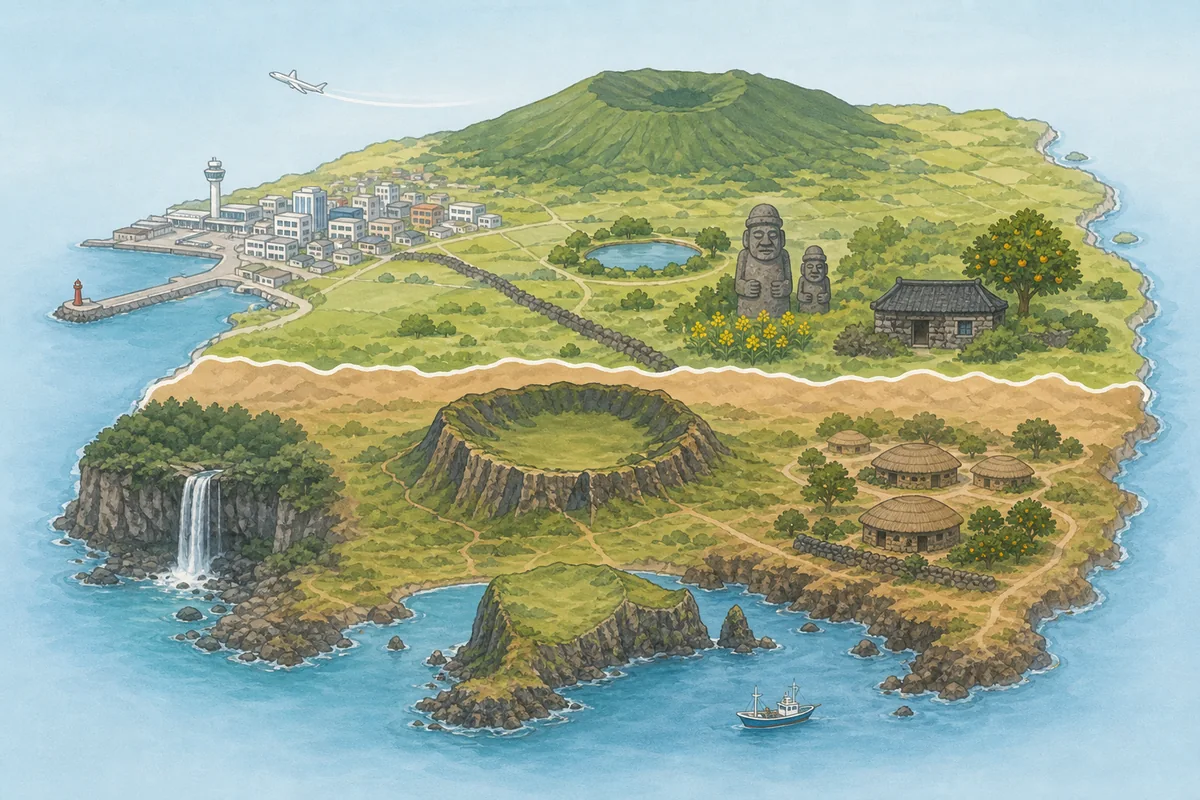
The island is divided administratively into two cities: Jeju-si in the north and Seogwipo in the south. They are not interchangeable, and choosing where to base yourself matters.
Jeju-si is the island’s capital and main hub. The airport is here. The ferry terminal is here. Most of the government offices, larger supermarkets, and transport connections are in Jeju-si. It is urban in a practical sense — not as dense as a mainland city, but clearly a working city with traffic, commercial streets, and a busy port area. The Dongmun Traditional Market is one of the best places in the city to see local produce, dried seafood, and Jeju-specific foods without the tourist markup.
Seogwipo sits on the southern coast and has a very different character. The landscape is more lush here because the south side of the island receives more rainfall and stays warmer. Seogwipo is smaller, more resort-oriented, and surrounded by some of the island’s most dramatic coastal scenery. Cheonjiyeon and Jeongbang waterfalls are both within walking distance of the city center. The pace is even slower than Jeju-si, and the streets feel more like a large town than a city.
The east and west coasts each have their own character too. The east tends to be windier and more open, with wide lava plains and traditional farming villages. The west has longer sandy beaches and has seen more resort development in recent years. Most visitors circle the island by car or bus, which is the most practical way to experience all four directions.
Coastal Villages and Everyday Island Life
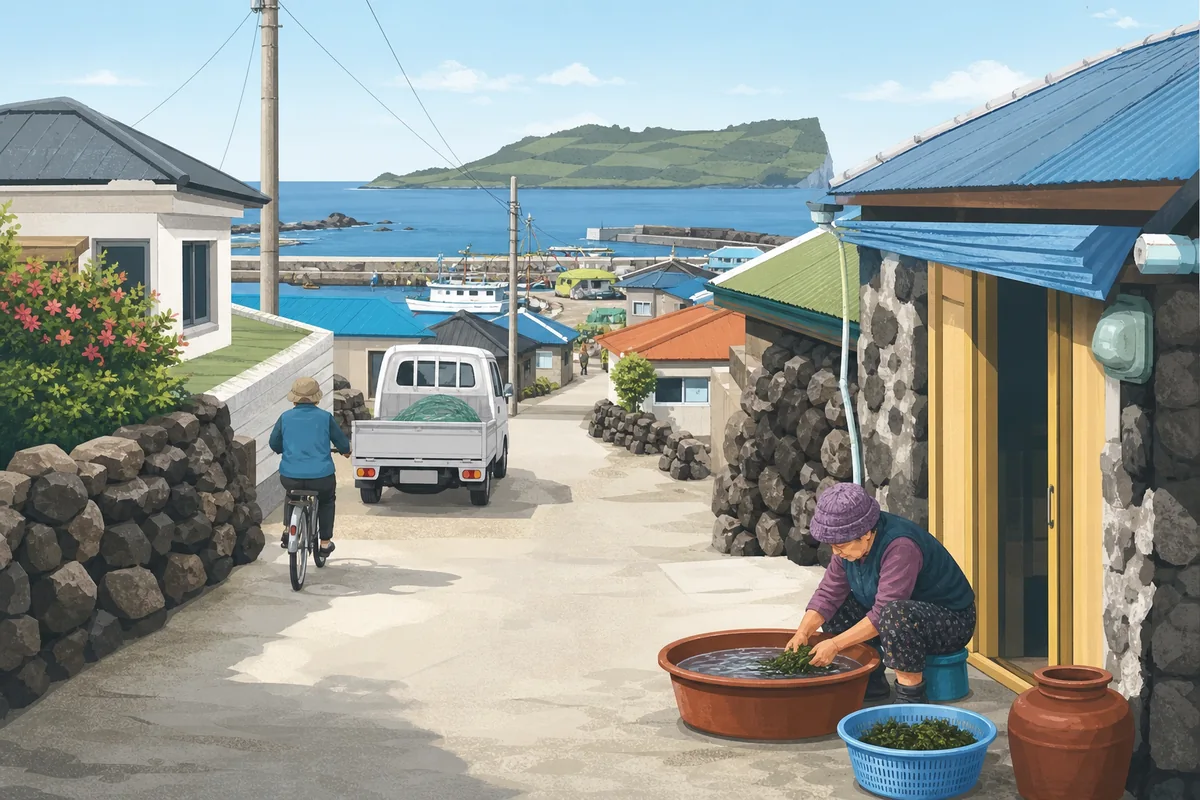
Between the two cities, the coastline is broken up by small villages that have existed for generations. These are not tourist villages built to look traditional. They are working communities where people fish, farm, and live according to the island’s rhythms.
The most distinctive feature of these villages is the stone walls. Built from the same black basalt that covers the island, the walls divide fields, surround houses, and line narrow roads. They are low enough to see over but solid enough to break the wind, which matters enormously in a place where strong seasonal winds roll in from the sea. The walls were built by hand over centuries, and they are one of the clearest signs that Jeju’s landscape is shaped by human effort as much as by geology.
Many coastal villages are also known for their haenyeo — the women divers who free-dive for abalone, sea urchin, and other seafood without oxygen tanks. The haenyeo tradition is centuries old and is now recognized by UNESCO as an intangible cultural heritage. In some villages you can still see haenyeo returning from the sea in the morning, sorting their catch near small stone huts called bulteok where they warm up after diving. This is not a staged performance. It is a livelihood, and it continues today alongside tourism.
Village markets, small seafood restaurants run by local families, and roadside stands selling hallabong tangerines or dried fish are all part of the coastal village experience. None of it requires a tour guide or a reservation. It just requires slowing down enough to notice it.
Jeju island Culture, Language, and Local Traditions
Jeju has its own language — Jejueo — which is distinct enough from standard Korean that mainland Koreans often cannot understand it. It is classified by UNESCO as a critically endangered language, and most fluent speakers are elderly. Younger Jeju residents speak standard Korean, but words and phrases from Jejueo still appear in everyday conversation, in place names, and in local signage.
The island’s mythology is also distinct. Jeju has its own creation story, its own pantheon of local gods, and a shamanistic tradition called musok that has survived alongside mainstream Korean religion. The stone statues called dol hareubang — the squat, wide-eyed figures you see at entrances to villages and tourist sites — are one of the most recognizable symbols of this local spiritual culture. They were traditionally placed at village gates to ward off evil and mark boundaries.
Key Jeju Words to Know
Jeju food is also its own category. The island’s cuisine relies heavily on seafood, black pork (a local breed raised on the island), and seasonal produce like hallabong tangerines, green tea, and various seaweeds. Gogi-guksu, a noodle soup made with pork broth, is a Jeju staple that you will not find in quite the same form on the mainland. Heuk dwaeji, or black pork barbecue, is served at restaurants across the island and is genuinely different from the standard Korean pork barbecue experience — darker meat, richer flavor, and usually cooked over wood charcoal.
Tourism Development and the Island’s Changing Identity
Jeju has been one of South Korea’s top domestic travel destinations for decades, and international tourism has grown significantly since the island introduced a visa-free entry policy for many nationalities. That growth has reshaped parts of the island in visible ways.
The area around Jeju-si’s airport has expanded with hotels, rental car agencies, and chain restaurants. The western coast around Aewol and Hallim has seen a wave of stylish cafes, boutique guesthouses, and design-focused shops that draw visitors specifically for the aesthetic. Some of the island’s most photographed spots — Seopjikoji on the east coast, the Bunjae Artpia garden, the Camellia Hill estate — exist primarily as visitor experiences rather than as part of the island’s working life.
This is not necessarily a problem, but it is worth recognizing. Tourism has brought economic opportunity to an island that historically had limited options. At the same time, rapid development has put pressure on the natural environment, on housing costs for local residents, and on the cultural practices that make Jeju distinctive in the first place. The haenyeo communities, for example, face a generational gap — younger women are not entering the profession at the same rate, partly because tourism has created other economic paths.
The island’s government and cultural organizations are actively working on preservation. But the tension between tourism and local identity is real, and visitors who are paying attention will notice it. The best response is not to avoid tourist areas entirely — some of them are genuinely worth visiting — but to also spend time in the parts of the island that are not performing for an audience.
What First-Time Visitors Should Notice
The most useful shift you can make as a first-time visitor is to stop treating the scenery as a backdrop and start reading it as information. The black walls tell you about the wind and the geology. The oreum hills tell you about volcanic history. The fishing boats pulled up near a village tell you about the tides and the season. The tangerine orchards wrapped in windbreaks tell you about the island’s agricultural economy.
When you drive or take a bus around the island’s coastal road, you pass through the actual texture of Jeju life — not a curated version of it. Small shrines at the roadside, stone walls enclosing fields of green onion or garlic, elderly women selling produce from folding tables, fishing villages where the smell of drying seafood hits you before you see anything. These details are not tourist attractions. They are just the island.
Hallasan is worth orienting yourself by even if you do not hike it. On a clear day you can see it from almost anywhere on the island. It reminds you that everything — the soil, the stone, the shape of the coastline — came from that central mass. The island is not a collection of separate attractions. It is one geological event, still unfolding slowly, and the people who live here have built their lives on top of it.
Give yourself at least four or five days if you want to move beyond the main tourist circuit. Three days is enough to see the highlights. Five days is enough to start understanding the place.
Frequently Asked Questions
What makes Jeju different from mainland Korea?
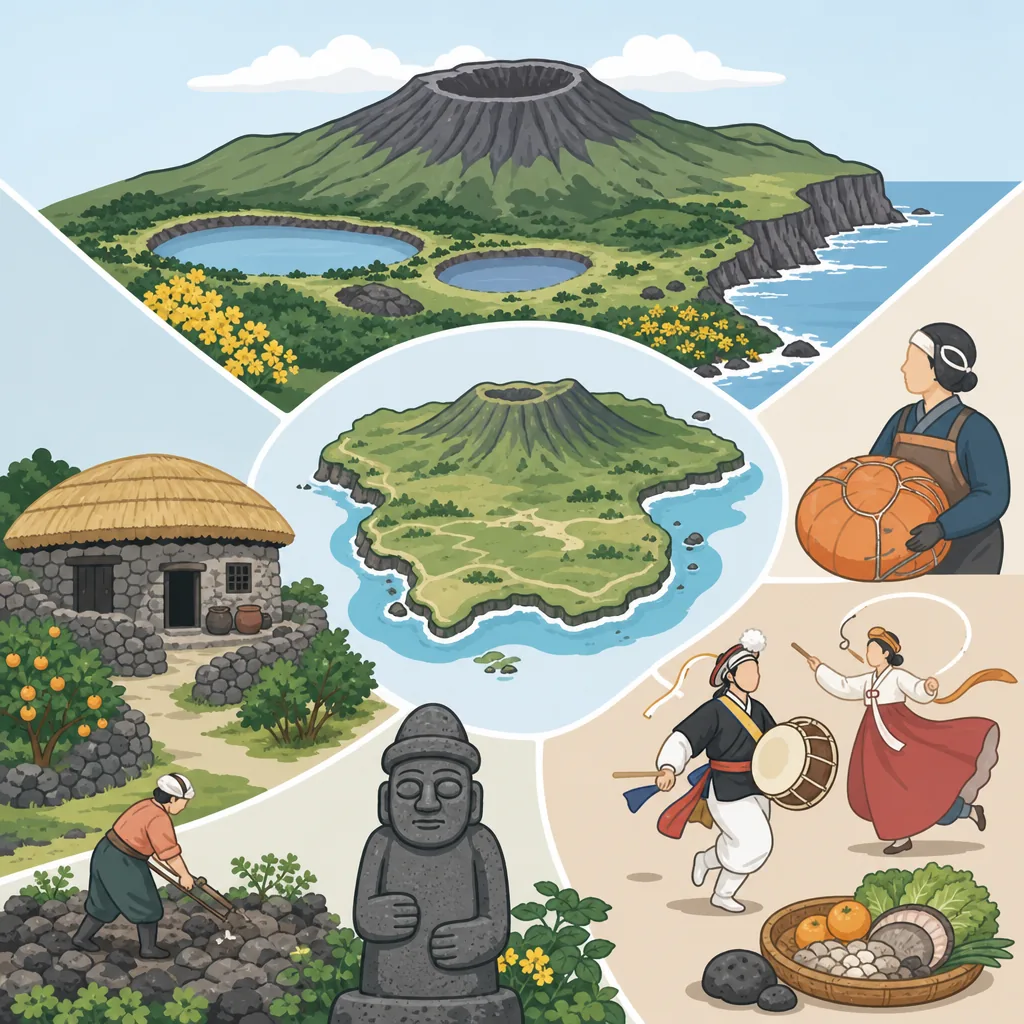
Jeju has its own volcanic landscape, its own dialect (Jejueo), distinct food traditions, and a social history shaped by centuries of geographic isolation. It was historically used as a place of exile and developed independently from the mainland in many ways. The physical environment — black lava rock, oreum hills, haenyeo diving culture, stone walls — is unlike anything on the Korean mainland.
Is Jeju-si the same as Seogwipo?
No, they are quite different. Jeju-si is the northern capital where the airport and main transport connections are located — it is more urban and practical. Seogwipo is on the southern coast, smaller, more resort-like, and surrounded by lush scenery and dramatic waterfalls. The two cities have different atmospheres and serve different purposes for visitors.
Why are there so many stone walls and lava rocks in Jeju?
Jeju is a volcanic island built from basalt, so lava rock is literally the ground beneath everything. The stone walls were built over centuries from this same material to divide fields, shelter crops from wind, and mark property boundaries. They are functional structures that reflect the island’s geology and its farming history — not decorative features added for tourists.
Is Jeju only for beach vacations?
Not at all. The beaches are real and worth visiting, but Jeju also offers volcanic hiking (including Hallasan), oreum hill walks, coastal village exploration, haenyeo culture, traditional markets, local food experiences, and a distinct cultural identity that has nothing to do with beach tourism. Many visitors who come for the beaches end up spending most of their time inland or in the island’s villages.
Jeju More Than Vacation Island becomes easier to handle when you recognize the situation and follow the practical steps above.
Jeju More Than Vacation Island becomes easier to handle when you recognize the situation and follow the practical steps above.
Note: This guide is for travel navigation in Korea. It is not medical, legal, or emergency professional advice. For urgent situations, contact local emergency services, official staff, or your embassy/consulate as appropriate.
Sources & Verification
- VISITKOREA – Imagine Your Korea — english.visitkorea.or.kr
Last checked: July 30, 2026