Visit Clinic Hospital Korea: What You Need to Know
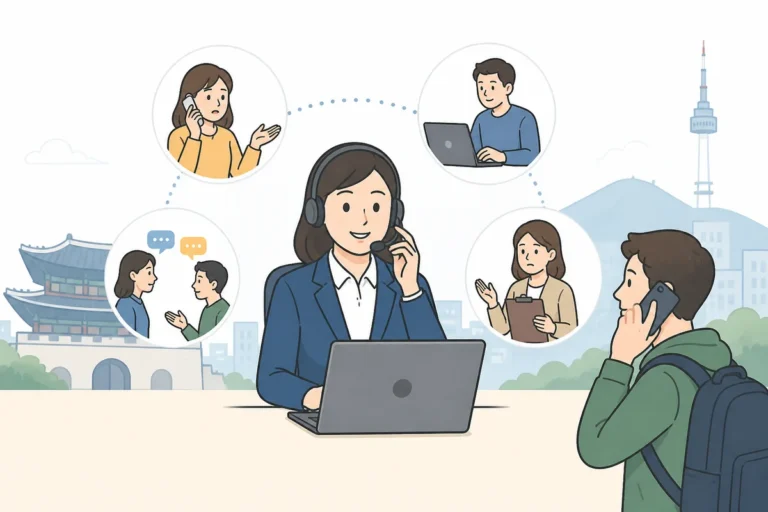
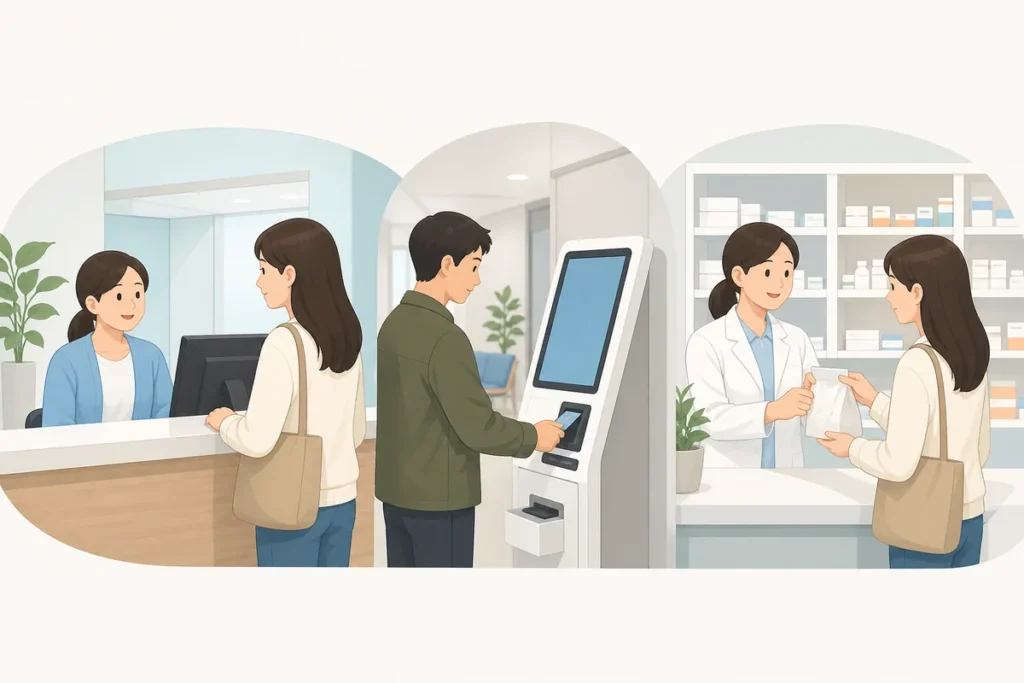
If you need a clinic or hospital in Korea, go to reception, show your passport or ID, and describe your symptom in simple words. After the doctor’s visit, pay at the payment desk, collect your prescription slip, and take it to a separate pharmacy — usually just outside the building or nearby on the same street.
What to Do First
- Bring your passport (or alien registration card if you have one)
- Find the reception desk — look for the sign 접수 (jeop-su)
- Tell staff your main symptom in one simple phrase or show it on your phone
- Wait to be called for your appointment (진료, jil-lyo)
- After the visit, go to the payment desk — look for 수납 (su-nap)
- Collect your prescription slip (처방전, cheo-bang-jeon) if the doctor gives one
- Walk to a nearby pharmacy (약국, yak-guk) and hand over the prescription
When This Guide Helps
If you need a clinic or hospital in Korea, the normal flow is simple: check in at reception, show your ID, explain your symptom briefly, pay after the visit, and take any prescription to a separate pharmacy. This guide walks you through that process in plain English.
This is for visitors handling a non-emergency clinic or hospital visit, such as a cold, stomach discomfort, a minor injury, or a skin issue. It does not replace a doctor’s judgment or tell you what treatment to choose. For a serious emergency, call 119 in Korea.
Clinic vs. Hospital: A Simple Starting Point
For most everyday issues, a local 의원 (ui-won), or small clinic, is the easiest place to start. These are common in neighborhoods and usually faster to use for a first visit.
A 병원 (byeong-won) is a hospital, and a 대학병원 (dae-hak-byeong-won) is a larger university hospital. Those are more useful for specialist departments or more complex care. If your issue is straightforward, a clinic is usually the practical first stop.
Some places in busy districts have English forms or staff who can help in basic English. Even when they do not, the front-desk process is usually manageable if you know the main steps and a few Korean words.
The Step-by-Step Flow Inside a Clinic or Hospital
Step 1 — Reception (접수)
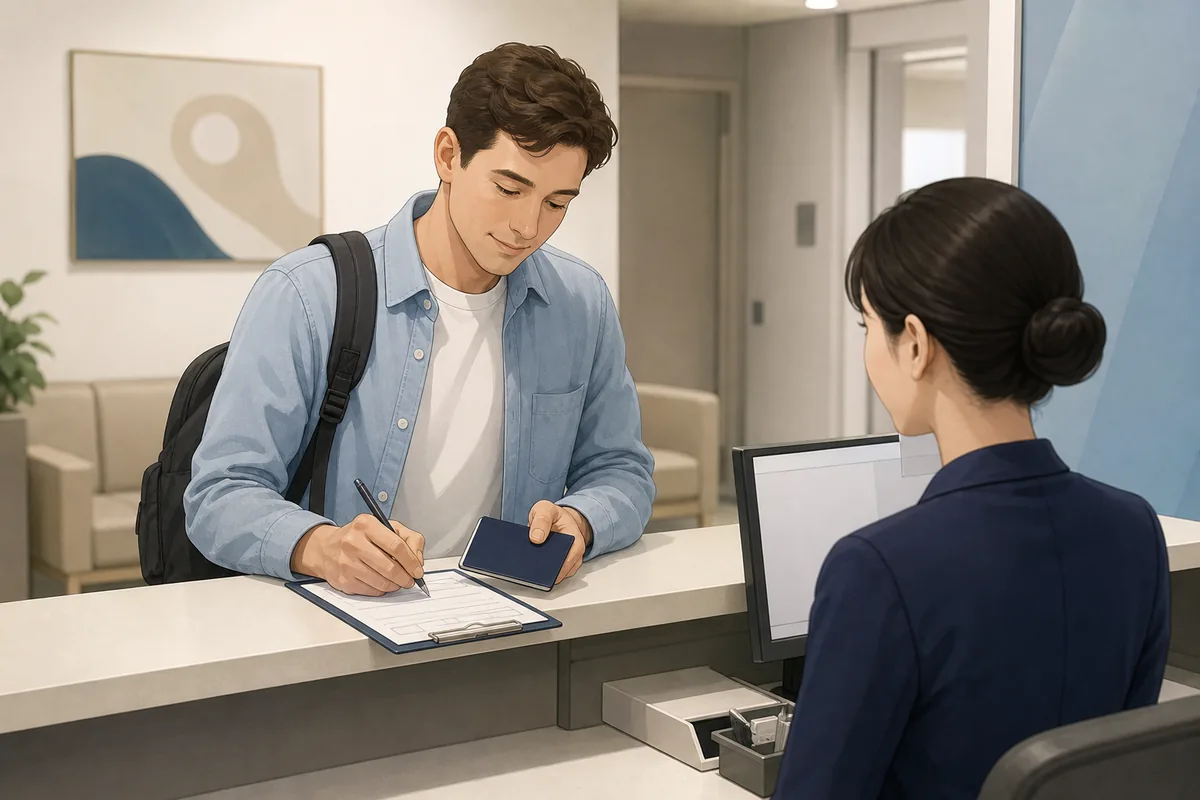
Walk in and find the front desk. The sign usually says 접수. Show your passport or other ID, then give a short description of why you came. If you have travel insurance, keep your documents ready, but you will usually still pay at the facility first.
Staff may ask you to write your name, birth date, and phone number on a form. Some clinics have English forms, while others do not. Reception staff usually guide you through it and tell you where to sit.
Step 2 — The Appointment (진료)
When your name or number is called, go to the doctor’s room. Speak slowly and use short phrases. Point to the area if that helps. If you want English, you can say “영어로 말씀해 주세요” (yeong-eo-ro mal-sseum-hae ju-se-yo), which means “Please speak in English.”
The doctor will ask questions and decide what to do next. That may include a test, a follow-up visit, or a prescription. Your job is just to answer clearly and follow the front-desk instructions.
Step 3 — Payment (수납)
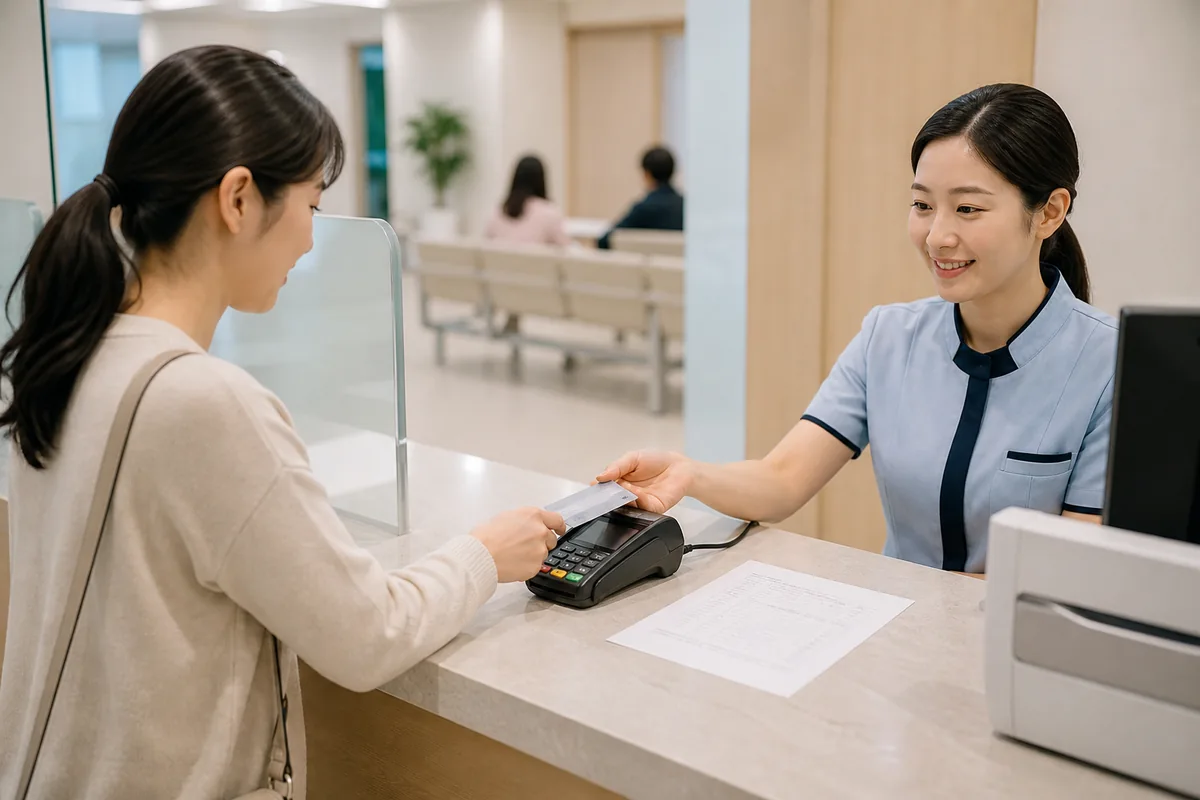
After the visit, return to the payment desk, marked 수납. The staff will print your bill. Visitors usually pay the clinic or hospital directly, by card or cash. Ask for a receipt with “영수증 주세요” (yeong-su-jeung ju-se-yo).
Keep the receipt if you need it for travel insurance or your own records. If you have questions about the amount, ask the desk staff before you leave the counter.
Step 4 — Prescription Slip (처방전)
If the doctor gives medicine, you will receive a printed prescription slip called 처방전 (cheo-bang-jeon). Keep it safe. This paper is what you take to the pharmacy.
Step 5 — The Pharmacy (약국)
Look for 약국 nearby. In Korea, pharmacies are usually separate from the clinic or hospital, often right next door or on the same street. Hand the prescription slip to the pharmacist. Then pay the pharmacy separately and receive the medicine there.
If you do not see a pharmacy inside the building, that is normal. Step outside and look for the 약국 sign at street level.
Korean Phrases You Can Show
You can show these directly on your phone screen at the desk or to the doctor.

Useful Korean Signs or Words
These are the signs you will actually see on walls, doors, and desks inside a Korean clinic or hospital.
Where to Get Help
The Korea Tourism Organization (KTO) helpline at 1330 has English-speaking staff and can help you find a nearby clinic or hospital, explain basic directions, or point you to a foreigner-friendly facility.
Many large hospitals also have an International Patient Center. If you see that sign, it is a useful place to start for paperwork and language support.
If you are staying in a hotel, the front desk can often suggest the nearest clinic or pharmacy and help you with the location name in Korean.
Common Mistakes
- Forgetting your passport. Bring it for registration.
- Leaving without the prescription slip. You need 처방전 for the pharmacy.
- Looking for the pharmacy inside the clinic. It is usually separate.
- Not asking for a receipt. Say 영수증 주세요 at the payment desk.
- Assuming English will be automatic. Keep your symptom in short, simple words and be ready to show text on your phone.
Visit Clinic Hospital Korea becomes easier to handle when you recognize the situation and follow the practical steps above.
Visit Clinic Hospital Korea becomes easier to handle when you recognize the situation and follow the practical steps above.

FAQ
Does a visitor need a visitor’s passport at a clinic in Korea?
Yes. For visitors, a passport is the standard ID for check-in. Bring it to the reception desk and keep it with you during the visit.
Does a visitor pay at the hospital or the pharmacy in Korea?
Usually both, separately. First you pay the clinic or hospital at 수납. Then you pay the pharmacy when you pick up the medicine.
What does 접수 mean at a hospital in Korea?
접수 means reception or check-in. It is the first desk you visit when you arrive.
Can a visitor go straight to a pharmacy in Korea without a prescription?
For prescription-only medicine, no. You need a 처방전 from a doctor first. For many basic over-the-counter items, you can ask the pharmacist directly.
Note: This guide is for travel navigation in Korea. It is not medical, legal, or emergency professional advice. For urgent situations, contact local emergency services, official staff, or your embassy/consulate as appropriate.
Sources & Verification
- VISITKOREA – Imagine Your Korea — english.visitkorea.or.kr
- Consumer Policy – Fair Trade Commissio — www.ftc.go.kr
Last checked: July 30, 2026