Weather Alert Messages in Korea Explained: Heat, Heavy Rain, Cold Waves
Weather alerts Korea sends to your phone can look urgent, especially if they arrive in Korean with a loud alarm sound. The good news is that the message format is usually simple. Once you know a few core words, you can understand the alert in seconds.
This guide explains the most common Korean weather warning messages, what they mean in plain English, how serious they usually are, and what to do next. You do not need to read Korean fluently to use it.
Quick Answer
If your phone just buzzed with weather alerts Korea uses for emergencies, look for one of these words: 폭염 (heat), 호우 (heavy rain), or 한파 (cold wave). The word 주의보 means advisory, while 경보 means warning. Check the official Korea Meteorological Administration website for live updates.
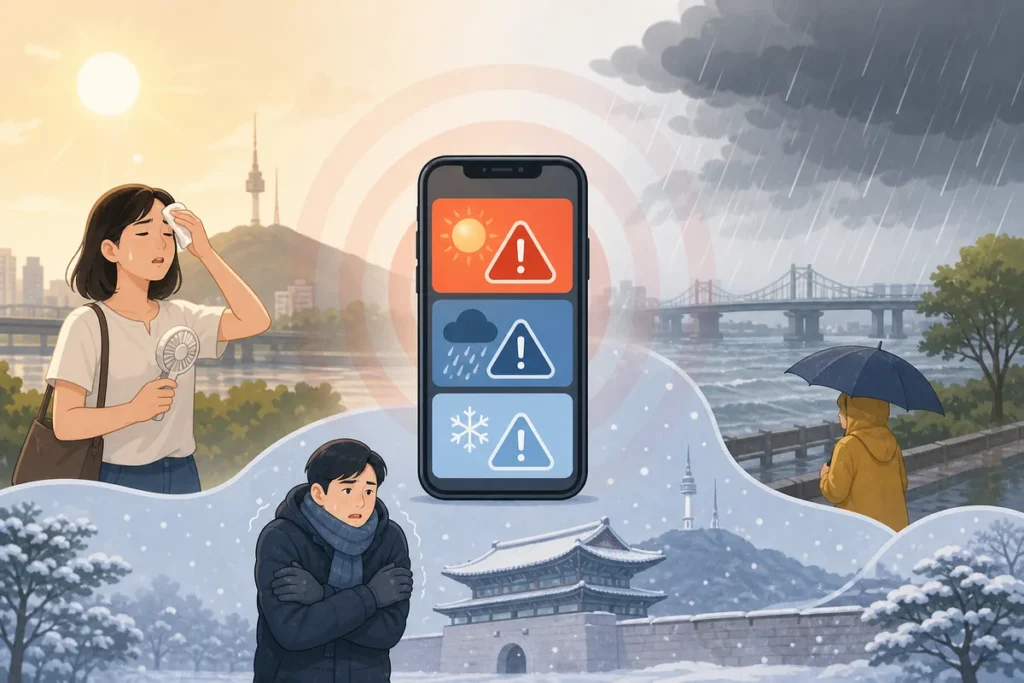
Table of Contents
- How Korean Weather Alerts Work
- Advisory vs. Warning
- What weather alerts Korea messages mean by hazard type
- Real message examples
- What foreigners often get wrong
- Useful Korean phrases
- Warnings and things to check
- FAQ
- Summary
How Korean Weather Alerts Work
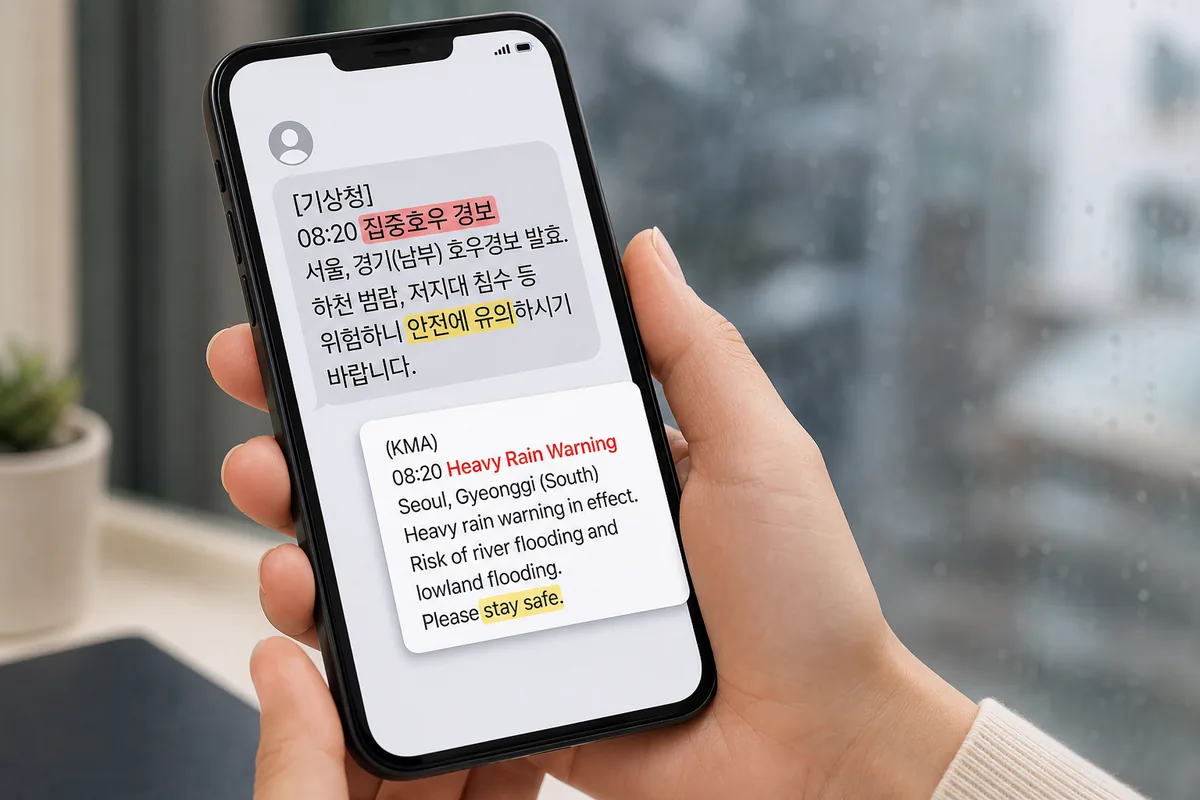
Korea uses a national emergency alert system managed by the Ministry of the Interior and Safety and the Korea Meteorological Administration. When a significant weather event is expected, your phone may receive a 재난문자 (disaster text message). These alerts can reach local phones, including many foreign SIM cards and roaming devices.
The message usually includes four parts:
- Hazard type — heat, rain, cold, wind, or another weather risk
- Affected area — a city, district, or province
- Timing — when the alert starts or how long it may last
- Recommended action — a short instruction such as avoid outdoor activity or stay away from low-lying areas
Local governments may use slightly different wording, but the core meaning is usually the same.
Advisory vs. Warning
Korean weather alerts usually use two main levels. Understanding them helps you decide how urgently to respond.
Think of 주의보 as a yellow light and 경보 as a red light. A warning does not always mean immediate danger at that second, but it does mean the situation is serious.

What weather alerts Korea messages mean
Heat Wave Alerts: 폭염주의보 and 폭염경보
A heat wave alert means temperatures are expected to stay dangerously high for several days. The heat may feel even worse because of humidity.
- 폭염주의보: heat advisory
- 폭염경보: heat warning
- Stay hydrated, limit outdoor time, and use air-conditioned spaces if possible.
- Check on older adults, children, and anyone who may be vulnerable to heat.
Try to avoid long walks, hiking, cycling, or other outdoor activities during the hottest part of the day.
Heavy Rain Alerts: 호우주의보 and 호우경보
Korea’s monsoon season and typhoon periods can bring intense rain. Heavy rain alerts are important because flooding can happen fast.
- 호우주의보: heavy rain advisory
- 호우경보: heavy rain warning
- Avoid underpasses, flooded roads, rivers, and drainage channels.
- Expect transport delays and possible station or road closures.
- If you are on a hillside, be aware of landslide risk.
Do not walk through moving water. Even shallow flooding can be more dangerous than it looks.
Cold Wave Alerts: 한파주의보 and 한파경보
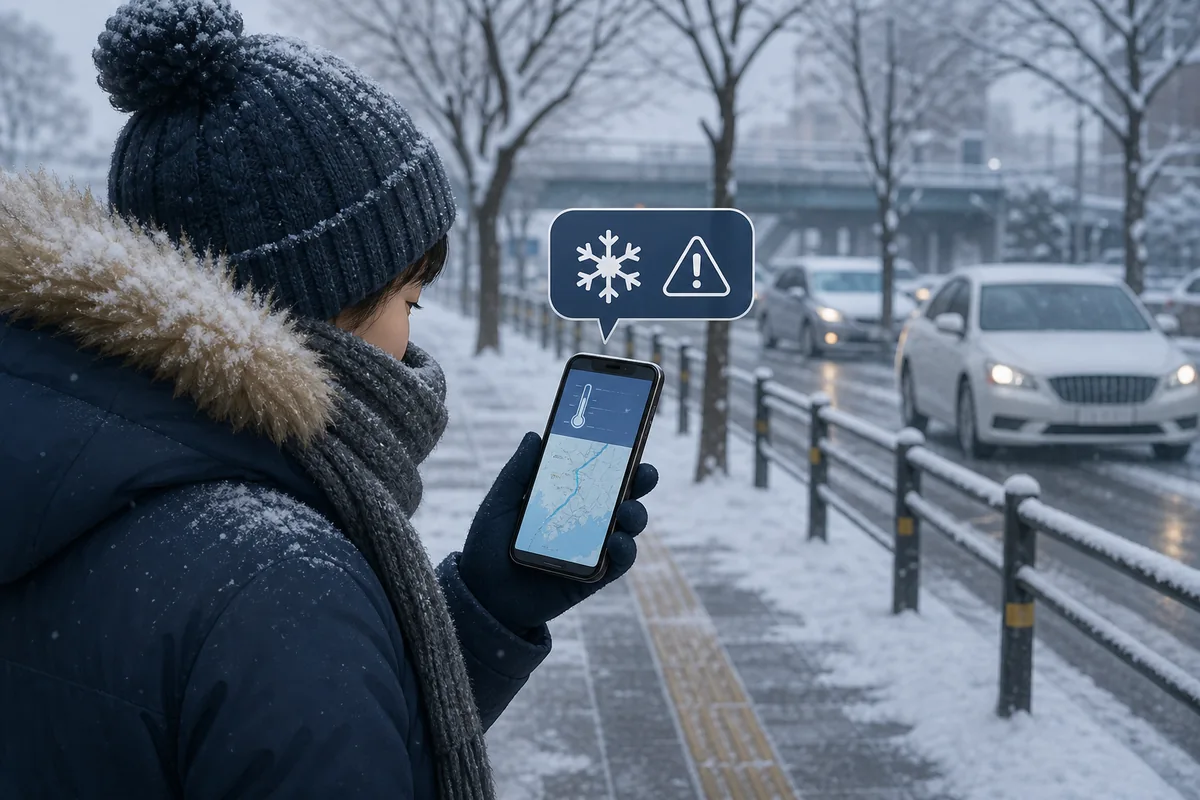
Cold wave alerts warn of a sharp temperature drop and possible ice-related hazards. Wind chill can make the weather feel much colder than the number on your phone.
- 한파주의보: cold wave advisory
- 한파경보: cold wave warning
- Dress in layers, cover exposed skin, and walk carefully on icy ground.
- Watch for black ice even when there is no snow.
- Some outdoor attractions and mountain routes may close temporarily.
Real Message Examples You Might See
These are simplified examples of the kind of text message a foreigner might receive. Exact wording can vary by city or district.
Example 1 — Heat advisory:
[서울특별시] 폭염주의보 발효 중. 낮 시간대 야외활동을 자제하시고 물을 자주 드세요.
Simple meaning: Heat advisory in effect. Avoid outdoor activity during the day and drink water often.
Example 2 — Heavy rain warning:
[부산광역시] 호우경보 발령. 저지대 및 침수 위험지역 접근을 삼가세요.
Simple meaning: Heavy rain warning issued. Avoid low-lying and flood-prone areas.
Example 3 — Cold wave advisory:
[경기도] 한파주의보. 빙판길 낙상에 주의하시고 외출 시 보온에 유의하세요.
Simple meaning: Cold wave advisory. Be careful of slips on icy roads and stay warm outside.
You do not need to understand every word. The hazard word and the level word are usually enough to tell you what to do.
What Foreigners Often Get Wrong
- Ignoring the alert. These messages are official and should be taken seriously.
- Relying only on a translation app. Machine translation can miss important details. Use official sources too.
- Thinking it is immediate danger right now. Many alerts are advance warnings, which gives you time to respond calmly.
- Assuming the alert covers all of Korea. Most alerts name a specific area, so check whether your location is included.
- Underestimating humidity in summer. Heat alerts in Korea can feel worse than the temperature number suggests.
Useful Korean Phrases for Weather Alerts
Warnings and Things to Check
- Confirm live alert status through the Korea Meteorological Administration or official government sources.
- Use the National Disaster and Safety Portal for official safety information.
- If you witness flooding, injury, or a person in distress, call 119 for fire and emergency services or 112 for police.
- Do not rely only on translation apps during severe weather.
- Roaming phones may receive alerts differently from local phones, so check official updates during severe weather seasons.
FAQ
Will I receive Korean weather alerts on my foreign phone?
Usually yes, if your phone is connected to a local Korean network. However, reception can vary by device, SIM type, or network settings, so it is still wise to check official sources.
Is a weather alert an emergency?
It can be. Some alerts are advisories, while others are warnings. Either way, they mean you should pay attention and adjust your plans.
Do I need to stay indoors for every alert?
Not always. An advisory may only require caution. A warning usually means you should reduce unnecessary travel and avoid the most dangerous areas.
What if I cannot read the message fully?
Look for the hazard word and the level word first. In most cases, that is enough to understand the main risk and the urgency.
Summary
For weather alerts Korea sends to your phone, the fastest way to read the message is to find the hazard word and the alert level. 폭염 means heat, 호우 means heavy rain, and 한파 means cold wave. 주의보 means advisory, while 경보 means warning. Check official updates, follow local safety guidance, and adjust your plans quickly when needed.