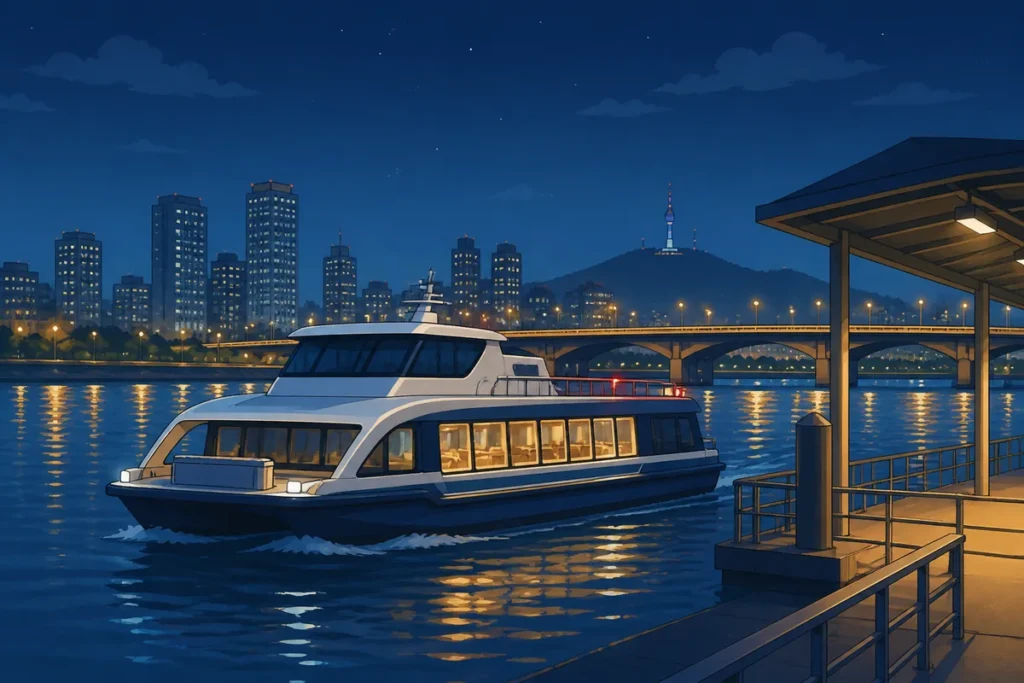
Hangang Bus night service connects a limited number of piers along the Han River after sunset, with added evening runs from August 15, 2026. It works as real point-to-point transport only when your starting pier and destination pier are on the same route. Check the timetable for your pier before you go. There is no single universal last boat: departure times differ by route and pier.
Hangang Bus night service is useful if you want a riverside way to move between a few Seoul piers after sunset, but it is not a substitute for the subway in every area. The real question is not “Can I ride it?” but “Which pier connects to where, and is there still a boat running on my date?” Check www.arex.or.kr official information for the current details.
Which Piers Work for Night Rides, and Where They Go
Hangang Bus currently operates on a route structure that links key riverside piers rather than running like a loop bus that stops everywhere. The main piers in service include Yeouido, Mapo, Ttukseom, and Jamwon, with Yeouido acting as the central hub most visitors pass through. Not every pier connects to every other pier in a single ride.
The practical way to think about it: each route has a defined start and end. If you are at Ttukseom and want to reach Yeouido, that connection exists. If you are at Mapo and want to reach Jamwon directly, check whether that pairing is on the schedule — it may require a transfer at Yeouido or may not be available as a direct run.
A common misunderstanding among first-time riders is treating Hangang Bus like Seoul Metro, where you board at any station and transfer freely to reach any other station. That logic does not apply here. Each pier serves specific routes, and arriving at the wrong pier for your intended destination means you are stuck — there is no cross-platform transfer on the river.
Before planning an evening trip, map your actual start pier and destination pier, then confirm that a direct route exists between them on the official Seoul Hangang Bus schedule published by Seoul Metropolitan Government.
How the Evening Add-On Service Differs from the Last Boat
From August 15, additional evening runs are added to the existing timetable. These are not a separate night-only service — they extend the operating window by inserting extra departures in the later evening hours, which means more options after sunset without necessarily pushing the final departure much later.
The last boat and the added evening runs are two different things. The added runs give you more frequency during the early-to-mid evening window, which is genuinely useful if you are coming from dinner or a riverside park and want to avoid the post-sunset rush. The last departure, however, is still a hard cutoff. Miss it and there is no next boat until the following morning.
Because the last departure time varies by route and pier, there is no single answer to “when is the last Hangang Bus?” Yeouido departures may have a different final run than Ttukseom departures. Confirm the last departure for your specific pier and route — not just the general service end time — on the official Seoul Hangang Bus timetable.
How to Use It as Real Transport, Not Just Sightseeing
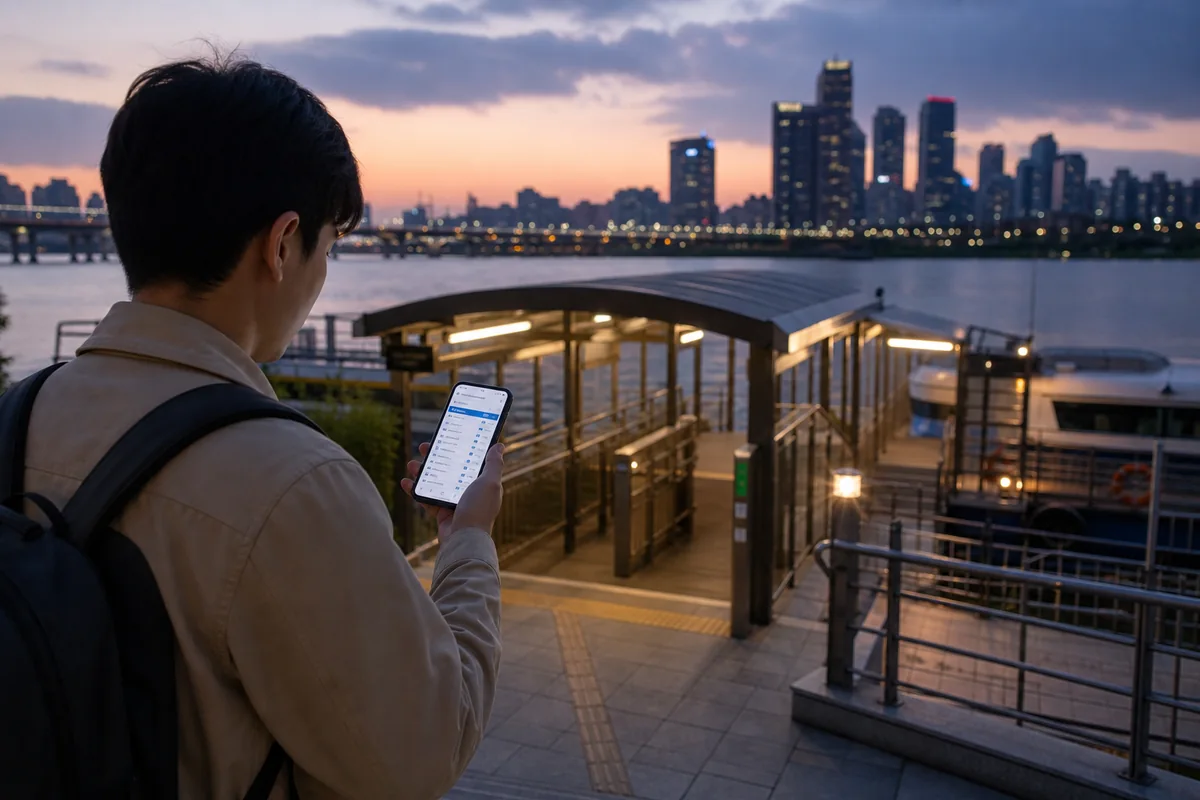
Hangang Bus works as practical transport when your origin and destination both happen to be pier-adjacent — meaning you can walk to a pier from where you are, and your destination is within walking distance of the arrival pier. That is a narrower set of situations than it sounds.
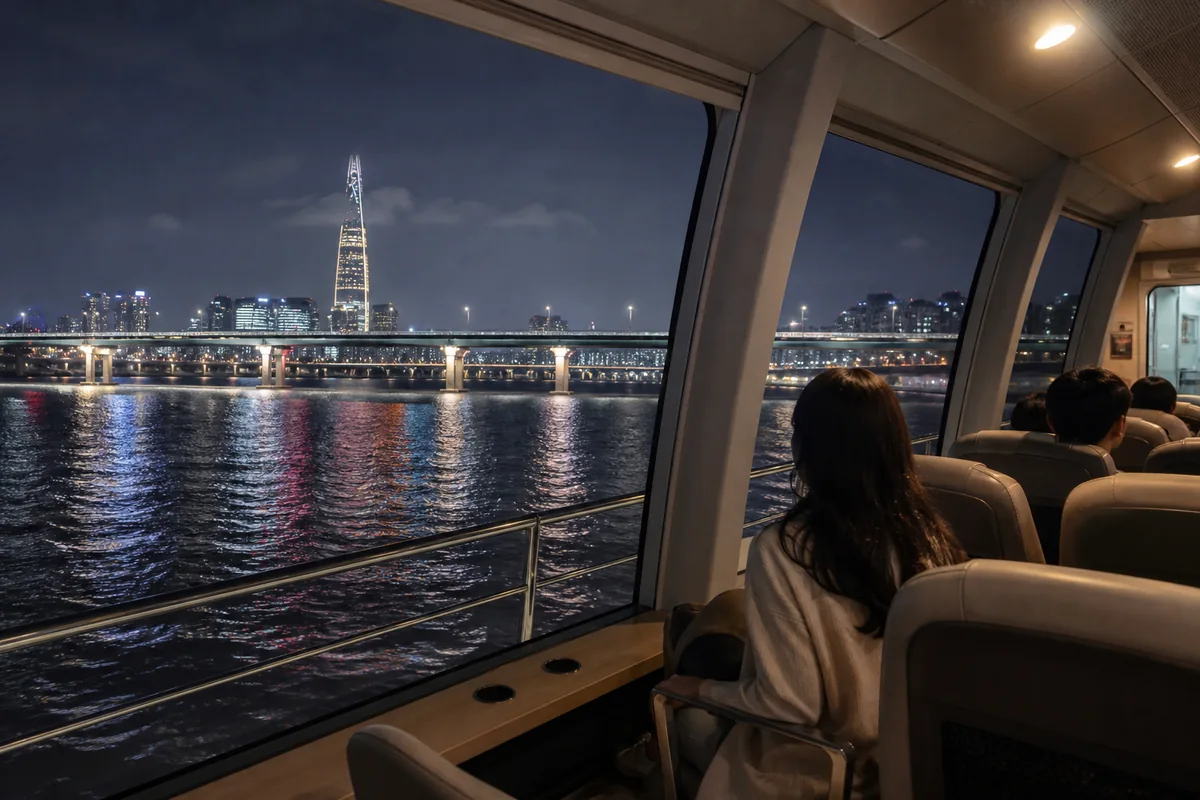
Yeouido to Ttukseom is a good example of a route that makes sense as transport. Both areas have subway access, but the boat ride is faster than going underground and switching lines, and in the evening the river view is a genuine bonus. Mapo to Yeouido is another workable pairing for someone already near the riverside in Mapo.
Where it breaks down as transport: if your hotel or destination is not close to a pier, the walk or taxi to reach the pier eats the time advantage. At that point you are riding for the experience, which is fine — just go in with that expectation.
Seat reservations apply. Hangang Bus is not a walk-up-and-board situation for every departure, especially on weekend evenings. If you are treating it as transport for a specific plan — catching a show at Yeouido, for example — book in advance through the official Seoul Hangang Bus reservation system rather than assuming space will be available.
Getting to the Pier: Subway, Walking, and Transfer Reality
Each pier has a different access situation, and the gap between “subway station nearby” and “actually at the pier” can be longer than it looks on a map.
Yeouido Pier is the most accessible. From Yeouinaru Station (Line 5), exit 3 or 4 leads toward the riverside park. The walk to the pier takes roughly 10 minutes depending on which part of the park the pier entrance is located. Follow signs for 한강버스 선착장 (Hangang Bus pier).
Ttukseom Pier sits near Ttukseom Resort Station (Line 7). The riverside area is close, but the pier is inside Ttukseom Hangang Park, so follow park signage once you exit the station.
Mapo Pier is accessible from Mapo Station (Line 5) or Gongdeok Station (Lines 5, 6, Airport Railroad), though the walk from either station to the riverside is not short. A short taxi ride from the station to the pier entrance saves time if you are running close to departure.
Jamwon Pier is near Sinbanpo Station (Line 9) or Express Bus Terminal Station (Lines 3, 7, 9). The pier is inside Banpo Hangang Park, and the walk from the station takes around 10–15 minutes.
One practical note: riverside parks in Seoul are large and the pier is not always at the park entrance. If you are arriving at night, the park lighting is good on main paths, but allow extra time to find the exact pier location rather than assuming you will see it immediately from the subway exit.
Korean Signs and Words to Look For at the Pier
Korean Phrases You Can Show to Staff
What Can Go Wrong
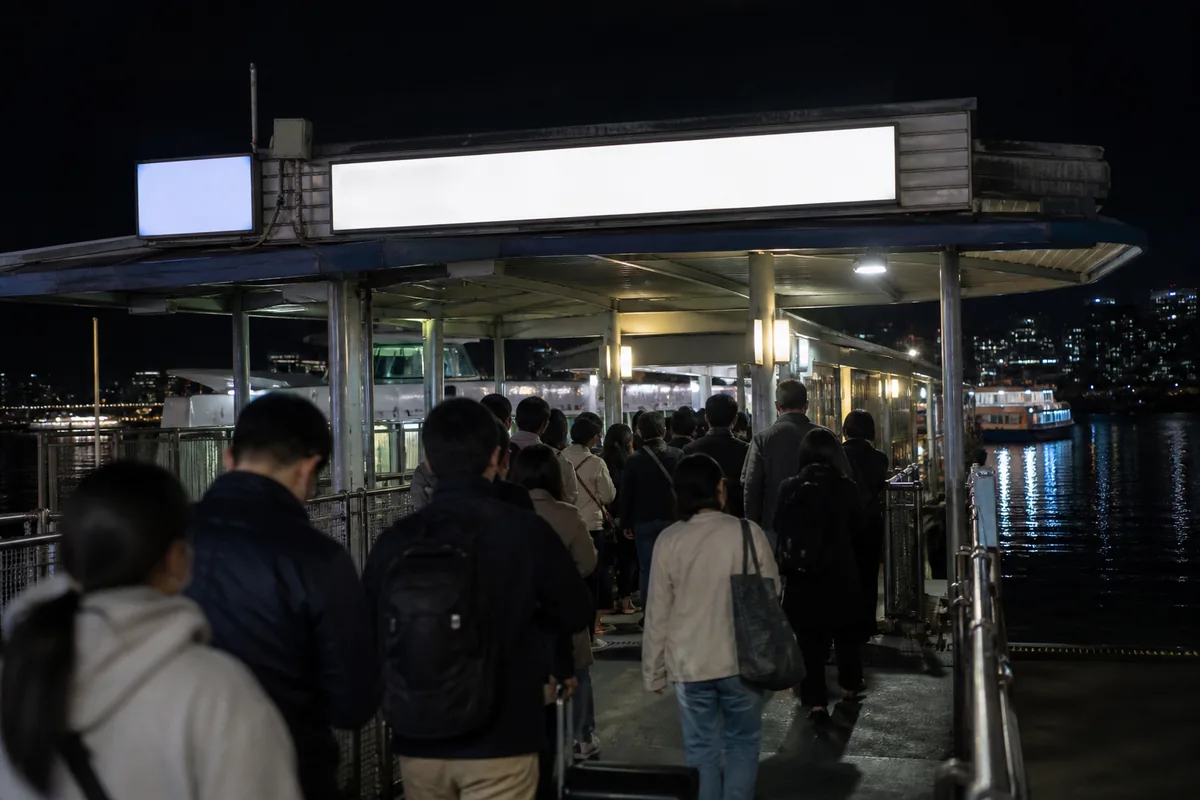
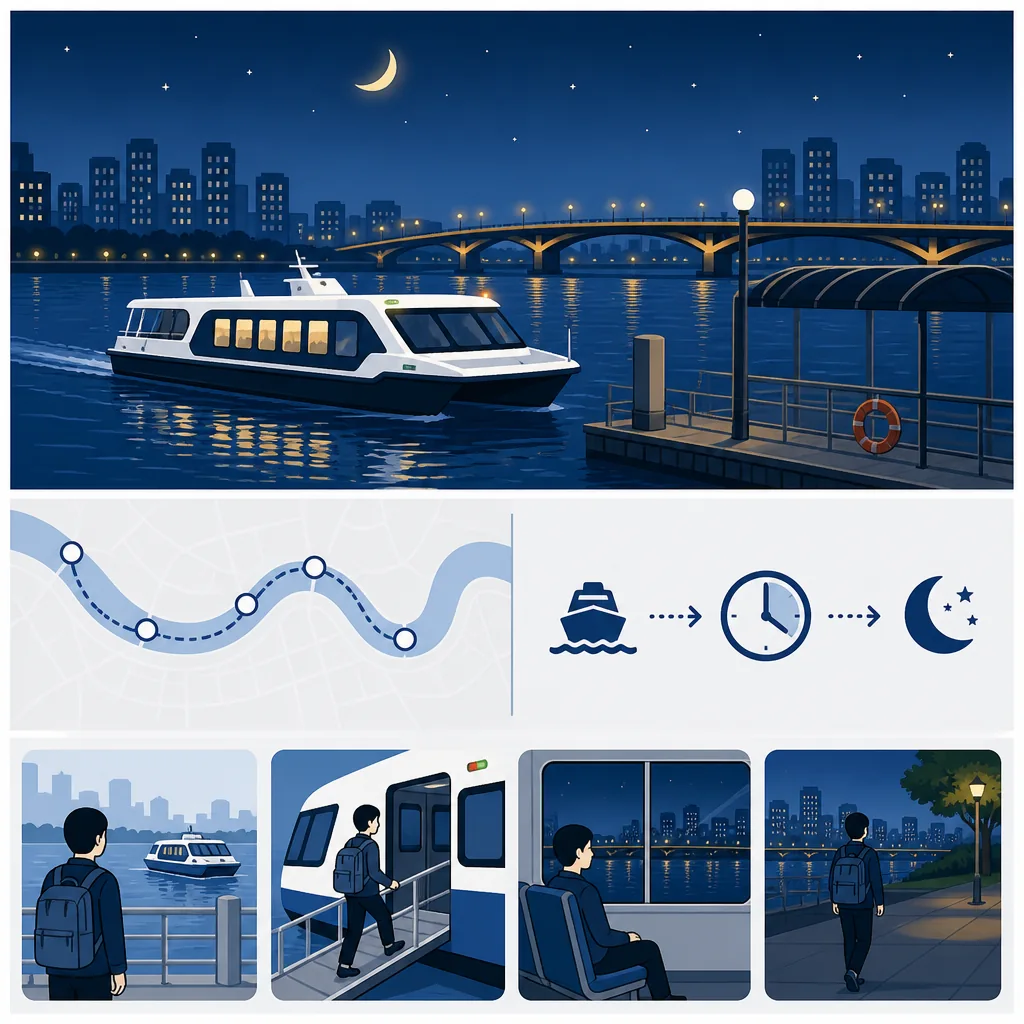
The most common problem is arriving at a pier that does not serve your destination. If you walk 15 minutes through a riverside park at night and discover the boat at that pier goes somewhere you do not want, you have lost both time and energy. Confirm the route before leaving your hotel, not at the pier.
Sold-out seats on weekend evenings are real. The boats have limited capacity, and the added evening runs from August 15 are popular. If you plan to ride after 7 or 8 PM on a Friday or Saturday, booking a day or two ahead is the safer move. Walk-up tickets exist but are not guaranteed.
Missing the last boat is a harder problem than it sounds because the piers are inside riverside parks, not next to taxi stands. If you miss the last departure, walk back to the nearest subway exit or find a road where you can call a taxi through Kakao T. The walk out of the park at night is fine — the parks are lit and generally safe — but it adds 10–20 minutes to your journey.
One more thing: some visitors assume all piers are open for boarding at all hours. A pier may be staffed only during operating hours. If you arrive early hoping to wait inside a terminal building, the facility may not be open yet.
- Confirm your start pier and destination pier are on the same route
- Check the timetable for your specific pier — not just the general service hours
- Note the last departure time for your route
- Book your seat in advance if riding on a Friday, Saturday, or holiday evening
- Allow 10–15 minutes extra to walk from the subway exit to the pier inside the park
- Have the Kakao T app ready in case you need a taxi after the last boat
Official Timetable and Route Check Before You Go
The timetable effective August 15, 2026 is published by Seoul Metropolitan Government through the official Hangang Bus information channels. Route maps, pier-specific schedules, and reservation links are available there. Because departure times and available routes can change — especially with seasonal adjustments — check the schedule within 24 hours of your planned trip, not just when you first research it.
If you cannot read the Korean timetable, the route map uses pier names in both Korean and English, and the departure columns are numeric, so the time grid is readable without Korean language ability.
For reservation issues or questions about a specific route, the pier staff at Yeouido — the main hub — can usually help in basic English or by pointing to a printed schedule. Arriving at the pier 20–30 minutes before your intended departure gives you time to sort out any confusion without risking the boat.
Which Hangang Bus pier goes to Yeouido at night?
Yeouido is the central hub, so multiple piers connect to it — including Mapo, Ttukseom, and Jamwon. The direction matters: confirm whether your pier has a departure toward Yeouido in the evening hours, not just during daytime. Check the pier-specific timetable on the official Seoul Hangang Bus schedule.
What time is the last Hangang Bus after sunset?
There is no single last-boat time that applies to all piers. Each route has its own final departure, and the times differ between Yeouido, Ttukseom, Mapo, and Jamwon. Look up the last departure for your specific pier and direction on the official timetable before leaving.
Is Hangang Bus useful as transportation or only for sightseeing?
It works as real transport when both your starting point and destination are close to a pier. Yeouido–Ttukseom and Mapo–Yeouido are practical pairings. If your hotel or destination is not near a pier, the access walk reduces the time benefit and it becomes more of an experience ride — which is still enjoyable, just go in knowing that.
How do I get to a Hangang Bus pier from the subway?
Each pier has a closest station: Yeouido Pier from Yeouinaru Station (Line 5), Ttukseom Pier from Ttukseom Resort Station (Line 7), Mapo Pier from Mapo or Gongdeok Station (Line 5), and Jamwon Pier from Sinbanpo or Express Bus Terminal Station (Line 9). The walk from the station exit to the pier inside the riverside park takes 10–15 minutes at most locations — build that into your timing.
Do I need to check the timetable for each pier separately?
Yes. The schedule is pier-specific and route-specific. The general service hours printed on promotional material do not tell you when the last boat leaves from your pier in your direction. Go to the official Seoul Hangang Bus timetable, select your departure pier, and read the evening columns for your route.
Note: This guide is for travel navigation in Korea. It is not medical, legal, or emergency professional advice. For urgent situations, contact local emergency services, official staff, or your embassy/consulate as appropriate.
Related Korea Guides
Sources & Verification
- AREX 공항철도 — www.arex.or.kr
Last checked: August 14, 2026