Quick Answer
24 hour businesses became common in Korea because dense city life, convenience store culture, delivery demand, and shift-work schedules created strong overnight demand for decades. That said, the picture is changing: some industries are cutting back on all-night hours as labor costs rise and foot traffic thins. Convenience stores, delivery apps, and jjimjilbangs remain the most reliable overnight options — but always check the specific location before heading out late.
Quick Rule
- Assume convenience stores are open 24 hours, but confirm individual franchise branches on Naver Map or Kakao Map.
- Use delivery apps (Baemin, Coupang Eats) late at night — many restaurants that close their doors still take orders.
- Check jjimjilbang hours directly; most are 24 hours, but a growing number now close between 2 a.m. and 6 a.m.
- Nightlife neighborhoods like Hongdae, Itaewon, and Sinchon have more all-night options than residential areas.
- Do not assume a business is open all night just because it was last time — hours change, especially after holidays or policy shifts.
- Look for the 24시 sign (24 hours) on storefronts; its absence usually means limited hours.
Why 24-hour businesses became common in Korea
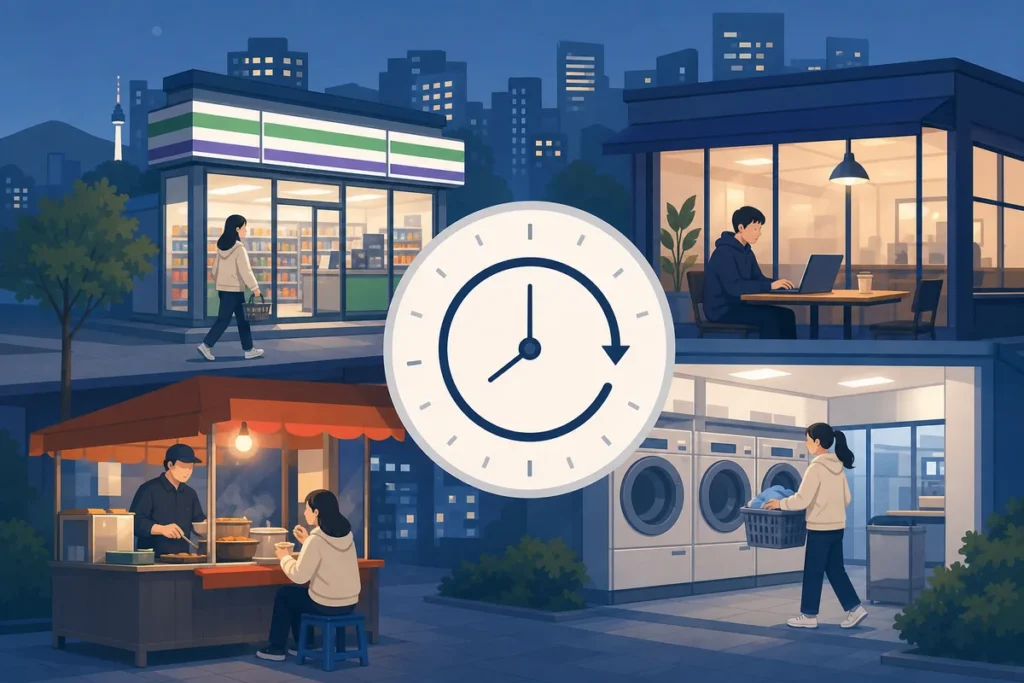
24 hour businesses grew out of practical demand more than romance or tradition. Cities like Seoul, Busan, and Incheon packed millions of people into dense urban grids where factories, hospitals, call centers, and service industries ran around the clock. Workers finishing late-night shifts needed food, transport, and somewhere to wash up — and businesses followed that demand.
The 1988 Seoul Olympics accelerated urban development and consumer infrastructure. Convenience store chains expanded fast through the 1990s and 2000s, and delivery culture grew alongside smartphone adoption in the 2010s. By the time foreign visitors started noticing the all-night streetscape, it had been building for decades.
High population density also matters. When a neighborhood has tens of thousands of residents within walking distance, even a small percentage of night owls represents enough customers to keep a store profitable at 3 a.m. That math works in Seoul’s core districts in a way it simply doesn’t in smaller towns.
Convenience stores: the clearest example of 24 hour businesses
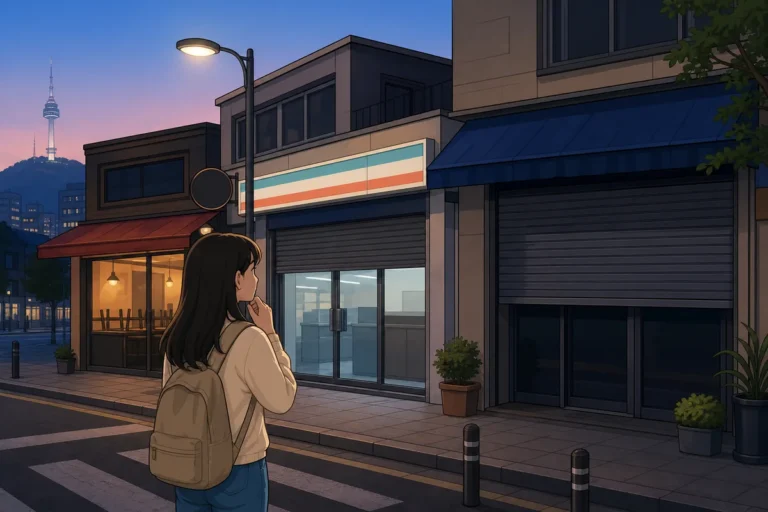
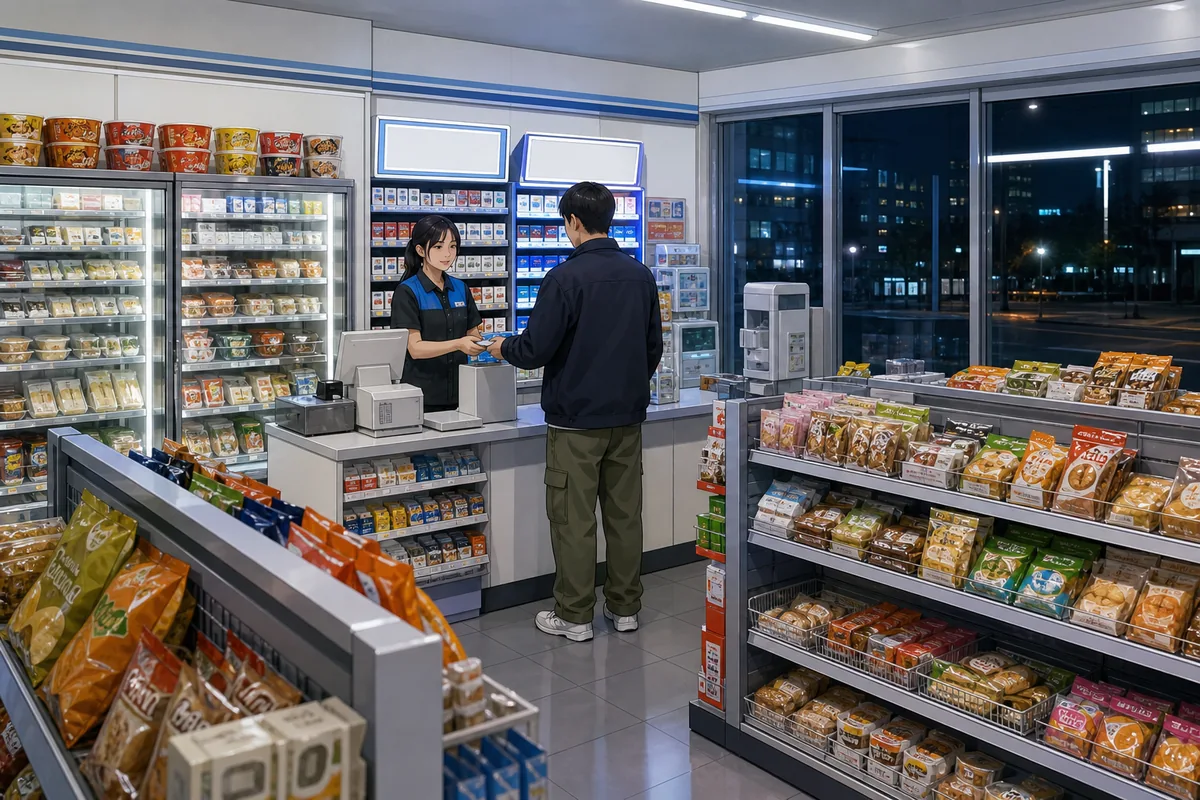
Walk any main street in a Korean city after midnight and you will almost certainly find a GS25, CU, 7-Eleven, or Emart24 glowing at the corner. These chains are the most visible face of 24 hour businesses in Korea, and most city-center branches genuinely do stay open all night.
They work as mini-restaurants, ATMs, parcel pickup points, phone chargers, and rest stops all at once. You can buy a hot meal, pay a utility bill, print a document, or sit at a small counter eating ramen at 4 a.m. — all under one roof. That range of services is exactly why they attract overnight customers who are not just hungry but need practical help.
Franchise agreements historically required many branches to stay open 24 hours, which is part of why the all-night pattern became so consistent. That policy has softened in recent years, but the majority of urban branches still maintain full overnight hours.
Signs to know at convenience stores
Delivery culture and late-night demand
Korea’s delivery culture is one of the main reasons restaurants can serve customers late at night without keeping their physical doors open. Apps like Baemin (배달의민족) and Coupang Eats connect customers to restaurants that might close their dining rooms at 10 p.m. but continue taking delivery orders until 1 or 2 a.m.
This split model — closed to walk-ins, open for delivery — is common in residential neighborhoods where foot traffic drops after midnight but apartment residents are still ordering. It means the street can look quiet while dozens of meals are moving through it on motorcycles.
For visitors staying in hotels or guesthouses, delivery apps are a practical overnight option even if you cannot read Korean. Many apps now have English interfaces, and the payment and address system is straightforward once you have done it once. Late-night delivery fees are sometimes higher, and not every restaurant delivers to every area, but the coverage in central districts is broad.
Jjimjilbangs, cafes, and other overnight spaces
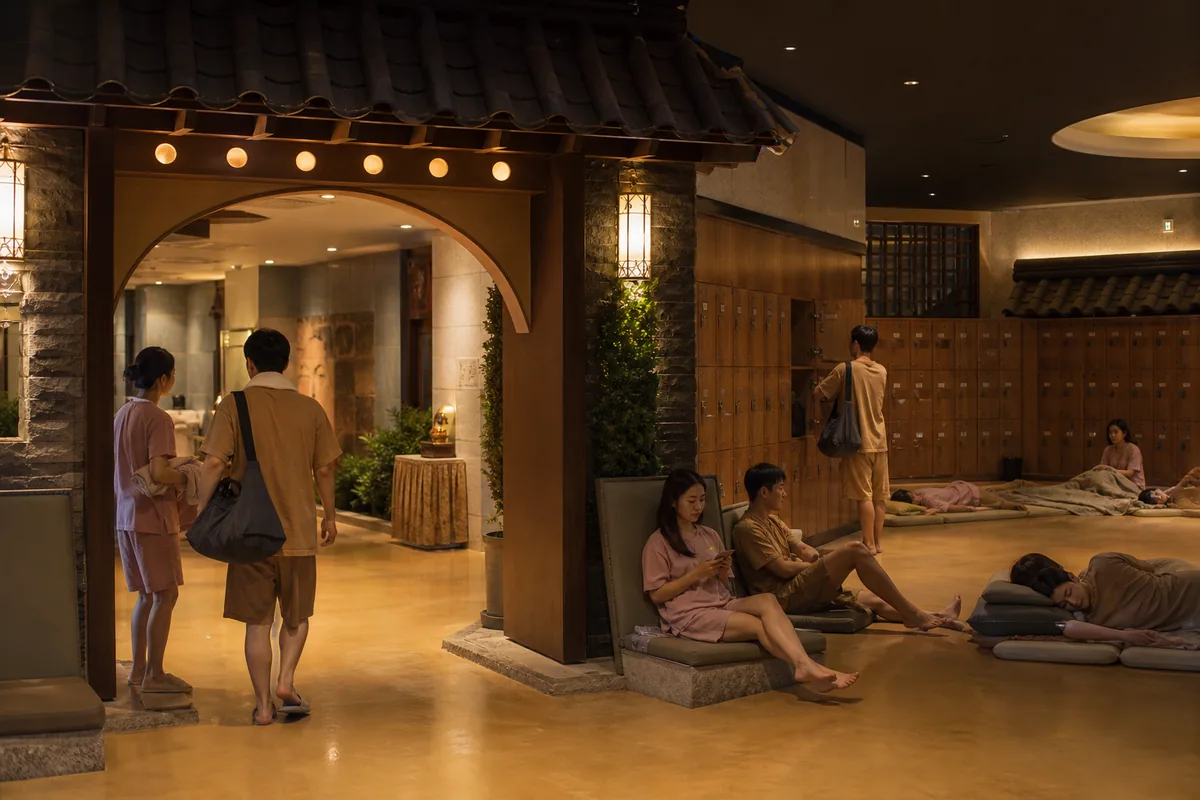
Jjimjilbangs (찜질방) — Korean bathhouse and sauna complexes — have traditionally been 24-hour spaces because they serve a specific overnight function: a cheap place to sleep. Workers who miss the last subway, travelers between early flights, and locals who just want a long soak and a rest all use them through the night. The sleeping area (수면실, su-myeon-sil) is a key part of the business model, not an afterthought.
PC bangs (PC방, internet cafes) follow a similar logic. Gaming culture in Korea runs late, and many PC bangs stay open all night because their core customer — a young person playing for several hours — is just as likely to arrive at midnight as at noon.
Cafes are more mixed. Dedicated 24-hour cafe chains exist, particularly near universities and in nightlife districts, but most standard cafes close between 10 p.m. and midnight. A cafe advertising 24시 is making a deliberate business choice to serve the overnight crowd — students cramming, couples with nowhere else to go, night-shift workers on a break.
Useful overnight vocabulary
Why some 24 hour businesses are shrinking
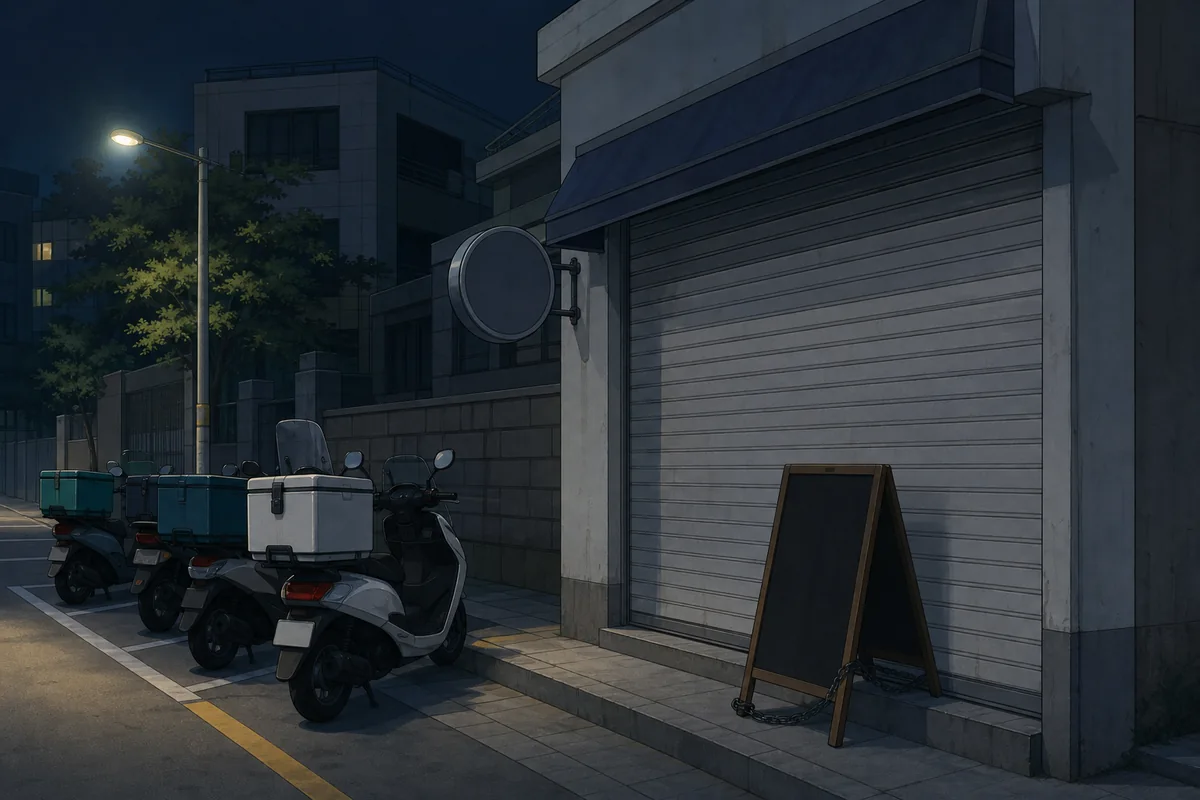
The all-night economy is not growing — in many sectors it is contracting. The main driver is the minimum wage increase that Korea implemented in stages from 2018 onward. Overnight shifts require premium pay, and for smaller businesses, the math stopped working. A 24-hour kimbap restaurant that could survive on thin margins in 2015 may not be able to do so today.
Staffing is the other pressure. Younger workers are less willing to take overnight shifts, and some small business owners who once ran their shops themselves through the night are now choosing to close rather than hire overnight staff at a loss.
The result is visible if you know what to look for. Chains that once guaranteed 24-hour service now post notices saying they close between 1 a.m. and 6 a.m. Some jjimjilbangs have shortened their overnight window. Certain convenience store franchise branches in low-traffic areas have negotiated exemptions from all-night requirements.
This does not mean the overnight economy is disappearing — it means it is concentrating. High-traffic areas, nightlife districts, and businesses with a clear overnight customer base are holding their hours. Quieter neighborhoods and marginal businesses are pulling back.
What still stays open late today
For a visitor, the practical picture is fairly clear. These categories are reliably open late in most urban areas:
- Convenience stores — GS25, CU, 7-Eleven, and Emart24 branches in city centers and busy neighborhoods are almost always 24 hours.
- Delivery apps — Baemin and Coupang Eats have late-night restaurant options in most urban districts, even when physical restaurants are closed.
- Jjimjilbangs — The majority are still 24 hours, though some now have a brief cleaning closure in the early morning.
- PC bangs — Especially near universities and in entertainment districts, most run all night.
- Nightlife neighborhoods — Hongdae, Itaewon, Sinchon, Gangnam’s club district, and Busan’s Seomyeon area have restaurants, bars, and snack stalls open until dawn on weekends.
- Late-night buses (심야버스) — Seoul operates owl buses (올빼미버스) on key routes after the subway closes around midnight.
What has become less reliable: standalone 24-hour restaurants outside nightlife zones, small neighborhood cafes advertising all-night hours, and convenience store branches in residential side streets. These are worth checking before you count on them.
How visitors should check hours before going out at night
The simplest tool is Naver Map (네이버 지도) or Kakao Map (카카오맵). Both show current business hours, and many listings include notes about whether hours have recently changed. Search the business name or type, tap the listing, and look for the hours section — it often shows today’s schedule specifically.
Google Maps works too, but its Korea data is less consistently updated than Naver’s. For convenience stores specifically, the chain apps (GS25 app, CU app) let you search for 24-hour branches near you — useful if you are in an unfamiliar neighborhood.
If you are planning a late-night jjimjilbang visit, call ahead or check the business’s own social media page. Many post their current hours on Instagram or Naver Blog, and those are often more current than map listings.
The key habit is simple: do not assume. The 24-hour culture is real and still visible, but it is no longer universal. A quick map check takes thirty seconds and saves a wasted trip at 2 a.m.
Frequently Asked Questions
Why are so many convenience stores open 24 hours in Korea?
Convenience store chains in Korea expanded rapidly through the 1990s and 2000s with franchise agreements that often required 24-hour operation. Dense urban populations meant there were always enough overnight customers — shift workers, students, commuters — to make all-night hours viable. The stores also evolved into multi-service hubs offering hot food, ATMs, and parcel services, which kept overnight foot traffic steady.
Are all convenience stores in Korea still open all night?
Most city-center and high-traffic branches are, but not all. Rising labor costs and lower overnight traffic in some residential areas have led individual franchise owners to apply for exemptions from 24-hour requirements. The safest approach is to check the specific branch on Naver Map or the chain’s own app before relying on it late at night.
Why have some 24-hour businesses disappeared in Korea?
The main reasons are higher minimum wages, difficulty finding workers willing to take late-night shifts, and reduced overnight foot traffic in some neighborhoods as lifestyle patterns shift. Businesses in quieter areas that once ran all night on thin margins have found it harder to justify the cost. The overnight economy is concentrating in high-traffic zones rather than disappearing entirely.
Are jjimjilbangs still open 24 hours in Korea?
Most are, because the overnight sleeping function is central to their business model. However, some now have a short closure window — often between 2 a.m. and 5 or 6 a.m. — for cleaning. It is worth checking the specific jjimjilbang’s hours before arriving late, especially outside major city centers.
The Short Version
Korea developed so many 24 hour businesses because dense cities, shift-work schedules, convenience store infrastructure, and delivery culture created real overnight demand for decades. The most reliable all-night options today are convenience stores in busy areas, delivery apps, jjimjilbangs, and nightlife neighborhoods. Some sectors — especially standalone restaurants and quieter neighborhood stores — have pulled back as labor costs rose. The pattern is still visible and genuinely useful for visitors, but checking hours on Naver Map before heading out late is always the right move.
Note: This guide is for travel navigation in Korea. It is not medical, legal, or emergency professional advice. For urgent situations, contact local emergency services, official staff, or your embassy/consulate as appropriate.
Sources & Verification
- VISITKOREA – Imagine Your Korea — english.visitkorea.or.kr
Last checked: July 30, 2026