Misio vs Dangisio: Korean Door Signs Explained
If you have ever stood in front of a door in Korea and felt unsure whether to push or pull, understanding misio vs dangisio will solve that problem immediately. These two Korean words appear on doors all across the country, and knowing what they mean takes less than one minute to learn.
Misio Vs Dangisio: What You Need to Know
미시오 (misio) = Push. 당기시오 (dangisio) = Pull. When you see 미시오 on a door, press it away from you. When you see 당기시오, grip the handle and bring it toward you. That is all you need to know to use almost any manually operated door in Korea.
Table of Contents
- Main Explanation
- Common Situations
- What Foreigners Often Get Wrong
- Useful Korean Phrases
- Warnings / Things to Check
- FAQ
- Summary
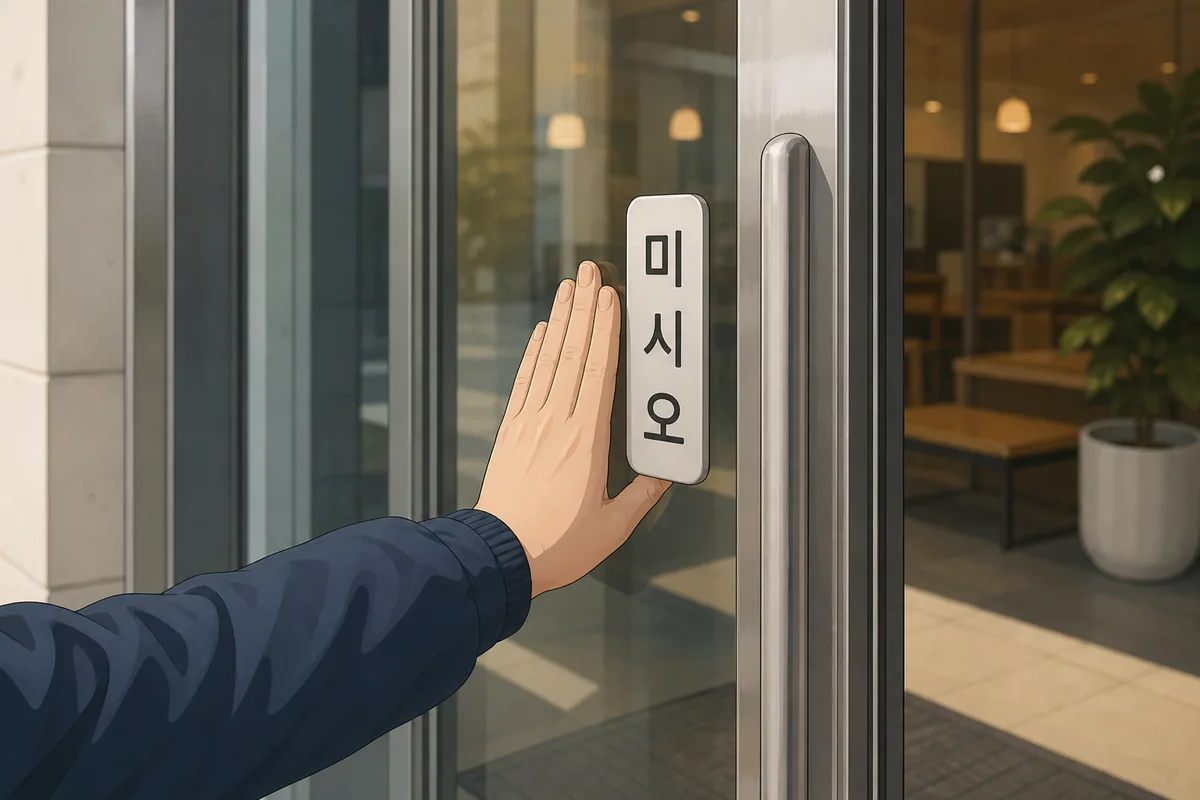
Main Explanation: What Misio and Dangisio Mean
misio vs dangisio is a simple sign-reading skill that helps you move through everyday places in Korea with confidence. Korean public doors in convenience stores, office buildings, hospitals, subway station entrances, schools, and government offices often carry one of two short instructions. These instructions are polite command forms in Korean, which is why they end in -시오, a formal and courteous ending similar to saying “please” in English.
미시오 comes from the verb 밀다 (milda), which means to push. The sign is telling you, politely, to push the door. 당기시오 comes from the verb 당기다 (dangida), which means to pull. The sign is telling you to pull the door toward you.
A simple rule of thumb: if the sign says 미시오, push; if it says 당기시오, pull. Once you recognize these two words visually, even without reading every letter, you will move through Korean doors with confidence.
Below is a quick comparison of the two signs.
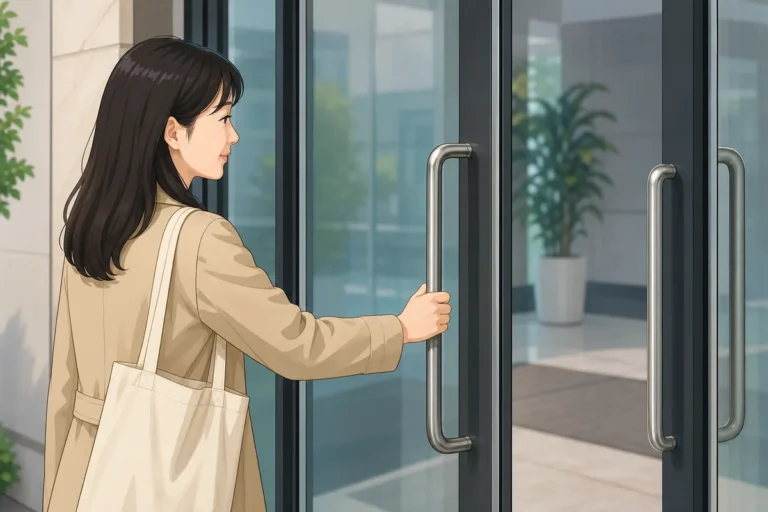
The signs are usually printed as small stickers or etched directly onto glass. On glass doors, you will often see the text at eye level or near the handle. On metal or wooden doors, the sign may be on a small plate beside or above the handle.
Common Situations Where You Will See These Signs
Korean Door Signs in Everyday Places
Convenience Stores (편의점)
Most convenience store doors in Korea, such as those at GS25, CU, 7-Eleven, and Emart24, are either automatic sliding doors or manual glass doors. Manual glass doors almost always carry 미시오 or 당기시오 on the glass panel. Automatic doors do not need these signs, but if a store has a secondary inner door, check for the sign before pushing.
Hospitals and Clinics
Hospital entrance doors are often heavy and swing in one direction only. The sign is critical here because pushing a pull door hard can startle people on the other side. Look for the sign at chest or eye level on the door glass or frame.
Government Offices and Banks
These buildings frequently have double doors, meaning one set of doors to enter a lobby and another set to enter the main area. Each set may have its own 미시오 or 당기시오 sign, and the direction can differ between the two sets.
Schools and Universities
Classroom and office doors in Korean schools are often sliding doors rather than swinging doors, so the push-pull signs may not appear. However, main building entrances almost always use the standard signs.
Subway Station Exits
Some older subway exits in Seoul, Busan, and other cities still use manually operated doors near emergency exits or staff areas. These doors reliably carry the signs.
What Foreigners Often Get Wrong
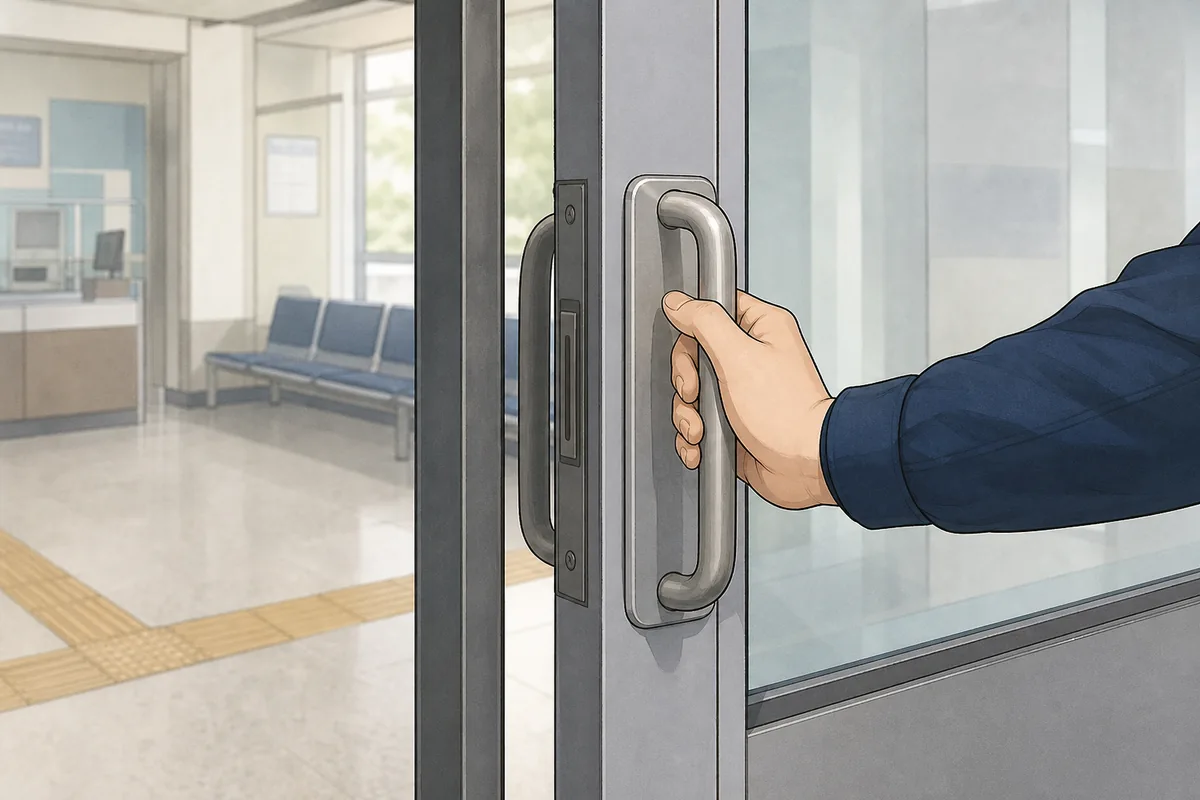
The most common mistake is ignoring the sign entirely and guessing based on which side the handle is on. In many countries, a handle suggests pulling and a flat plate suggests pushing. Korea follows a similar logic, but the sign is always more reliable than the hardware, because some Korean doors have handles on both sides.
Another frequent confusion involves assuming that all glass doors in Korea are automatic. Many are not. Visitors sometimes walk directly into a glass door because they expected it to slide open. If the door has a handle and a sign, it is manual.
Some visitors also confuse 미시오 with 비상구 (bisanggu), which means emergency exit. These are different signs entirely. 비상구 is a green sign with a running figure and is about exit direction, not about how to operate the door.
Finally, worn or sun-faded signs on older doors can make the text hard to read. In that case, look at the hinge side of the door. If the hinges are visible on your side, you are on the push side. If the hinges are on the other side and you can only see the door edge, you are likely on the pull side.
Useful Korean Phrases for Door Situations
Signs and Words to Recognize
Warnings / Things to Check
- Do not force a door. If the door does not move after a firm push or pull, stop and re-read the sign. Forcing a door that opens the other way can damage it or startle people on the other side.
- Worn signs are common on older buildings. If the text is faded and unreadable, check the hinge position as described above, or wait a moment to observe how others use the door.
- Some doors have signs in English too. Newer buildings, especially in Itaewon, Hongdae, and tourist-heavy areas of Seoul, may add “PUSH” or “PULL” below the Korean text.
- Automatic doors may have a sensor, not a sign. If you see a small sensor strip above the door frame and no handle, the door is automatic. Stand in front of it and wait a moment.
- Hospital doors may be heavier than expected. Apply steady, controlled pressure rather than a sudden shove, especially in medical facilities where patients or elderly visitors may be close to the other side.
- Signs on this page reflect general practice across Korea. Confirm any building-specific access rules directly with the facility, as some locations use keycard or intercom entry that overrides standard door signs.
FAQ
Does 미시오 always mean push, without exception?
In standard Korean signage, 미시오 always instructs you to push. There are no known cases where the word is used to mean pull. However, if a sign appears damaged, misprinted, or placed on the wrong side of a door by mistake, the physical behavior of the door is your final guide. Push gently first; if the door does not move, try pulling.
Can 당기시오 appear on glass doors?
Yes, absolutely. Glass doors in cafés, clinics, offices, and shops frequently carry 당기시오 as a small sticker or etched text. Glass doors are among the most common places to see both Korean door signs, because the transparent surface makes it easy to miss the direction until you read the label.
What should a visitor do if the sign is missing or unreadable?
First, look at the hinge side of the door. Visible hinges on your side usually mean you should push. If you cannot see the hinges, try a gentle push first. If that does not work, try pulling. You can also wait briefly to watch how the next person opens the door, or ask someone nearby using the phrase 어떻게 열어요? (How does a visitor open this?)
Are these signs used everywhere in Korea, or only in Seoul?
These signs are used nationwide across South Korea, not only in Seoul. You will see 미시오 and 당기시오 in Busan, Incheon, Daegu, Jeju, and smaller cities and towns. The wording is standardized Korean, so it does not change by region.
Is there an English version of these signs in Korea?
Some buildings in tourist areas, international hotels, and major airports add “PUSH” or “PULL” in English alongside the Korean text. However, this is not guaranteed everywhere, so learning to recognize 미시오 and 당기시오 visually is still the most reliable approach for any visitor.
What if the door has no handle at all?
A door with no handle is almost certainly a push door, or it may be an automatic door. If there is no sensor strip above the frame and no handle, look for a flat push plate, which is a rectangular metal or plastic panel at hand height. Press it firmly and the door should swing open away from you.
Summary
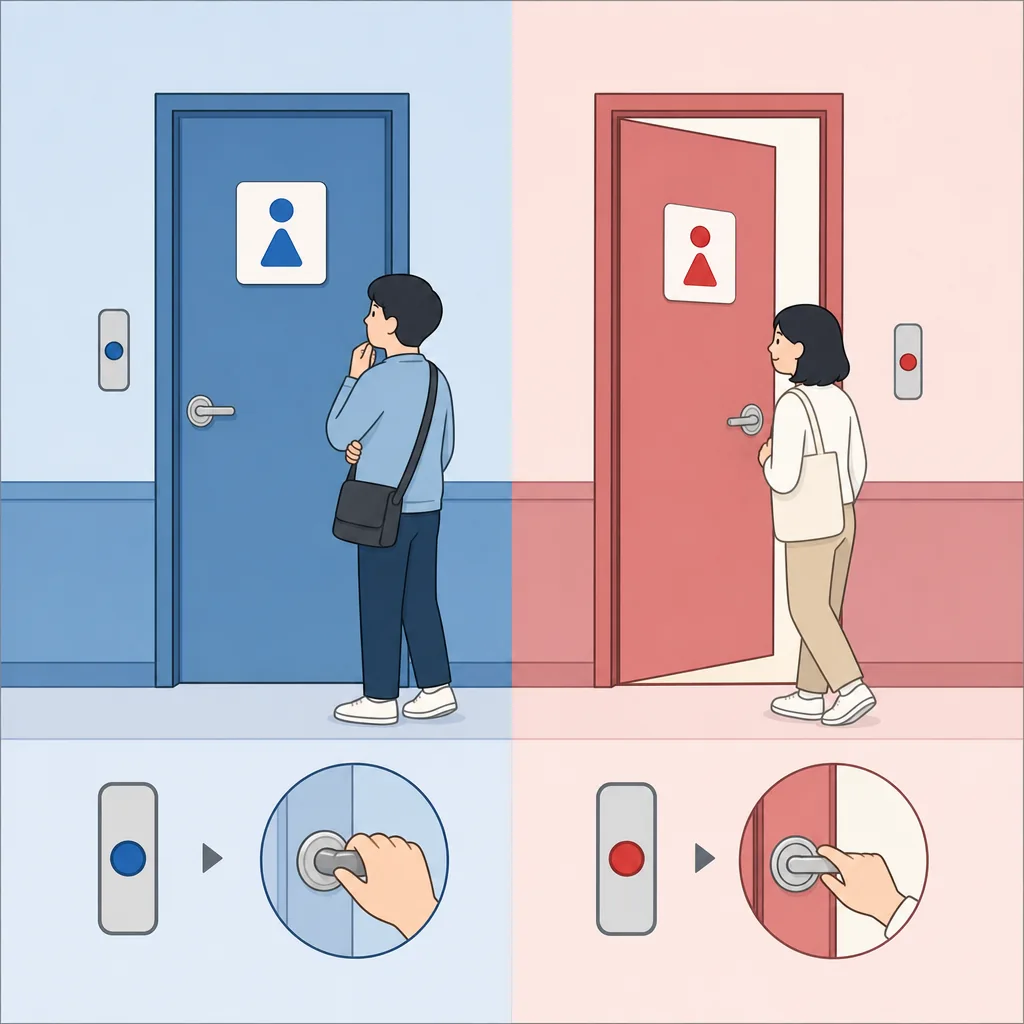
The difference between misio vs dangisio is simple and immediately useful for any visitor to Korea. 미시오 means push and 당기시오 means pull. These Korean door signs appear on manual doors in convenience stores, hospitals, government offices, schools, subway areas, and countless other public spaces across the country.
- See 미시오? Press the door away from you.
- See 당기시오? Grip the handle and bring it toward you.
- No sign? Check the hinge side, apply gentle pressure, or ask someone nearby.
- Automatic doors carry no push-pull sign and open when you approach the sensor.
Recognizing these two words takes only a moment, and it will save you from the awkward push-pull struggle that catches nearly every first-time visitor off guard. For further reading on Korean public signage standards, the National Institute of Korean Language (국립국어원) provides official guidance on Korean language usage in public spaces.
Related and Official Resources
Sources & Verification
- 한국어기초사전 — krdict.korean.go.kr
- National Institute of Korean Language — www.korean.go.kr
Last checked: July 30, 2026