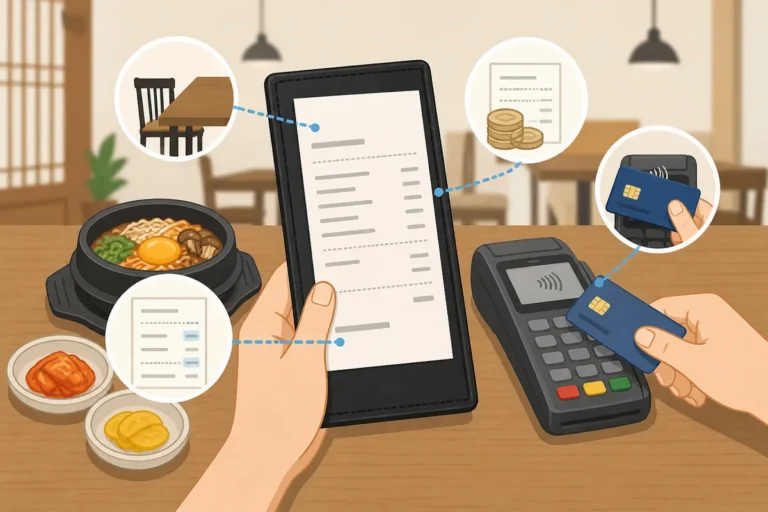
If you see 할인, 행사, 1+1, or 적립 on a Korean store sign, it usually means a sale, a special promotion, a buy-one-get-one-style deal, or points accumulation. This guide shows you exactly how to read those words so you know what discount you are actually getting before you pay.
Korean Discount Signs Explained: What You Need to Know
- Look for 할인 to confirm an immediate price reduction is already applied.
- Check 행사 signs closely — they cover many promotion types, not just price cuts.
- With 1+1, pick up two of the same item and confirm both ring up before paying.
- Treat 적립 as savings for a future visit, not a discount today.
- Ask a staff member to confirm the deal if the sign is unclear or in Korean only.
- Check the shelf tag and the checkout screen to verify the final price matches.
- Remember that promotion rules and dates vary by store, so confirm on the day.

What these Korean sale signs usually mean
Korean discount signs use a small set of recurring words that appear on shelf labels, hanging posters, checkout receipts, and app notifications. Once you recognise the four core terms — 할인, 행사, 1+1, and 적립 — you can decode most promotions you will encounter in supermarkets, convenience stores, department stores, and cafes. The key distinction to keep in mind is whether the sign means money comes off your bill right now, or whether any benefit is stored for a later purchase.
The four core korean discount signs
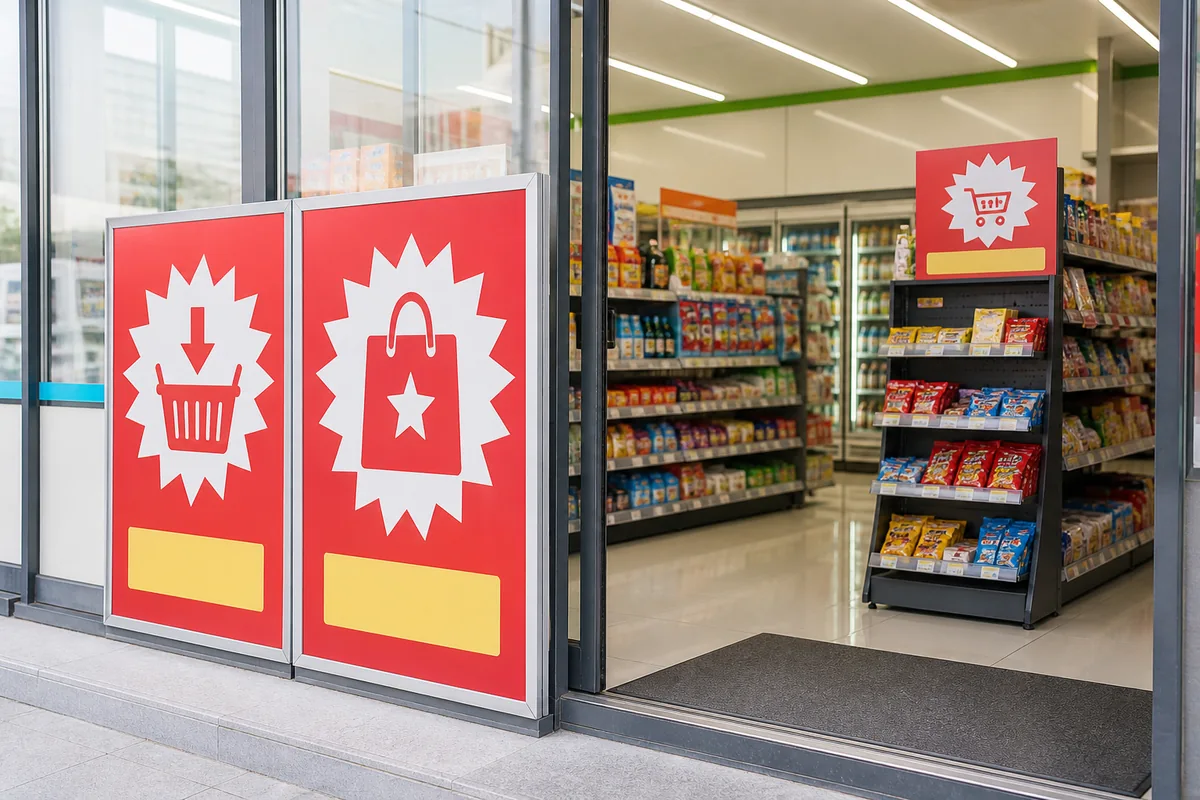
할인: direct discount on the price
할인 is the most straightforward of all Korean discount signs. It means the price has already been reduced, or will be reduced at the register. You will see it written as a percentage — for example, 30% 할인 means thirty percent off — or as a flat amount, such as 1,000원 할인, which means one thousand won off the original price. Supermarkets like Emart and Homeplus use 할인 stickers directly on product packaging, while clothing stores often display it on large hanging banners above a rack.
When you see 할인 on a shelf tag, the discounted price is usually shown in red or in a larger font next to the original price. The original price is often crossed out. You do not need to do anything special to receive the discount — it applies automatically when the item is scanned. If the price on the screen at checkout does not match the shelf tag, point to the tag and say “이 가격이요” (ee ga-gyeok-ee-yo), which means “this price.”
Common 할인 sign formats
행사: special promotion or event sale
행사 literally means “event” in Korean, and in a retail context it signals that a product or section is part of a special promotional period. This is the broadest of the four terms, and that breadth is exactly what confuses newcomers. A 행사 sign does not tell you automatically whether the benefit is a price cut, a bundle deal, a gift-with-purchase, or a points bonus. You need to read the rest of the sign to understand what kind of promotion is running.
In convenience stores such as CU, GS25, and 7-Eleven, 행사 stickers are placed on the shelf edge below specific products. The sticker usually includes a short description of the deal type alongside the word 행사. In supermarkets, a 행사 banner over a refrigerated section might mean a weekend-only price reduction, while the same word on a checkout counter display might refer to a card-linked discount. The safest habit is to treat 행사 as a prompt to look more carefully, not as a guaranteed saving.
What 행사 can cover
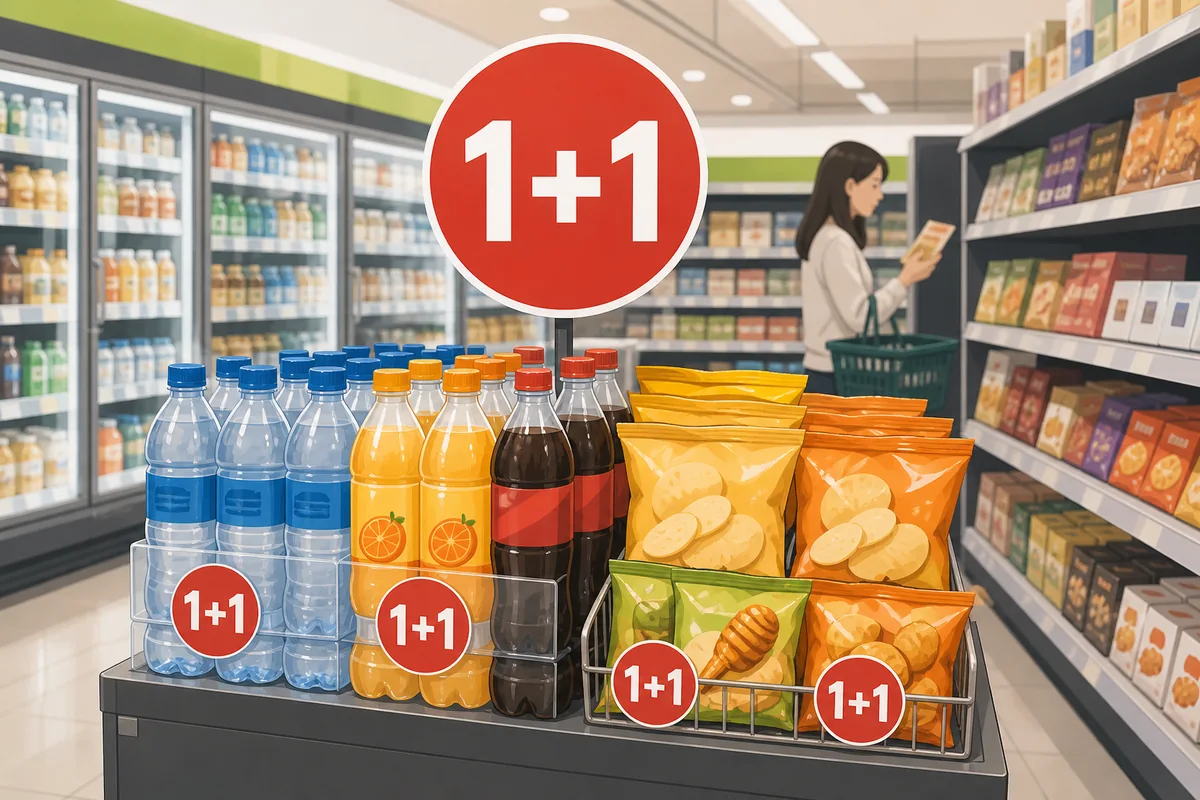
1+1: how buy-one-get-one offers work
1+1 is read aloud as “one plus one” and it means that when you buy one item, you receive a second item free. It is one of the most popular promotion formats in Korean convenience stores and is also common in supermarkets and pharmacies. The deal sounds simple, but there are a few practical points that catch first-time visitors off guard.
First, you usually need to physically pick up two of the same product and place both on the counter. The system then charges you for one and gives you the second for free. If you only bring one item to the register, the cashier may not automatically give you a second one — although in some stores they will ask. Second, the free item must typically be the same product and the same size. You cannot usually mix flavours or sizes unless the sign specifically says so. Third, the 1+1 offer is tied to a specific product code, so a very similar product from the same brand sitting next to it on the shelf may not be included.
You will also see 2+1 signs in Korean stores. This means buy two, get one free — so you pay for two items and receive three. The same rules about identical products and picking up the correct quantity apply.
1+1 and related bundle sign formats
적립: points and loyalty rewards
적립 means “accumulation” and refers to loyalty points being added to your account when you make a purchase. It is not a discount on today’s transaction. Instead, points build up over multiple visits and can be redeemed for discounts or free items on a future purchase. This distinction matters because a sign that says 적립 next to a product does not mean the product is cheaper right now.
Common loyalty programs in Korea where you will see 적립 include the T멤버십 (T Membership from SK Telecom), OK캐쉬백 (OK Cashbag), and store-specific apps for chains like CU, GS25, Starbucks Korea, and Olive Young. At the checkout, staff will often ask “적립 카드 있으세요?” (jeong-nip ka-deu i-sseu-se-yo?), which means “Do you have a points card?” If you do not have one, you can simply say “없어요” (eob-seo-yo), meaning “I don’t have one,” and the transaction continues normally.
On receipts, 적립 appears as a line showing how many points were added. A separate line may show your cumulative total. Points are usually expressed in won-equivalent units, so 100 points is roughly equivalent to 100 won in future spending power, though this varies by program. Confirm the redemption rules with the specific store or app, as they change periodically.
Useful 적립 phrases and signs

How to tell whether the offer saves money now or later
The fastest way to judge a Korean discount sign is to ask one question: does the sign describe a change to today’s price, or does it describe something added to an account? 할인 and 1+1 both affect what you pay at the register right now. 적립 does not. 행사 can go either way depending on the promotion type, so you need to read the full sign.
A useful secondary check is to look at the shelf price tag. In Korean supermarkets and convenience stores, the shelf tag often shows the original price and the promotional price side by side. If two prices appear and one is crossed out or shown in grey, the lower price is what you will pay. If only one price appears alongside a 적립 or 포인트 note, that single price is what you pay in full today — the points benefit comes later.
Now vs. later — quick sign reading guide
Common traps foreigners miss on Korean shelf tags
Even when you recognise the words, a few situations can still lead to a surprise at the checkout. Being aware of these in advance will save you confusion and awkward moments at the register.
- Card-specific discounts: Some 할인 and 행사 signs only apply if you pay with a specific Korean bank card or credit card. The card name is usually printed in small text on the sign. If you are paying with a foreign card, the discount may not apply. Look for the word 카드 (card) on the sign and confirm with the cashier if you are unsure.
- App-only prices: Some convenience stores and supermarkets show a lower price that is only available when you pay through their official app. The sign may show both the app price and the regular price. Look for 앱 전용 (aep jeon-yong), which means “app exclusive.”
- Membership-only deals: Signs marked 회원 전용 (hoe-won jeon-yong) mean the offer is for registered members only. Non-members pay the regular price.
- 1+1 with a quantity limit: Some 1+1 promotions cap the number of free items per customer per day. This is usually printed in small text at the bottom of the shelf label.
- 행사 end dates: Promotions in Korean stores are often weekly or tied to specific dates. A sign that was accurate yesterday may no longer apply today. Check for the date range, often shown as ~월 ~일까지 (until [month] [day]).
- 최대 (maximum) language: When a sign says 최대 XX% 할인, it means up to that percentage off — not every item in the display is discounted by that full amount.
Note: Promotion rules, participating products, and card eligibility change frequently. Always confirm the current terms on the day of your visit by checking the shelf label carefully or asking a staff member. The information in this guide reflects general patterns and may not match every store’s current offer.

Quick reading cheat sheet for shopping signs
Use this summary when you are standing in front of a shelf and need a fast answer. These are the most common korean discount signs you will encounter across supermarkets, convenience stores, and cafes in Korea.
Korean discount sign cheat sheet
Read 할인 as an immediate price cut, 행사 as a broad promotion label, 1+1 as a buy-one-get-one-style deal, and 적립 as points for later. Check the fine print, date, and payment method before assuming the discount applies.
Korean Discount Signs Explained becomes easier to handle when you recognize the situation and follow the practical steps above.
Korean Discount Signs Explained becomes easier to handle when you recognize the situation and follow the practical steps above.
What does 할인 mean in Korea?
할인 means discount or reduced price. If a sign says 30% 할인, the item is 30% off.
What does 1+1 mean in Korean stores?
1+1 usually means buy one item and get one more item free, often on the same product and within the promotion rules.
What does 적립 mean on a receipt or sign?
적립 means points are added to your membership account or card. It is savings for later, not an immediate price cut.
What does 행사 mean in Korea?
행사 means a special promotion or event sale. It can include discounts, bundle deals, or limited-time offers.
Note: This guide is for travel navigation in Korea. It is not medical, legal, or emergency professional advice. For urgent situations, contact local emergency services, official staff, or your embassy/consulate as appropriate.
Sources & Verification
- VISITKOREA – Imagine Your Korea — english.visitkorea.or.kr
- 한국어기초사전 — krdict.korean.go.kr
- National Institute of Korean Language — www.korean.go.kr
Last checked: July 30, 2026