Quick Answer
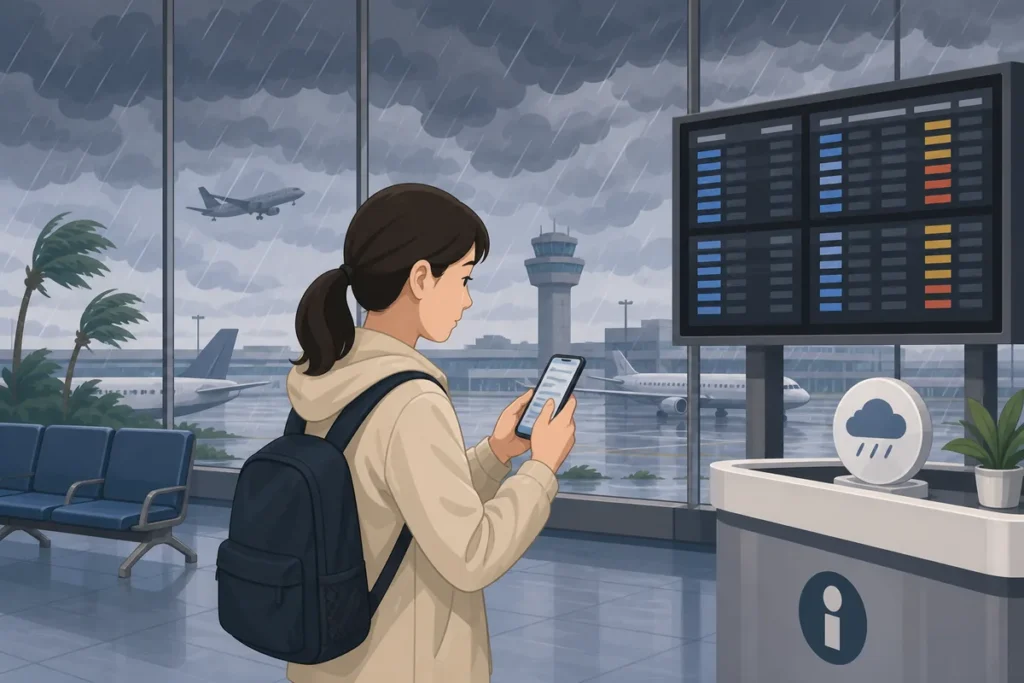
If a typhoon is affecting Incheon Airport, check your airline’s official app or notice page first — that is the fastest way to confirm whether your specific flight is delayed, cancelled, or still operating. Then cross-check on the Incheon International Airport Corporation departure and arrival boards. Decide whether to leave for the airport only after you have a confirmed status, because transport routes to the airport can also be disrupted during a typhoon.
What to Do First
- Open your airline’s app or website and search your flight number directly
- Check the email or SMS your airline sent — cancellation notices often go out hours early
- Go to the Incheon International Airport Corporation official site and look at the real-time departure or arrival board
- Read any airport-wide weather alert or notice posted on the airport site
- Check whether AREX (Airport Railroad Express) and bus routes to the airport are running normally
- Do not leave for the airport until you have confirmed your flight’s current status
- If the flight is cancelled, contact your airline directly before going to the terminal

When This Guide Helps
This guide is for visitors who are already in Korea and have a flight at Incheon Airport while a typhoon is approaching or passing through. It covers how to check flight status, where to find official airport notices, and how to decide when to leave. It does not cover what to do once you are already inside the terminal — that situation has its own set of steps — and it does not cover medical or safety emergencies. Check Home – Korea Meteorological Administration for the current details.
Typhoons in Korea typically affect the peninsula between July and September. They move quickly and conditions can shift within a few hours, so information that was accurate in the morning can change by the afternoon. Checking once and assuming nothing has changed is one of the most common mistakes travelers make.
How to Check Flight Status During an Incheon Airport Typhoon
The airline’s own system is almost always updated before third-party flight trackers. Open the airline’s official app, go to “My Bookings” or “Flight Status,” and enter your flight number. Most major airlines operating at Incheon — Korean Air, Asiana Airlines, Jeju Air, Jin Air, and international carriers — send push notifications or SMS when a flight status changes. If you have not enabled notifications, check manually.
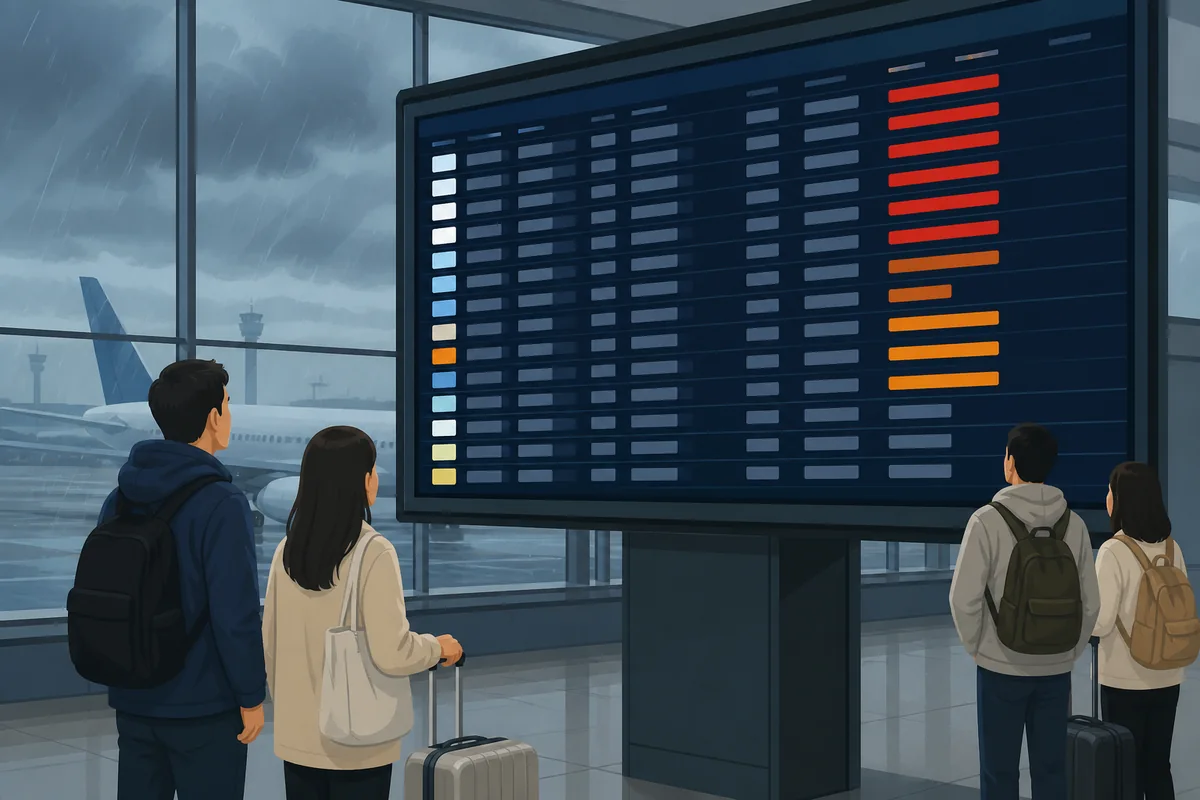
After confirming with the airline, go to the Incheon International Airport Corporation official website and look at the live departure or arrival board. The board shows the current status for every flight: on time, delayed, cancelled, or boarding. It also lists the gate number and any schedule changes. This is the same information displayed on the large screens inside the terminal, so checking it from home gives you the same picture.
The airport site also posts official weather-related notices under a news or announcement section. During a typhoon, these notices explain which runways are affected, whether the airport is operating normally, and any instructions for passengers. Read these notices even if your flight still shows “on time” — conditions can change and a notice may already flag upcoming disruptions.
Checking Transport to the Airport
Getting to Incheon Airport during a typhoon is a separate problem from the flight itself. AREX (Airport Railroad Express), which connects Seoul Station and Gimpo Airport to Incheon Terminal 1 and Terminal 2, is generally more reliable than road transport during heavy rain, but service can be suspended if conditions are severe. Korea Railroad Corporation (Korail) and the Seoul Metro publish real-time service alerts on their official apps and websites. Bus routes, including the Airport Limousine buses, are more vulnerable to road flooding and traffic delays.
Check transport status before you leave your accommodation. Allow significantly more time than usual if transport is running but conditions are poor. If AREX is suspended, the official Incheon Airport site and the Korea Railroad Corporation site will carry that notice.
Korean Phrases You Can Show
Useful Korean Signs or Words
Where to Get Help
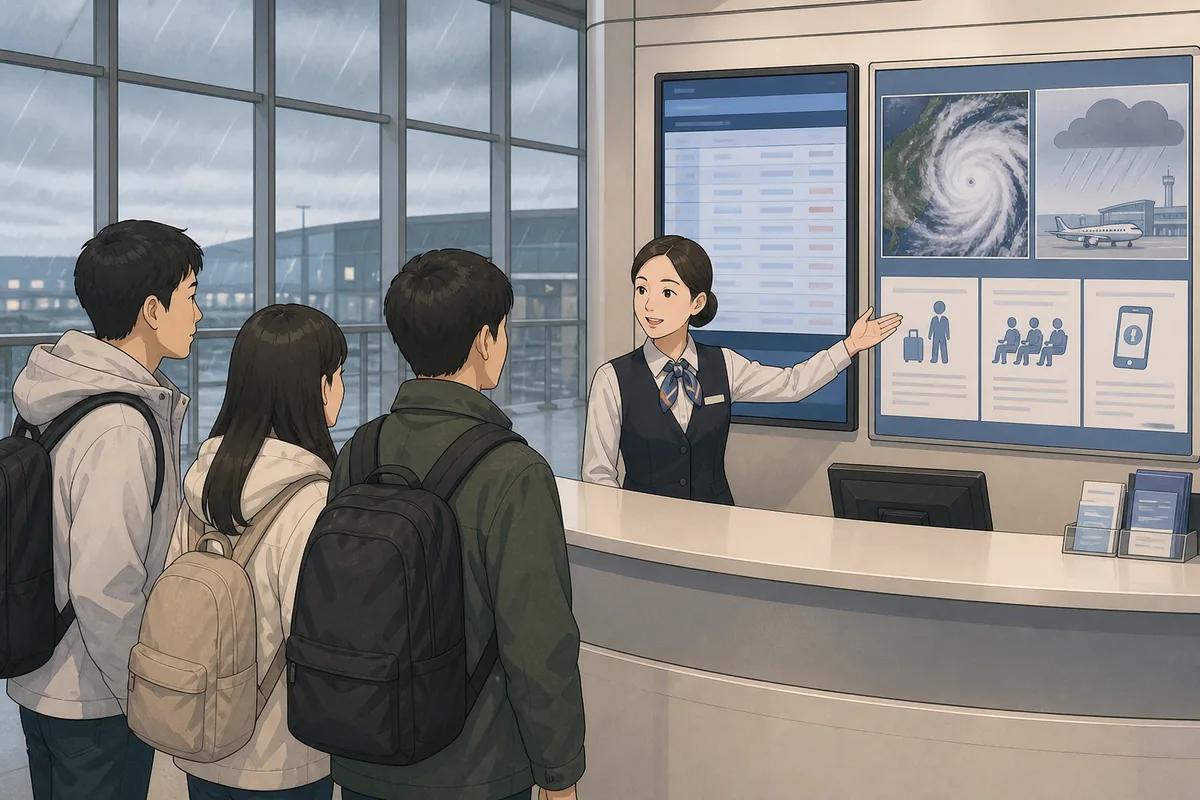
Inside the terminal, the airline’s own check-in counter is the right first stop for flight-specific questions — cancellations, rebooking, and refunds are handled there, not at the general airport information desk. The information desk (안내 데스크, an-nae de-seu-keu) is useful for questions about the terminal itself: which floor, which gate area, where to find a specific counter.
Incheon Airport has English-speaking staff at the main information desks in both Terminal 1 and Terminal 2. The desks are located in the main departure hall on the departure level. If you cannot find your airline’s counter, ask at the information desk and they will direct you.
For transport disruptions, the AREX information counter inside the airport basement level can confirm whether trains are running. If you are still at your accommodation and trying to decide whether to travel, calling the airport’s general inquiry line is an option — Incheon International Airport Corporation publishes a passenger inquiry number on its official website.
Common Mistakes
- Checking once and assuming nothing changes. Typhoon-related disruptions update frequently. A flight showing “on time” at 8 a.m. can be cancelled by 10 a.m. Check again before you leave and again when you arrive at the terminal.
- Relying only on third-party flight trackers. Sites like FlightAware or Google Flights pull data from official sources but sometimes lag behind. The airline’s own app and the Incheon Airport board are faster.
- Going to the airport before confirming the flight is operating. If your flight is cancelled, going to the terminal does not speed up rebooking — and getting there during a typhoon adds unnecessary risk. Call or use the app first.
- Ignoring transport disruption notices. Even if your flight is confirmed, a suspended AREX service or flooded road can make it impossible to reach the airport on time. Check transport separately.
- Assuming the airline will call you. Airlines send SMS and push notifications, but these sometimes fail during high-volume disruption events. Check actively, do not wait passively.
- Confusing Terminal 1 and Terminal 2. Incheon Airport has two separate terminals with different check-in halls and different AREX stops. Confirm which terminal your airline uses before you travel — this matters especially if you need to find a counter quickly.
Official Resource
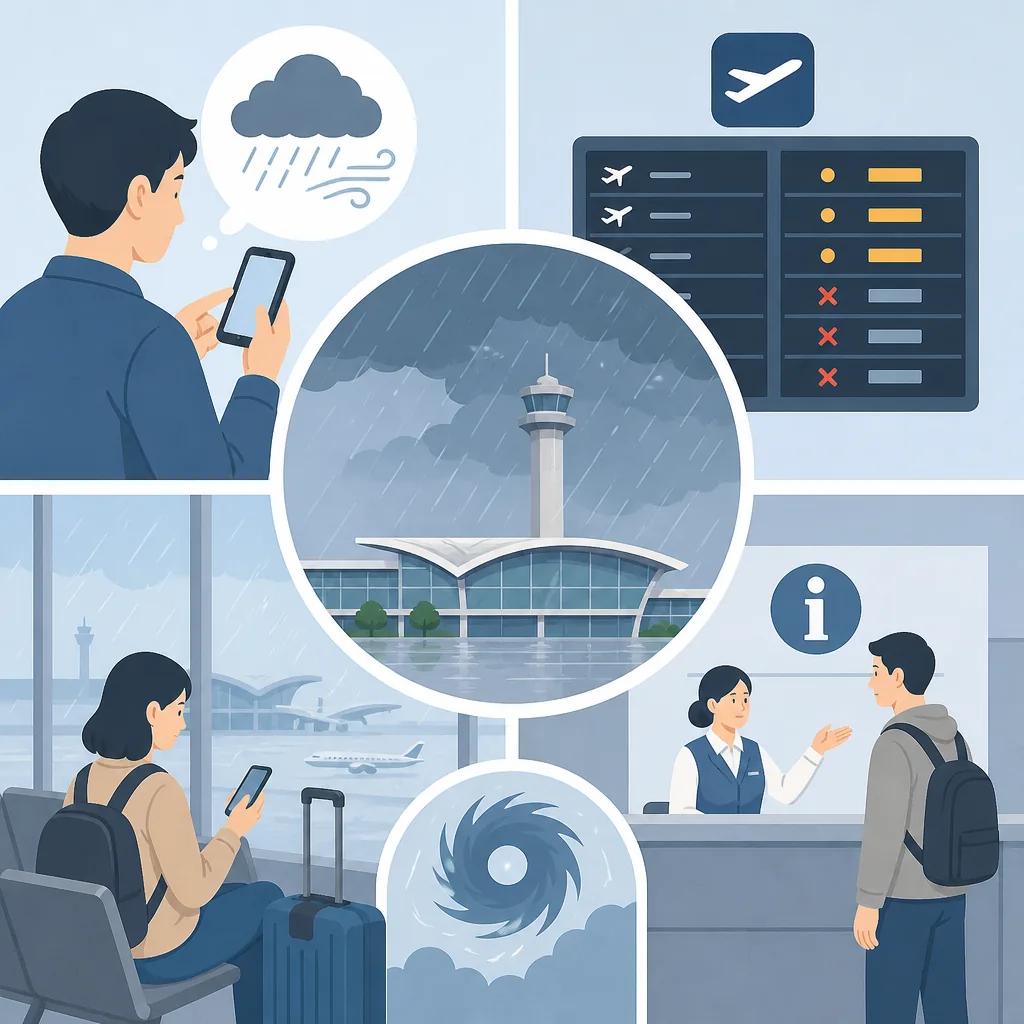
The Incheon International Airport Corporation operates the official airport website, which carries the real-time departure and arrival board, weather-related notices, and terminal maps. Korea Meteorological Administration issues official typhoon advisories and track forecasts. For transport, Korea Railroad Corporation (Korail) publishes AREX service status updates on its official channels.
Related Korea Guides
If you are navigating other parts of your trip around this disruption, guides on using AREX from Seoul, understanding Korean airport terminals, and reading Korean transit apps can help fill in the gaps this article does not cover.

FAQ
How do I check if my Incheon Airport flight is delayed during a typhoon?
Open your airline’s official app or website and search by your flight number — this is the fastest and most accurate source. Then confirm on the Incheon International Airport Corporation’s real-time departure board, which shows current status for all flights. Check both sources, because one may update before the other during fast-moving disruptions.
Where can I see Incheon Airport cancellations and airport notices?
The Incheon International Airport Corporation official website has a live flight board that shows cancellations alongside delays and gate changes. The same site posts official weather and operational notices in an announcements section — look for 공지사항 (gong-ji-sa-hang). Inside the terminal, the large departure and arrival screens show the same real-time data.
Should I leave for the airport if a typhoon is coming?
Confirm your flight’s current status before leaving. If the flight is cancelled, there is no reason to travel to the airport — contact your airline from your accommodation instead. If the flight is still operating, check whether AREX and road transport are running normally, allow extra travel time, and monitor updates while you are on the way. Do not leave based on a status check from several hours earlier.
What does delayed mean on the departure board in Korea?
The word 지연 (ji-yeon) on the departure board means the flight is running late but has not been cancelled. It usually appears alongside a revised departure time, though that time can change again. Keep checking the board and your airline’s app for updates, and watch for a gate change notice as well — disruptions sometimes come with gate reassignments.
Note: This guide is for travel navigation in Korea. It is not medical, legal, or emergency professional advice. For urgent situations, contact local emergency services, official staff, or your embassy/consulate as appropriate.
Sources & Verification
- Home – Korea Meteorological Administration — Korea Meteorological Administration
Last checked: August 7, 2026