Korean Hotel Fire Safety Signs Explained: What You Need to Know
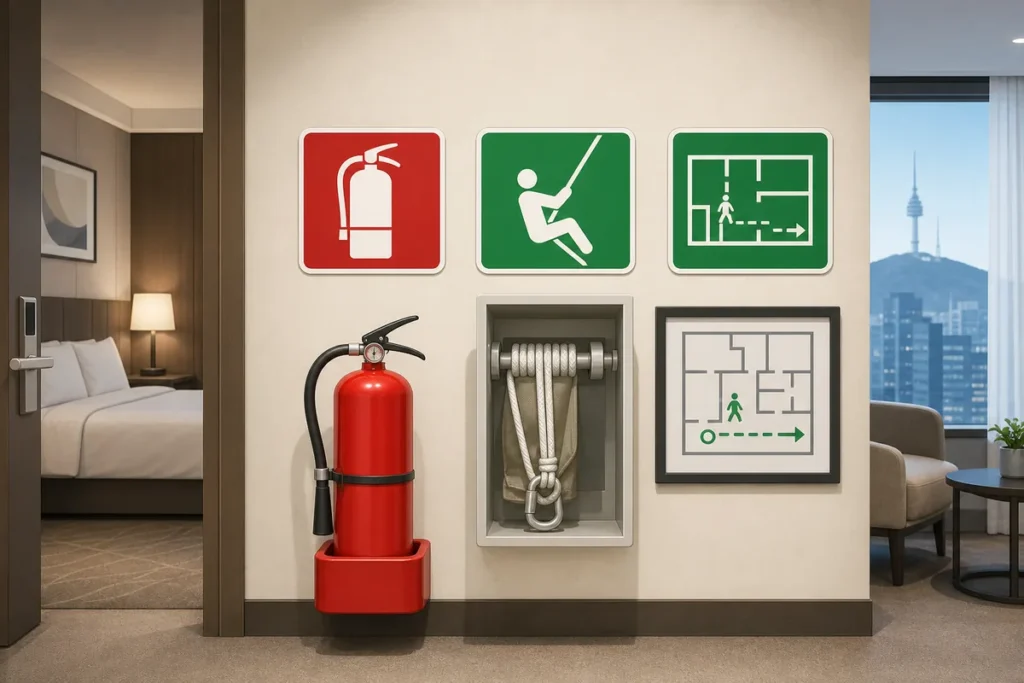
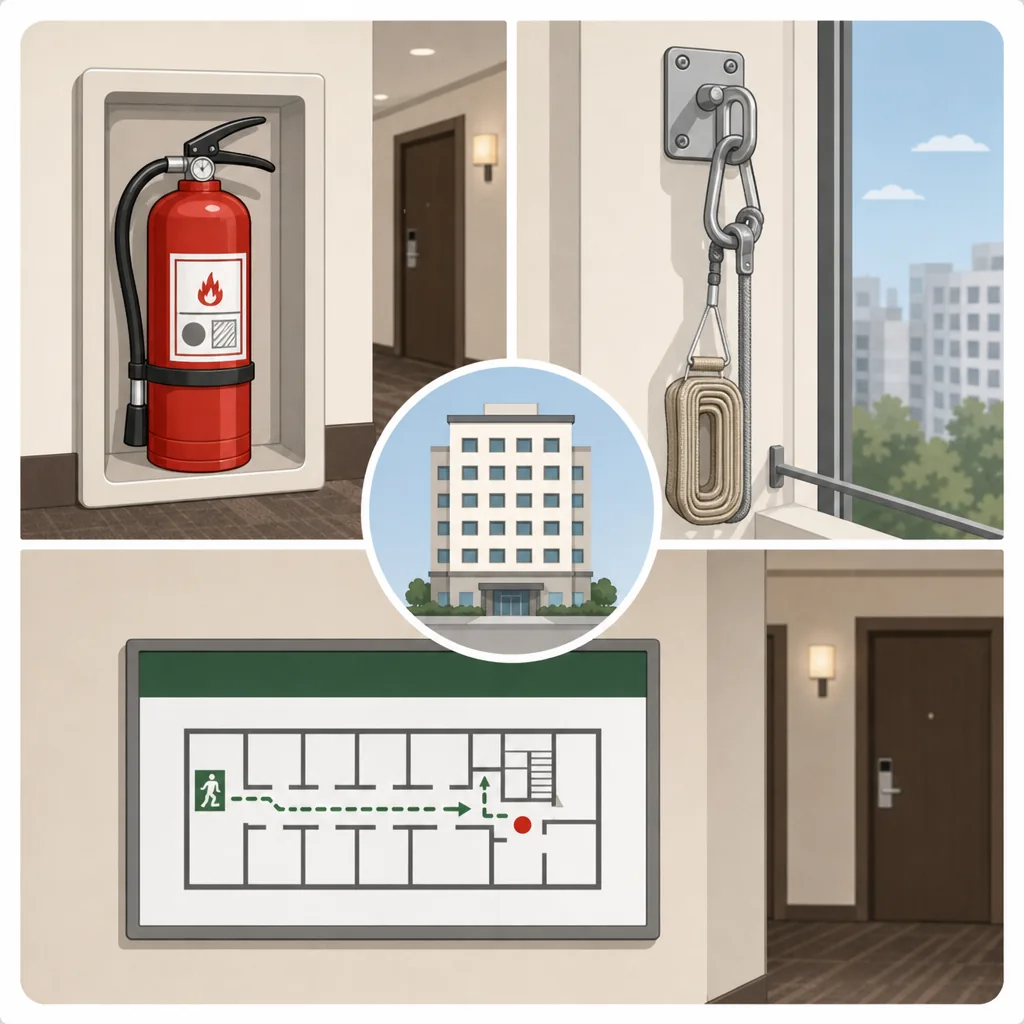
If you see 소화기, 완강기, or 대피도 in a Korean hotel, these are hotel fire safety signs that mark the fire extinguisher, emergency escape device, and evacuation map. Spot them on your first walk down the corridor so you already know where everything is before you need it.
What to Do First
- When you arrive, walk the corridor once and find the nearest emergency exit stairwell door.
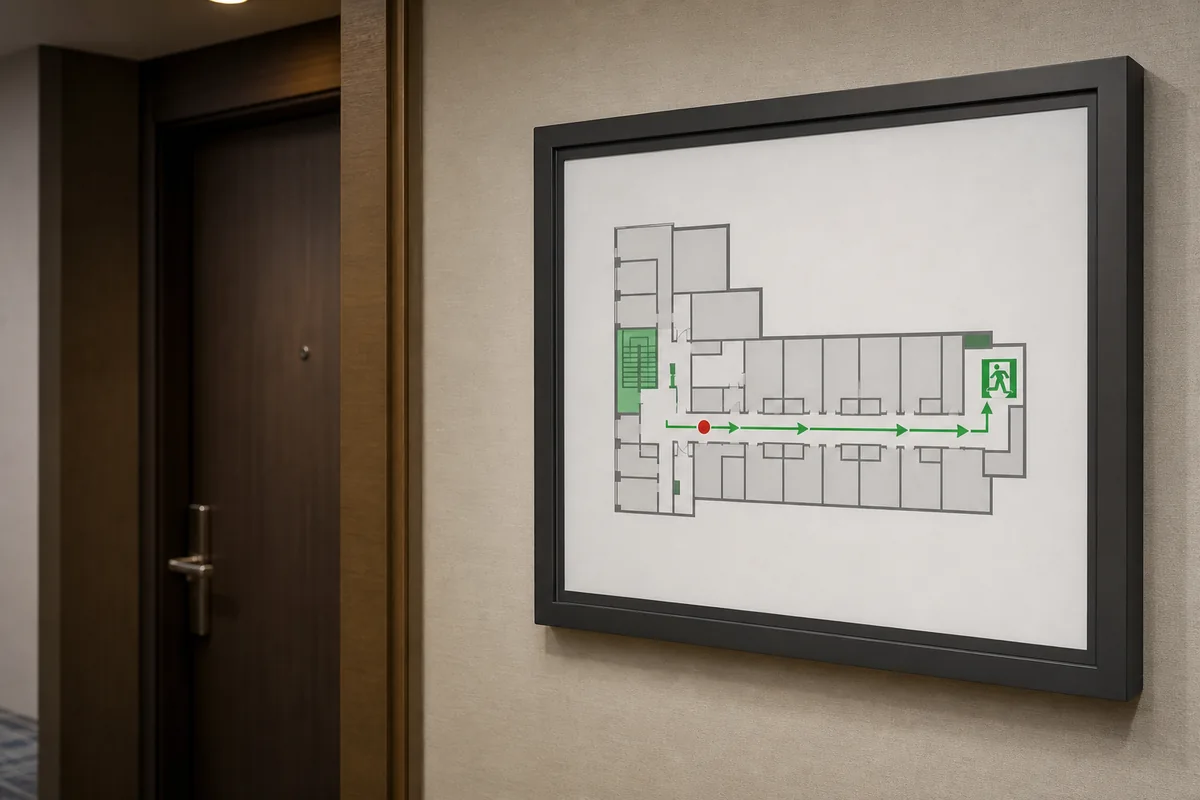
- Locate the 대피도 (evacuation map) — usually posted on the back of your room door or on the corridor wall.
- Count how many doors stand between your room and the nearest stairwell exit.
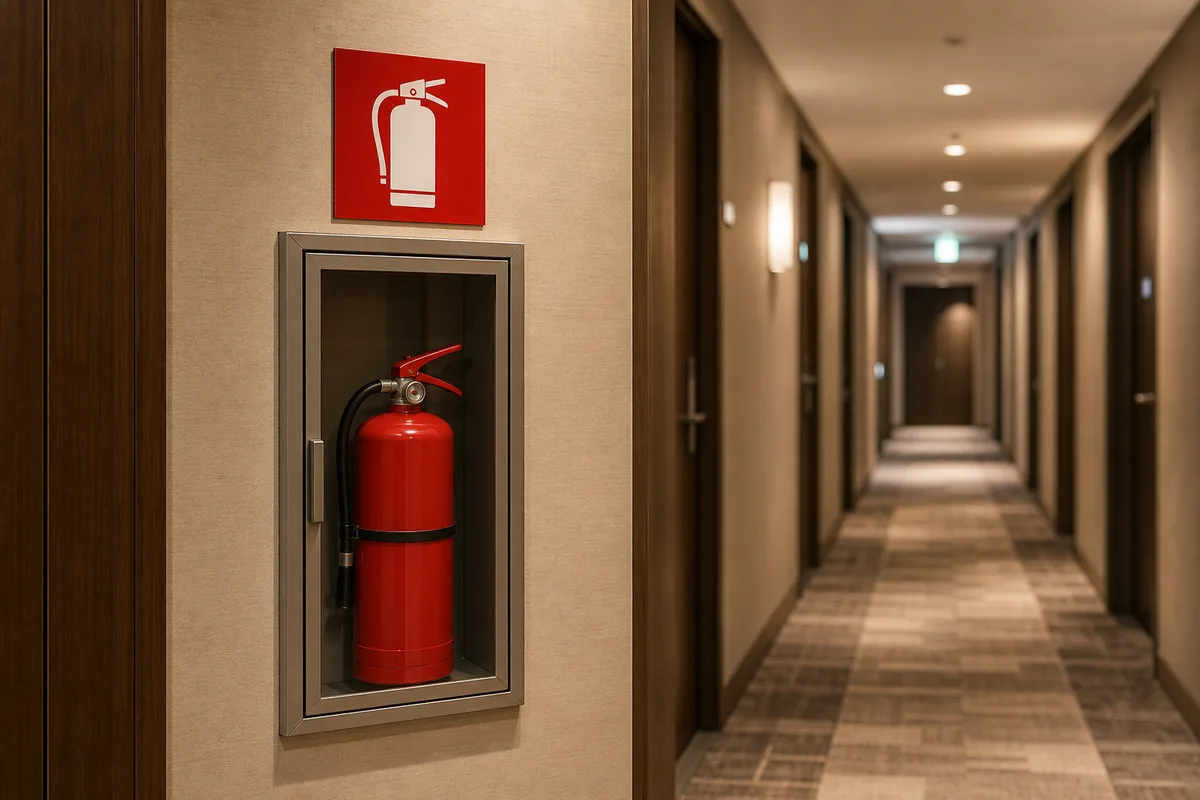
- Note where the red 소화기 (fire extinguisher) box or cabinet is on your floor.
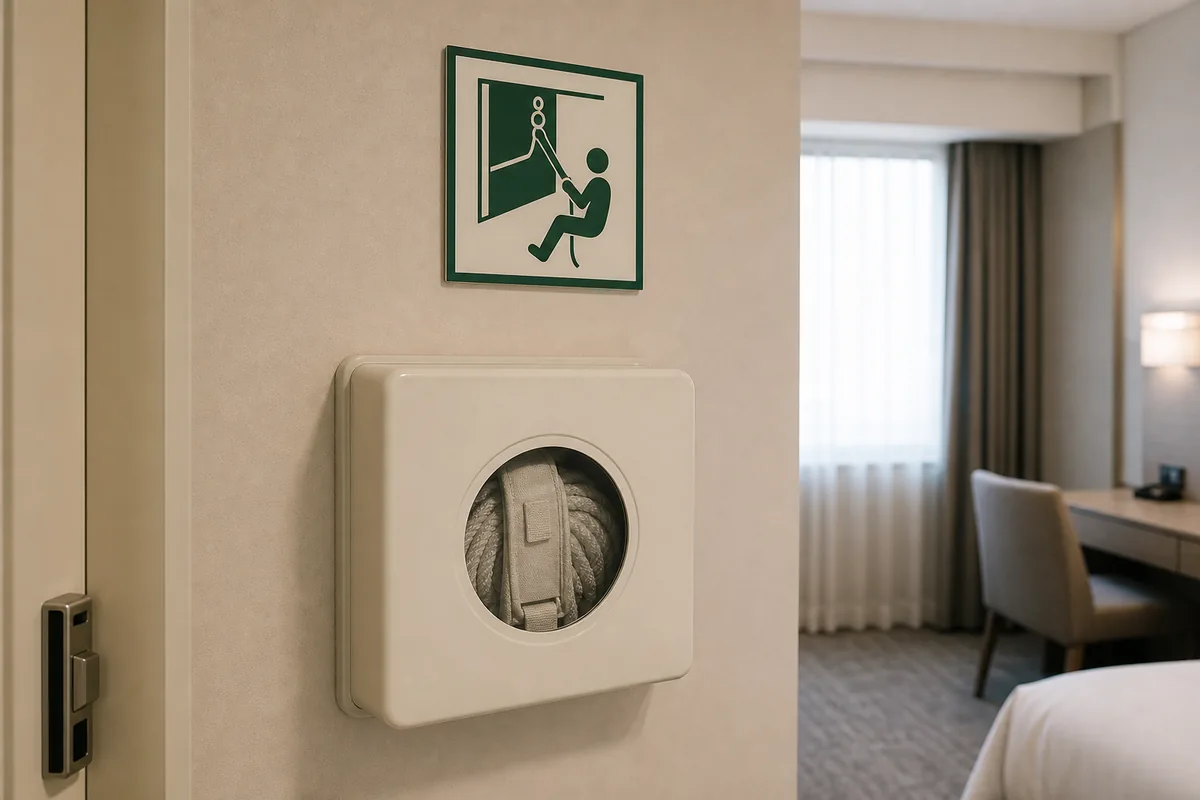
- Look for the 완강기 cabinet near a window if your floor is above ground level — do not touch it unless directed by staff.
- Save the hotel’s front desk number from the room phone or your key card sleeve.
- If an alarm sounds, follow posted arrows and hotel staff instructions — do not use the elevator.
When This Guide Helps
This guide is for first-time visitors staying in a Korean hotel, guesthouse, or serviced apartment who have never seen Korean fire safety signage before. It is useful when you check in and want to understand what the labels and wall-mounted equipment around you actually mean, or when you spot an unfamiliar red cabinet or posted diagram and want to know what it is before any emergency happens.
This guide is a sign-reading and navigation tool, not emergency-response advice. For any real fire or safety emergency, follow hotel staff directions and call 119 (Korea’s fire and emergency number).
hotel fire safety signs: Korean Phrases You Can Show
Phrases to Show Hotel Staff
Useful Korean Signs or Words
Hotel Fire Safety Signs Decoded
Where to Get Help
Your first point of contact in any hotel safety question is the front desk (프런트 데스크). Staff at larger hotels often speak basic English and can walk you to the evacuation map or point out equipment locations. If you are already in your room, use the room phone to call the front desk — the number is usually printed on the phone itself or on a card beside it.
For a real fire emergency in Korea, the national emergency number is 119. This line handles fire and medical emergencies. Operators have access to interpretation services, so you can speak in English and ask for an interpreter if needed. Do not call 119 to ask general safety questions — use it only in an actual emergency.
If you cannot reach staff and need to communicate urgently, show the phrase cards above on your phone screen. Hotel staff, security guards, and other guests in the corridor can all help direct you to the nearest exit or stairwell.
Common Mistakes
- Skipping the corridor walk on arrival. Most guests go straight to the room. Taking two minutes to find the nearest stairwell door before you need it is the single most useful thing you can do.
- Assuming the nearest door is an exit. Some corridor doors lead to storage rooms or service areas, not stairwells. Look for the green 비상구 sign above the door frame.
- Mistaking the 완강기 cabinet for a storage box. The wall cabinet near a window on upper floors contains the escape descent device. It is not a luggage shelf or a minibar. Leave it closed unless directed by staff or emergency personnel.
- Reading the 대피도 without finding 현재 위치 first. The map only makes sense once you know which marked room is yours. Locate the “You Are Here” marker before tracing the exit route.
- Planning to use the elevator during an alarm. Elevators in Korean hotels, like everywhere, should not be used during a fire alarm. The 비상계단 is always the correct route.
- Assuming all hotels have the same layout. Exit locations, equipment positions, and stairwell access vary by building. Always read the specific 대피도 posted on your floor — do not rely on memory from a different hotel.
- Ignoring a fire alarm as a false alarm. Treat every alarm as real until hotel staff confirm otherwise. Move toward the stairwell and wait for guidance rather than staying in the room.
Official Resource
Korea’s fire safety regulations for hotels are set by the National Fire Agency (소방청). Hotels are required by law to post evacuation maps and maintain fire safety equipment on every floor. If you notice missing or damaged safety equipment in your hotel — such as a 소화기 cabinet that appears empty or a 대피도 that is missing from your door — report it to the front desk so they can address it. You do not need to contact authorities yourself; the hotel management is responsible for compliance.
The 119 emergency line is operated around the clock and is the correct number for fire and life-safety emergencies anywhere in Korea. For non-emergency travel assistance, the Korea Tourism Organization operates a helpline at 1330, available in English, Chinese, Japanese, and other languages.
Related Korea Guides
If you found this guide useful, you may also want to read about navigating Korean hospital emergency rooms as a foreign visitor, understanding Korean pharmacy signs and over-the-counter labels, reading Korean subway and bus signs for first-time travelers, and what to do if you lose your passport or valuables in Korea. These topics follow the same approach: decode the signs and words first, then you can act with confidence.
FAQ
What does 소화기 mean in a Korean hotel?
소화기 means fire extinguisher. In Korean hotels it is typically a red cylinder stored in a red wall-mounted cabinet or bracket in the corridor, often near stairwell doors. The characters literally combine “extinguish fire” and “device.” You do not need to know how to use it — just know where it is and alert hotel staff if there is a fire.
What is 완강기 in English?
완강기 is an emergency descent device — a rope-and-harness system that allows a person to lower themselves from an upper-floor window to the ground in a fire emergency. It is stored in a wall cabinet, usually near a window on floors above ground level. As a guest, you should know where the cabinet is but should not open or operate it unless directed by trained staff or emergency personnel. Exact usage instructions vary by device model.
What does 대피도 mean on a hotel door or wall?
대피도 means evacuation map or floor escape plan. It is a diagram of your floor showing room positions, corridor layout, the locations of exits and stairwells, and a marked spot labeled 현재 위치 (your current location). It is most commonly posted on the back of the room door or on the corridor wall near the elevator. Read it when you first arrive so you already know your exit route.
How does a visitor find the emergency exit in a Korean hotel?
Look for green illuminated signs showing a running figure — these are the 비상구 (emergency exit) signs. They are mounted above or beside stairwell doors, usually at the ends of corridors. The door itself may be labeled 비상계단 (emergency staircase). If you are unsure, ask at the front desk using the phrase 비상구가 어디예요? or check the 대피도 posted on your floor for the exact route from your room.
Key Takeaways
- 소화기 = fire extinguisher — red cabinet in the corridor.
- 완강기 = emergency descent device — wall cabinet near upper-floor windows; do not open unless directed.
- 대피도 = evacuation map — posted on your room door or corridor wall; find 현재 위치 first.
- 비상구 / 비상계단 = emergency exit / staircase — follow the green running-figure signs; never use the elevator during an alarm.
- Walk the corridor on arrival, locate the nearest stairwell, and save the front desk number.
- For real emergencies in Korea, call 119. For travel help, call 1330.
- Understanding these basic hotel fire safety signs takes only a few minutes and gives you confidence for the rest of your stay.
Korean Hotel Fire Safety Signs Explained becomes easier to handle when you recognize the situation and follow the practical steps above.
Korean Hotel Fire Safety Signs Explained becomes easier to handle when you recognize the situation and follow the practical steps above.
Note: This guide is for travel navigation in Korea. It is not medical, legal, or emergency professional advice. For urgent situations, contact local emergency services, official staff, or your embassy/consulate as appropriate.
Sources & Verification
- 1330 Travel Helpline & Complaint Center- VISITKOREA — english.visitkorea.or.kr
- 한국어기초사전 — krdict.korean.go.kr
- National Institute of Korean Language — www.korean.go.kr
Last checked: July 30, 2026